Best Time to Post on Instagram: 2025 Data-Driven Guide
Discover the powerful features that will transform how your team collaborates and manages projects.

Alto AI
on
Jan 17, 2026
In 2026, social media success is no longer a vanity game. Likes are fleeting and follower counts can be misleading. True growth and ROI come from meaningful, scalable interactions. But as ad costs rise and organic reach dwindles, how do you genuinely connect with your audience on platforms like Instagram and Facebook without burning out your team? The key isn't just posting more-it's about engaging smarter. This guide will provide ten actionable, tactical strategies to help you not just improve social media engagement but transform your comments and DMs into a powerful engine for sales and brand loyalty.
We'll move beyond generic advice and dive into the specific systems, content formats, and automation workflows that top brands use to turn conversations into conversions, 24/7. This article is your blueprint for building a high-performance engagement strategy that scales. You will learn how to deploy AI-powered response systems, filter and qualify leads directly from ad comments, and manage all your conversations from a unified inbox. These methods are designed to boost your efficiency and capture opportunities that are often lost in a noisy social feed.
From interactive content that sparks real-time dialogue to strategic community-building that fosters loyalty, each point is a practical step toward a more robust social presence. We will cover how to use data to refine your content, maintain rapid response times, and ensure brand safety by automatically filtering harmful content. The goal is to build a comprehensive system that integrates your paid and organic efforts seamlessly. For a foundational overview on boosting your overall social media presence, explore this complete guide to social media optimisation. Let's explore the tactics that will define your success.
1. AI-Powered Automated Response Systems
Responding instantly to every comment and direct message is one of the most powerful ways to improve social media engagement, but it's often impossible to manage manually. AI-powered automated response systems solve this by using artificial intelligence to generate contextually relevant, on-brand replies to comments and DMs 24/7. These tools analyze incoming messages for intent and sentiment, allowing them to provide instant, human-like answers without any manual intervention.

This approach significantly increases your response rate and engagement velocity. E-commerce brands use platforms like Meet Alto AI to handle thousands of daily ad comments, while DTC companies automate the first response to product inquiries, capturing leads within seconds. For agencies, this technology is a game-changer, enabling them to manage 50+ client accounts with consistent, high-quality engagement.
How to Implement AI Response Systems
To get started, focus on clear, actionable steps:
Start Simple: Begin by automating responses to high-intent keywords like "price," "link," or "how to buy." This provides immediate value and allows you to test the system's effectiveness.
Refine Your AI's Voice: Regularly review the AI-generated responses and refine its personality prompts. Ensure the tone aligns perfectly with your brand, whether it's witty, professional, or friendly.
Set Escalation Rules: Establish clear rules for when a conversation should be handed over to a human agent. Complex customer service issues or highly negative feedback often require a personal touch.
Tag and Train: Use sentiment tagging to train the AI on your tone preferences. This helps it better understand nuances and respond more appropriately over time.
By automating the initial stages of interaction, you not only improve social media engagement but also free up your team to focus on more strategic tasks. You can explore a deeper dive into how Instagram comment automation works for further insights.
2. Smart Lead Filtering and Qualification
Sifting through hundreds of comments and DMs to find genuine leads is a major drain on resources. Smart lead filtering and qualification automates this process by using intelligent systems to identify, score, and prioritize high-intent prospects. This technology analyzes behavioral signals, keywords, and engagement patterns to separate hot leads from casual inquiries, ensuring your sales team focuses only on conversations most likely to convert.
This strategic approach is crucial to improve social media engagement with the right audience. For example, e-commerce brands use smart filters to distinguish price-sensitive shoppers from premium buyers, tailoring their follow-up accordingly. DTC companies can automatically flag repeat commenters or past purchasers as VIPs, routing them for immediate, personalized attention. Agencies leverage this to efficiently manage multiple client accounts, ensuring high-value leads are never missed.
How to Implement Smart Lead Filtering
Getting started requires a clear strategy for defining what a "qualified lead" looks like for your business:
Define Your Ideal Customer Profile (ICP): Before setting any rules, clearly outline the characteristics of your best customers. Use this profile to create filter criteria based on specific keywords, questions, or sentiment.
Create Tiered Filters: Don't use a one-size-fits-all approach. Create separate filter sets for different campaigns or product lines. A filter for a high-ticket item should be more stringent than one for a free trial.
Use Negative Keywords: Just as important as identifying what leads are, define what they are not. Add negative keywords like "unsubscribe," "scam," or competitor names to filter out irrelevant noise and spam.
Analyze and Adjust: Regularly monitor your system for false positives and adjust scoring weights. Your filters should evolve as you learn more about how your audience communicates and what signals lead to a conversion.
By automating lead qualification, you transform your social media inbox from a cluttered support queue into a powerful sales pipeline. You can learn more about how to efficiently manage Instagram comments to streamline this process.
3. Unified Inbox Management for Omnichannel Conversations
Managing conversations across multiple social platforms, ad accounts, and brand pages quickly becomes chaotic. A unified inbox management system is essential to improve social media engagement at scale, consolidating all interactions from Instagram comments, Facebook DMs, ad responses, and more into a single, organized dashboard. This provides a complete view of each customer's history, preventing missed messages and fragmented conversations.
This approach streamlines team collaboration and ensures no customer falls through the cracks. Digital agencies use platforms like Meet Alto AI to manage 50+ client inboxes from one location, while e-commerce brands track a customer's journey from their first ad comment to a final purchase inquiry in DMs. Customer support teams can also use this system to route complex issues to the right specialists without losing context, creating a seamless service experience.
How to Implement a Unified Inbox
To get started with a centralized system, follow these steps:
Establish Clear Protocols: Create rules for message ownership and response times. Define who is responsible for what type of inquiry (e.g., sales, support, general) to ensure accountability.
Use Tags and Labels: Organize conversations by type, urgency, or stage in the sales funnel. Tags like "Lead," "Support Ticket," or "VIP Customer" help teams prioritize their workflow.
Set Up Automated Routing: Implement rules that automatically assign conversations to specific team members based on keywords or message content. For example, messages containing "refund" or "broken" can be sent directly to the support team.
Track Conversation Status: Use statuses like "New," "Responded," and "Archived" to manage the conversation lifecycle. This prevents multiple team members from responding to the same message and ensures every inquiry is resolved.
4. Interactive Content and Real-Time Engagement
Creating content that invites immediate, two-way interaction is a cornerstone strategy to improve social media engagement. By using features like polls, quizzes, Q&As, and live sessions, you lower the barrier to participation and encourage your audience to actively connect with your brand. This type of content transforms passive scrolling into an active experience, generating momentum that social media algorithms often reward with increased organic reach.
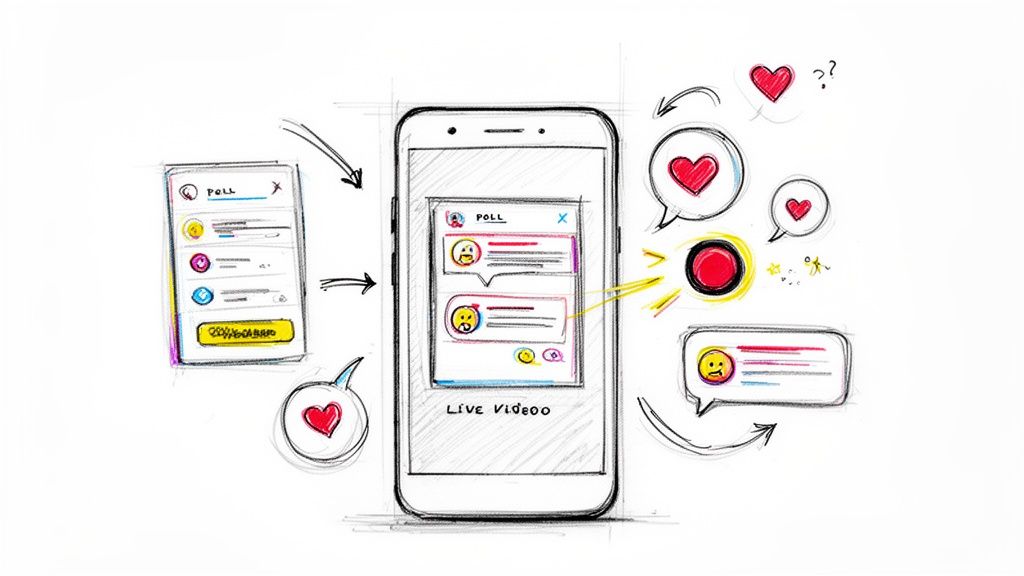
This approach is highly effective because it makes your audience feel heard and involved. For instance, DTC brands can run weekly product polls in Instagram Stories to gather valuable feedback while boosting engagement metrics. E-commerce companies can use interactive quizzes to guide users to the perfect product, creating a personalized shopping journey. For agencies, running a client's Instagram Q&A not only builds community but also provides rich insights into customer pain points and desires.
How to Implement Interactive Content
To successfully integrate interactive content, focus on creating a consistent and engaging experience:
Ask Specific, Compelling Questions: Avoid generic questions. Instead of "What do you think?", ask "Which of these two features would you use more?" This clarity invites more substantive and immediate responses.
Respond Promptly: The first hour after posting is critical. Engage with comments and replies quickly to signal that a real-time conversation is happening, which encourages others to join in.
Create Recurring Segments: Establish a consistent schedule for interactive content, like a "Quiz Tuesday" or a "Weekly Q&A." This trains your audience to anticipate and participate in your engagement efforts.
Incentivize Participation: Reward engagement with shout-outs, exclusive discount codes, or early access to new products. Recognizing your community’s contributions fosters loyalty and encourages continued interaction.
5. Strategic Community Building and User-Generated Content
Actively cultivating a loyal community of brand advocates is one of the most authentic ways to improve social media engagement. This strategy focuses on encouraging customers to create and share their own content featuring your products, turning them into a powerful marketing force. User-Generated Content (UGC) leverages social proof, builds genuine trust, and significantly reduces your content creation burden.

This approach transforms your customers from passive followers into active participants. For example, an e-commerce brand can feature customer unboxing videos on its Stories, while a DTC company can create a hashtag campaign for product styling ideas. When prospective buyers see real people enjoying your products, it serves as a powerful, unbiased testimonial that ad copy can rarely match. This method fosters a deep sense of belonging and brand loyalty.
How to Implement Community Building with UGC
To effectively build a UGC engine, follow these actionable steps:
Create a Simple Branded Hashtag: Develop a memorable and easy-to-spell hashtag that customers can use when posting. Promote it in your bio, posts, and even on your product packaging.
Feature the Best UGC: Regularly share the best user-submitted content on your official channels. Always credit the original creator to show appreciation and encourage more submissions.
Offer Incentives: Motivate participation by offering rewards for quality submissions, such as discounts, free products, or a feature on your main feed. This gamifies the experience and shows you value their effort.
Set Clear Guidelines: Provide simple guidelines to help users create on-brand content. This could include tips on lighting, style, or what to include in their posts, ensuring the UGC aligns with your aesthetic.
Engage with Creators: Go beyond just reposting. Like, comment, and share submissions to build real relationships with your most enthusiastic advocates, making them feel seen and valued.
6. Data-Driven Content Optimization and Posting Strategy
Guessing what content will perform well is an inefficient and expensive way to manage social media. A data-driven approach removes subjectivity by using analytics and performance metrics to scientifically determine the best posting times, content formats, and topics that resonate with your audience. This method ensures your resources are allocated to high-performing content types, significantly improving engagement and ROI.

This strategy empowers brands to make informed decisions that directly boost performance. For example, e-commerce brands might analyze their metrics and discover that carousel posts showing a product in use outperform single images by 40% in saves and shares. DTC companies can pinpoint Tuesday evenings from 7-9 PM as their peak engagement window, allowing them to schedule their most important announcements for maximum impact. Agencies use these analytics to provide concrete proof of performance and justify content budgets to clients.
How to Implement a Data-Driven Strategy
To get started, focus on a systematic approach to analysis and testing:
Establish Baseline Metrics: Before making any changes, document your current engagement rates, reach, and follower growth. This baseline will be your benchmark for measuring the success of new tactics.
Test One Variable at a Time: To accurately isolate what works, change only one element per test. For instance, test different posting times while keeping the content format the same, or test different captions with the same image.
Review Analytics Weekly: Avoid making conclusions based on daily fluctuations. A weekly review provides a clearer picture of trends and performance, allowing for more strategic adjustments.
Segment Your Analysis: Dig deeper by segmenting your data. Analyze performance by audience demographic, campaign type, or ad creative to uncover more nuanced insights that improve social media engagement across different initiatives.
Document and Template Winning Content: Once you identify successful patterns, create content templates or guidelines based on them. This streamlines future content creation and ensures consistent high performance.
7. Rapid Response Time and Conversational Sales
In social media, speed is the ultimate competitive advantage. A rapid response time to comments and messages is a powerful signal of an attentive, customer-centric brand. By prioritizing immediate replies, you not only reduce customer friction but also open a window for conversational sales, turning simple inquiries into guided purchase journeys. This approach transforms your social media channels from broadcast platforms into real-time sales consultation tools.
This strategy is crucial for capturing high-intent prospects at their peak interest. For example, e-commerce brands that respond to product questions on their ads within two minutes see significantly higher conversion rates. Similarly, DTC companies can use platforms like Meet Alto AI to instantly turn a "how much?" comment into a DM conversation that addresses price, highlights value, and provides a direct checkout link. For agencies, maintaining a sub-60-second response time across dozens of client accounts becomes a key differentiator and a driver of measurable results.
How to Implement Rapid Response and Conversational Sales
Follow these steps to build a system for speed and conversion:
Establish Response Time SLAs: Set clear service-level agreements (SLAs) for your team, such as a target of responding to all comments and DMs within five minutes. Monitor this metric weekly to ensure consistency.
Automate the First Touch: Use an automation tool to provide an immediate first response, especially during off-hours or high-volume periods. This initial reply can acknowledge the query and let the user know a human will follow up shortly, or it can answer the question directly.
Create Response Templates: Develop a library of pre-approved templates for frequently asked questions about shipping, pricing, or product details. This empowers your team to respond quickly and accurately without composing every message from scratch.
Train for Conversational Selling: Coach your team to do more than just answer questions. Teach them to ask follow-up questions, understand customer needs, and gently guide the conversation toward a relevant product or solution. This is a key way to improve social media engagement and drive revenue.
8. Harmful Content Filtering and Brand Safety Management
Protecting your community from spam, trolls, and harmful language is critical to improve social media engagement in a positive way. Manually deleting every toxic comment is a draining, never-ending task. Automated harmful content filtering solves this by identifying and hiding comments containing profanity, spam links, or brand-damaging keywords, ensuring your comment sections remain a safe and welcoming space for genuine interaction.
This system acts as a 24/7 moderator, protecting your brand's reputation and ensuring your advertising budget isn't wasted amplifying toxic engagement. E-commerce brands use platforms like Meet Alto AI to automatically hide spam comments on viral product ads, preventing scams and maintaining credibility. Agencies rely on this to protect multiple client accounts from controversial topics or negative competitor mentions, ensuring a consistently positive brand image across their portfolio.
How to Implement Harmful Content Filtering
To effectively manage brand safety, follow these actionable steps:
Establish Clear Guidelines: Before activating filters, create a documented moderation policy. Define what constitutes spam, harassment, or off-topic content for your brand. This ensures consistency.
Build Your Keyword Lists: Start by creating a "hide list" of common profanities, spam phrases ("check my profile"), and competitor names. You can also create a "whitelist" for trusted community members whose comments should never be hidden.
Review and Refine: Periodically check your "hidden" folder or quarantine to see what the system is catching. This helps you refine your keyword lists, ensuring you aren't accidentally hiding legitimate customer feedback.
Balance Safety and Transparency: While hiding harmful content is essential, be transparent about your community guidelines. Pin a comment or include a link in your bio explaining your moderation approach to foster trust.
By automating brand safety, you create a healthier environment for your audience, which encourages more positive and productive conversations. To build a robust strategy, you can find more details in this guide on social media moderation.
9. Team Collaboration and Workflow Accountability
As your social media presence grows, managing engagement becomes a team sport. Establishing clear collaboration structures, assignment protocols, and accountability measures is essential to ensure no customer inquiry falls through the cracks. Transparent workflow management improves response quality, prevents duplicated effort, and creates a system that can scale effectively across multiple team members.
This systematic approach directly helps to improve social media engagement by ensuring every interaction is handled by the right person at the right time. For example, a customer support team can use a platform like Meet Alto AI to automatically assign comments containing service-related keywords to a support agent. Meanwhile, sales teams can compete on lead response times with shared inboxes and leaderboards, and agencies can coordinate seamlessly across multiple client pages from one dashboard.
How to Implement Team Collaboration Workflows
To build a high-performing, accountable team, focus on these practical steps:
Create Clear Escalation Pathways: Document and automate the process for handling complex issues. For instance, a comment marked with negative sentiment could be automatically assigned to a senior manager for review.
Use Performance Dashboards: Leverage analytics to track key metrics like response time, tickets closed, and leads captured per team member. Use this data for constructive coaching and identifying process improvements.
Establish Review Rhythms: Hold regular team meetings to discuss common inquiry patterns, review challenging conversations, and refine your response strategies and documentation.
Recognize High Performers: Publicly acknowledge team members who excel in engagement quality or efficiency. This fosters healthy competition and reinforces the behaviors you want to see.
By creating a structured and transparent system, you empower your team to deliver consistent, high-quality engagement that builds customer trust and drives business results.
10. Strategic Paid Social Integration with Organic Engagement
Treating paid social media ads and organic engagement as separate activities is a missed opportunity. Strategic integration unifies these efforts, creating a powerful amplification loop. When you respond instantly and intelligently to comments on your ads, you signal to algorithms that your content is valuable, which can improve ad quality scores, reduce cost-per-result, and ultimately drive higher ROAS.
This integrated approach views the entire customer journey, from ad impression to post-purchase support, as a single, connected experience. By actively managing ad comments, you not only improve social media engagement but also turn passive viewers into active leads and customers. Every comment becomes a chance to build trust and guide a user further down the funnel.
Brands that implement this strategy see significant returns. E-commerce businesses have improved ROAS by over 25% by ensuring rapid, helpful responses to ad comments. DTC companies use sentiment analysis from ad comments to refine creative and messaging, while agencies can more effectively optimize client budgets by allocating spend to ads that generate the highest engagement velocity.
How to Implement Paid and Organic Integration
Follow these steps to merge your paid and organic strategies:
Track High-Intent Comments: Monitor which ad creatives generate the most comments with buying intent keywords like "price," "link," or "how to get." This data is a goldmine for creative optimization.
Test Response Variations: A/B test different response messages in your ad comments to see which ones drive the most clicks, DMs, or conversions. This allows you to refine your communication for maximum impact.
Inform Ad Targeting: Use engagement patterns and user feedback from your ad comments to build more accurate custom and lookalike audiences for future campaigns.
Automate to Accelerate: Use an automation tool like Meet Alto AI to instantly reply to every ad comment. This ensures no lead is missed and provides the immediate engagement that algorithms favor, maximizing your ad spend effectiveness.
10-Point Comparison of Social Media Engagement Solutions
Solution | Implementation complexity | Resource requirements | Expected outcomes | Ideal use cases | Key advantages |
|---|---|---|---|---|---|
AI-Powered Automated Response Systems | Medium–High — AI setup & personality tuning | AI credits, training data, monitoring staff | 24/7 replies, faster engagement, scalable responses | High-volume comment streams, agencies, DTC | Consistent brand voice, immediate lead capture |
Smart Lead Filtering and Qualification | Medium — model training & rule definition | Historical data, scoring algorithms, dashboards | Higher conversion efficiency, prioritized leads | Paid social funnels, sales teams, lead-heavy campaigns | Focuses resources on high-intent prospects |
Unified Inbox Management for Omnichannel Conversations | Low–Medium — integrations & workflow updates | Platform integrations, team training | Fewer missed messages, unified conversation history | Multi-page agencies, support teams, omnichannel brands | Consolidates touchpoints, improves collaboration |
Interactive Content and Real-Time Engagement | Medium — creative cadence + moderation | Content creators, moderators, live tools | Higher engagement rates, more organic reach | Product feedback, community growth, live events | Drives authentic interaction and first-party data |
Strategic Community Building and User-Generated Content | Medium–High — long-term cultivation & moderation | Community managers, incentives, curation workflows | Increased loyalty, authentic content, reduced content costs | Brands seeking social proof and viral growth | Generates credible UGC and stronger brand advocates |
Data-Driven Content Optimization and Posting Strategy | Medium — analytics setup and A/B testing | Analytics tools, historical data, analysts | Improved ROI, optimized timing and formats | Brands optimizing performance and budgets | Evidence-based content improvements |
Rapid Response Time and Conversational Sales | Medium — SLA enforcement and routing | 24/7 coverage or AI + trained reps | Faster conversions, reduced sales cycle | Time-sensitive ads, high-intent inquiries | Converts leads quickly, improves CSAT |
Harmful Content Filtering and Brand Safety Management | Low–Medium — filter rules and review workflows | Moderation tools, legal/guidelines, reviewers | Safer community, reduced toxic engagement | High-visibility brands, viral campaigns | Protects reputation and reduces moderation load |
Team Collaboration and Workflow Accountability | Low–Medium — process design and adoption | Assignment tools, dashboards, training | Clear ownership, fewer duplications, measurable KPIs | Growing support/sales teams, agencies | Improves accountability and team efficiency |
Strategic Paid Social Integration with Organic Engagement | High — cross-team coordination & tracking | Unified analytics, attribution, budget tools | Higher ROAS, lower CPL, richer audience insights | Integrated paid+organic campaigns, agencies | Amplifies ad performance via unified engagement |
Turn Your Engagement Strategy into a Revenue Machine
You've just navigated a comprehensive blueprint for transforming your social media presence. We've explored everything from AI-powered response systems and smart lead qualification to the power of a unified inbox and strategic community building. The central theme is clear: to truly improve social media engagement in today's competitive landscape, you must move beyond manual, reactive tactics and embrace a systematic, automated, and data-driven approach.
The days of chasing vanity metrics like likes and shares for their own sake are over. True engagement is a powerful business driver, a direct line to customer acquisition, and a critical component of brand reputation. Each strategy we've covered, from optimizing your content cadence based on hard data to integrating your paid and organic efforts, is a gear in a larger machine designed to produce tangible results.
From Insights to Action: Your Next Steps
The journey from knowledge to implementation is where real growth happens. Don't let this be just another article you read and forget. Instead, commit to taking specific, measurable actions.
Audit Your Current Workflow: Where are the bottlenecks? Are you spending too much time on low-value tasks like deleting spam or answering repetitive questions? Identify the single biggest time-drain in your current engagement process.
Prioritize One Key Area: You don't need to implement all ten strategies overnight. Choose one that aligns with your most pressing business goal. Is it lead capture? Focus on interactive content and rapid response. Is it brand safety? Implement robust harmful content filtering.
Set a Measurable Goal: Define what success looks like. Aim to decrease your average response time by 50% in the next 30 days, or increase qualified leads from Instagram comments by 20%. A clear target focuses your efforts and demonstrates ROI.
The ultimate goal is to build a system where every comment, message, and mention is an opportunity. It's a system where your team is freed from tedious manual work to focus on what humans do best: building relationships, closing sales, and delighting customers. This is the difference between simply managing a social media page and monetizing an engaged community.
The Power of a Unified, Intelligent System
Remember the core principles that connect these diverse tactics. First, speed is currency. The faster you can identify and respond to a high-intent comment or DM, the higher your chances of conversion. Second, context is critical. Managing conversations in isolated silos across Facebook, Instagram, and ad comments leads to missed opportunities and a disjointed customer experience. Finally, automation is your scaling partner. You cannot manually filter every comment or qualify every lead 24/7, especially as your ad spend and audience grow.
By implementing these strategies, you are not just posting content; you are building an intelligent, responsive ecosystem. You're creating a brand that listens, reacts, and adds value at every touchpoint. This proactive approach is what turns passive scrollers into loyal customers and builds a defensible brand in a crowded market. It’s how you stop renting attention from platforms and start building an asset you own: a thriving, profitable community.
Ready to stop manually managing your comments and start converting them into customers? Meet Alto AI provides the unified smart inbox and AI-powered automation to implement these advanced strategies seamlessly. Book a demo with Meet Alto AI today and discover how to protect your ad spend, capture every lead, and turn your engagement into a predictable revenue engine.