Best Time to Post on Instagram: 2025 Data-Driven Guide
Discover the powerful features that will transform how your team collaborates and manages projects.

Alto AI
on
Jan 16, 2026
Think of social media reputation management as the art and science of listening to, and shaping, the public conversation about your brand online. It's about more than just putting out fires; it’s the proactive process of monitoring mentions, jumping into comments, and handling feedback to build a positive narrative around your business.
This isn't just a "nice-to-have." It's a core growth strategy.
Why Social Media Reputation Management Is Essential Today
Picture your brand's social media pages as its digital storefront. Every comment, tag, and DM is a live conversation happening right there in your lobby. For e-commerce and DTC brands pouring money into paid ads, managing that lobby isn't just a defensive chore—it's absolutely critical for growth and survival.
Ignoring these conversations is like leaving your front door wide open. You’re exposing your brand to risks that can instantly kill customer trust and poison your return on ad spend. A single, unanswered negative comment festering on a Facebook ad can stop hundreds of potential customers in their tracks, silently bleeding your campaign dry.
The Direct Link Between Reputation and Revenue
Every single interaction on your social channels is a chance to either build trust or shatter it. When you manage these conversations proactively, you turn what could be a liability into a genuine revenue-generating asset. Brands that engage thoughtfully don't just solve problems; they build fiercely loyal communities that become their best advocates.
Today’s customers have high expectations. A whopping 73% of social media users expect brands to respond within 24 hours. In a world that connected, timely management isn't just good service—it's a business imperative that directly protects your bottom line. As you can find out on sites like SproutSocial.com, brands that analyze customer sentiment see better outcomes, improve their positive-to-negative mention ratio, and build a stronger voice in the market.
"Your social media presence is a 24/7 focus group. Ignoring the feedback—positive or negative—is like paying for market research and then throwing the results in the trash."
This proactive approach doesn't just protect your ad investment; it multiplies it. A well-managed comment section under an Instagram ad becomes a powerful engine for social proof. Positive interactions encourage new buyers and send conversion rates soaring. The alternative? A page littered with spam and unresolved complaints that screams "we don't care," sending potential customers straight to your competitors.
The Four Pillars of Reputation Management
A truly solid strategy is built on four key components. Getting these right is how you build a resilient brand image that actively contributes to your business goals.
Let's break down how these pillars work together.
Pillar | Core Activity | Business Impact |
|---|---|---|
Monitoring | Tracking brand mentions, keywords, and competitor activity. | Identifies risks and opportunities in real time. |
Engagement | Responding to comments, messages, and reviews promptly. | Builds community, loyalty, and customer trust. |
Content Strategy | Publishing content that reinforces positive brand values. | Shapes the public narrative and showcases expertise. |
Crisis Preparation | Creating a plan to handle negative events effectively. | Mitigates damage and allows for a controlled response. |
Ultimately, great social media reputation management is about taking the reins of your brand's story. It ensures that how people see you online matches the reality of the excellent product or service you provide, turning your social channels into a powerful asset for sustainable growth.
Building Your Social Listening and Response System
Winging it with social media reputation management just doesn't cut it. To do it right, you need a reliable system, not just random acts of engagement here and there. Think of it as building a digital nervous system for your brand—one that feels every important conversation and automatically triggers the right response. Without a structured workflow, your team is stuck putting out fires instead of preventing them in the first place.
A solid system is what takes you from chaos to control. It makes sure you catch every critical mention, from direct tags and DMs to the sneaky comments on your ads and even the chatter happening around your competitors. The whole point is to build a scalable, repeatable process that protects your brand and surfaces new opportunities, 24/7.
The cornerstone of any great system? A unified inbox. Forget frantically bouncing between Facebook, Instagram, TikTok, and a half-dozen other platforms. A centralized inbox pulls every last message, comment, and mention into a single, clean dashboard. This one change can slash response times and stop critical customer issues from ever falling through the cracks.
This simple flow captures the core cycle of reputation management, moving from just listening to actively engaging and, ultimately, growing the brand.
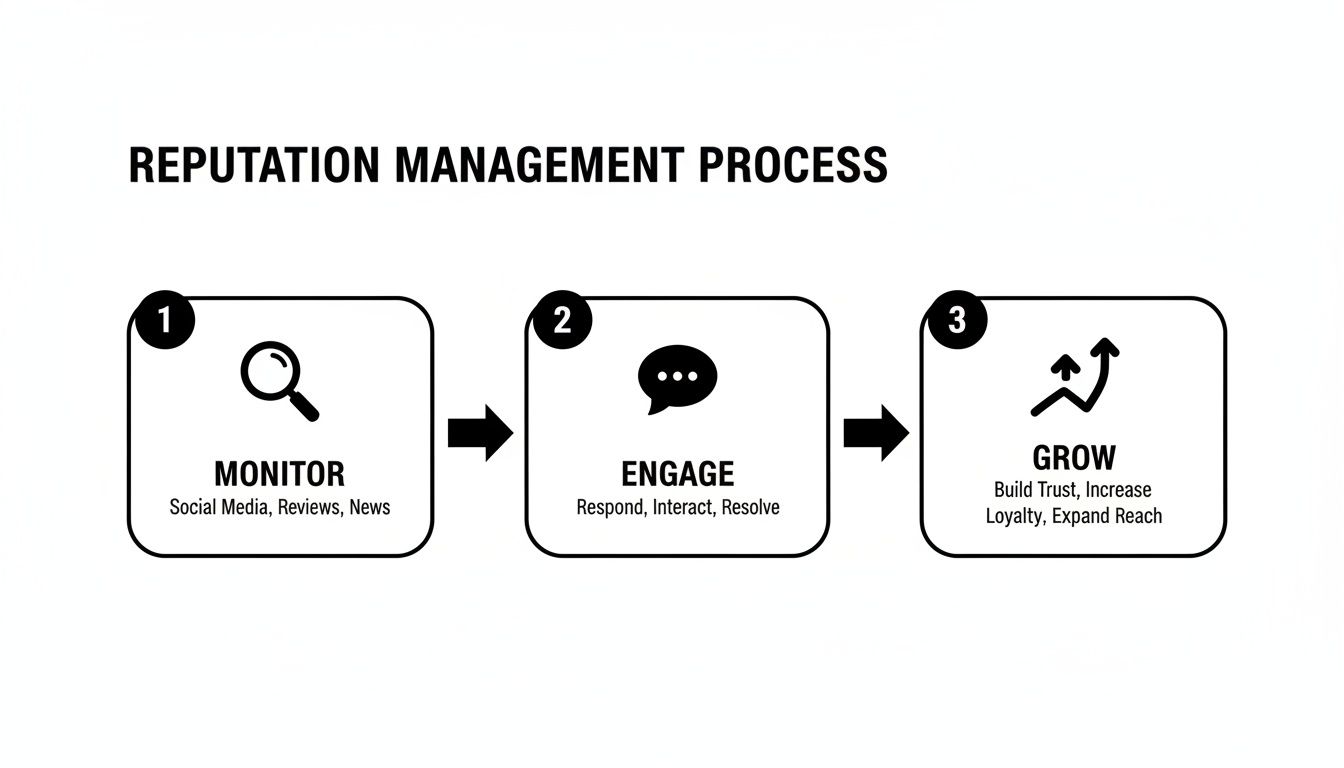
As you can see, it’s a continuous loop. Listening tells you how to engage, and engaging the right way is what drives positive growth for the brand.
Setting Up Your Monitoring Dashboard
First things first: you need to decide what you’re actually listening for. This goes way beyond just your brand’s handle. Before you get lost in the tools, it helps to nail down the core principles of What Is Social Media Monitoring. A truly comprehensive listening setup should keep tabs on several key areas.
Brand Mentions: This is the obvious one. Track your company name, product names, and even common misspellings or abbreviations people might use.
Key Personnel: Keep an ear out for mentions of your CEO or other public-facing executives. Their personal brand reputation is tied directly to the company's.
Competitor Activity: You don't need to stalk them, but keep an eye on your top 2-3 competitors. It's a great way to benchmark sentiment and spot the customer service gaps you can fill.
Campaign Hashtags: For any marketing campaign, you need to track its specific hashtags to measure reach and see how people are feeling about it in real-time.
Industry Keywords: Monitor broader industry terms. This helps you find conversations where your brand can jump in, add value, and position itself as an expert.
Once you have these keywords plugged into a social listening tool, you've got a 360-degree view of the entire conversation. It means you're just as likely to spot a brewing crisis as you are to find a hot sales lead.
Establishing Clear Response Protocols
With your listening system fired up, the next step is defining exactly how your team responds. A consistent brand voice isn't optional, and having pre-defined protocols is how you get there. Without clear guidelines, one team member might offer a discount for a complaint while another just says "sorry," creating a confusing and unfair experience for customers.
A response protocol isn't about scripting robotic, copy-paste answers. It's about giving your team a framework so they can make smart, consistent decisions that reflect your brand’s values in every single interaction.
Your protocols should be simple, categorizing incoming messages to guide the right action. This is a huge piece of effective social media moderation, a topic we dig into much deeper in our complete guide.
A Simple Triage System:
Positive Feedback: These are gold. Your protocol should be to thank the user personally and, if it feels right, ask for permission to share their content. This is how you turn happy customers into passionate brand advocates.
Neutral Questions: These are often pre-sale inquiries. Speed and accuracy are everything here. The protocol should route these questions to a team member with deep product knowledge who can give a helpful answer and nudge a potential customer toward a sale.
Negative Feedback: This is where you earn your reputation. The protocol must be to respond quickly and publicly with empathy. Acknowledge the issue, and then immediately move the conversation to a private channel (like DMs) to sort out the specifics. This shows everyone watching that you’re responsive without airing all the dirty laundry in public.
By creating these simple "if-then" scenarios, you take the guesswork out of the equation. You ensure every customer interaction, good or bad, actually strengthens your brand’s reputation. This systematic approach is what separates the pros from the amateurs.
Developing Your Social Media Crisis Management Plan
Solid social media reputation management is about more than just fielding the usual comments and DMs. It's about being ready for the storm before it makes landfall.
Sooner or later, every brand faces a social media crisis. It’s a matter of ‘when,’ not ‘if.’ When that moment comes, a team without a plan is thrown into reactive panic mode. They make bad calls under pressure, and those mistakes can pour gasoline on the fire.
A crisis management plan is your brand's emergency guide. It’s a clear, pre-approved roadmap that helps your team respond with speed, control, and a consistent voice when everything is on the line. This prep work is what separates the brands that navigate the storm from the ones that get swamped by it.
Defining What Constitutes a Crisis
First things first: you have to know the difference between a minor headache and a full-blown meltdown. Not every negative comment means you should sound the alarm and activate your emergency protocol.
A true crisis is a situation that poses a real threat to your brand’s operations, finances, or its entire reputation. Your plan needs to spell out these different levels of severity clearly.
Here’s a simple way to think about it:
Level 1 (Minor Issue): A single negative comment or a one-off complaint from an unhappy customer. This is business as usual for your social media team, who can handle it with standard responses.
Level 2 (Growing Problem): You start seeing multiple, similar complaints bubble up about a specific product or service. This probably needs to be kicked up to a manager for a more coordinated reply.
Level 3 (Full Crisis): This is the big one. We're talking about a situation with the potential for widespread negative press, legal trouble, or severe, lasting damage to your brand. This level triggers the full crisis management plan.
This tiered system stops you from overreacting to small bumps in the road while making sure you're geared up for the major threats. It’s about being measured, not emotional.
Building Your Crisis Playbook
Once you’ve defined your crisis levels, it’s time to build the playbook itself. Think of this document as your team's single source of truth when the pressure is on. It removes the guesswork from critical decisions and should be dead simple for everyone to find and use.
Your playbook absolutely must include these three things:
A Clear Chain of Command: Who's in charge? Who gets notified, and in what order? This needs to be spelled out with names, roles, and contact info for your core crisis team—from the social media manager all the way up to legal and the CEO.
Internal Communication Protocols: How will the team talk to each other without the public listening in? Set up a dedicated, private channel—like a locked Slack channel or a specific group chat—to share updates and coordinate your next moves.
Pre-Approved Messaging Templates: You can't predict every single scenario, but you can get ahead of the common ones. Draft some holding statements you can use immediately, like, "We are aware of the situation and are looking into it. We will share an update as soon as we have more information." This lets you respond instantly while you get your facts straight. Publicly acknowledging the issue is a vital first step, which we cover in our guide on how to respond to negative comments.
A crisis playbook is like a fire extinguisher. You hope you never have to use it, but when you do, its presence is the difference between a small, contained problem and a catastrophic blaze.
The Financial Impact of Preparation
Getting prepared isn't just about protecting your brand's image; it's about protecting your wallet.
Research shows that 80% of executives agree that social media crises cause real harm to brand reputation and customer loyalty. What’s worse, these digital firestorms spread an incredible 1200% faster than traditional news.
But here’s the upside: brands that have a crisis plan can cut potential financial losses by as much as 30%. For e-commerce brands that live and die by their ad spend—where positive engagement drives 20-40% lifts in spending—this kind of preparation is non-negotiable. This data from New Media highlights a simple truth: a well-thought-out crisis plan is one of the best investments you can make in your brand's long-term health.
Using Automation and AI to Scale Your Efforts
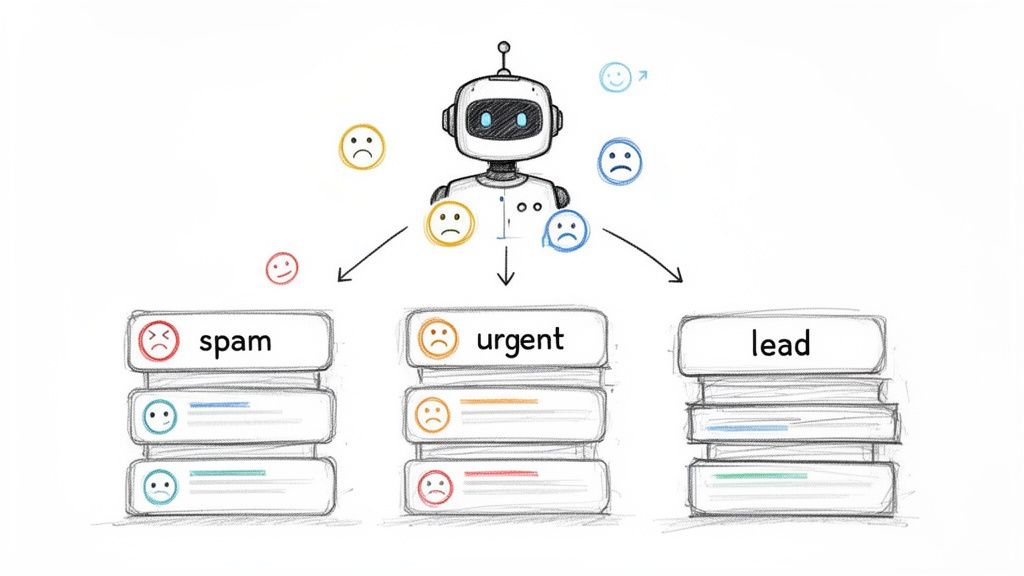
Let's be honest. Manually managing a constant flood of comments, messages, and tags feels like trying to catch rain in a thimble. It's just not possible to keep up without a small army of moderators.
This is where automation and AI stop being trendy buzzwords and start acting as a genuine force multiplier for your team. It’s how you scale your social media reputation management without burning out your staff or breaking the bank.
Think of AI as a hyper-efficient assistant who works 24/7. Its job is to sort through all the noise so your human team can focus on the conversations that actually matter. It’s not about replacing people—it’s about empowering them to do their best work.
Your First Line of Defense Against Noise and Negativity
The most immediate win from automation is its power to act as a digital gatekeeper, especially on your paid ad campaigns. These tools can be trained to instantly find and hide comments that violate your community rules, creating a much safer and more positive space for real customers.
This kind of instant moderation is non-negotiable for protecting your brand and getting the most from your ad spend. Harmful comments can sink a campaign fast. This includes things like:
Spam and Scams: Automatically hiding sketchy links to fraudulent sites or phony get-rich-quick schemes.
Profanity and Hate Speech: Filtering out offensive language that could easily alienate your audience.
Troll Comments: Removing messages from users who are only there to start fights and disrupt conversations.
By dealing with this junk before it ever gets seen, you free up your team’s time to engage with actual customers who have real questions or feedback. It's the foundational first step.
Unlocking Deeper Insights with Sentiment Analysis
Beyond just kicking out the bad actors, AI brings a new layer of intelligence to the table: sentiment analysis. This tech reads the text in a comment or message and figures out the emotional tone behind it—is the person happy, angry, or just asking a question?
This is a complete game-changer for prioritizing your team’s work. Instead of just tackling a flooded inbox from oldest to newest, your system can automatically categorize and tag conversations. The most critical issues get handled first. Every time.
Sentiment analysis acts like a triage nurse for your social media inbox. It instantly identifies the most urgent cases, flags potential sales opportunities, and organizes the rest, ensuring no critical conversation gets lost in the shuffle.
For example, a comment like, "My order arrived broken, I'm so disappointed!" would be tagged as negative and urgent, bumping it right to the top of the queue.
On the other hand, a message asking, "Do you have this in a larger size?" can be flagged as a sales lead and routed straight to the right person. This automated sorting is a core feature of platforms that provide advanced Instagram comment automation.
This smart routing lets your team operate with surgical precision. They solve problems faster and capture revenue opportunities that might have otherwise slipped through the cracks.
Protecting Your Brand in an Era of Digital Distrust
The need for strong, AI-powered moderation has never been more critical. The internet is flooded with manufactured content designed to mislead shoppers and torpedo a brand's credibility.
In fact, some projections show that by 2026, 30-40% of online reviews will be manipulated, with up to 20% being outright AI-crafted fakes. This "Trust Deficit" is a huge problem on platforms like Instagram and Facebook, where unmonitored ad comments become a breeding ground for scams. This directly threatens your ad ROI before you even get a real lead.
Ultimately, bringing in automation and AI isn't just about being more efficient; it's about survival and growth. To really scale your efforts and protect your brand's reputation, it's worth exploring more advanced AI brand monitoring strategies. These tools give you the 24/7 protection and smart insights needed to build real, lasting trust with your audience.
Measuring the ROI of Reputation Management
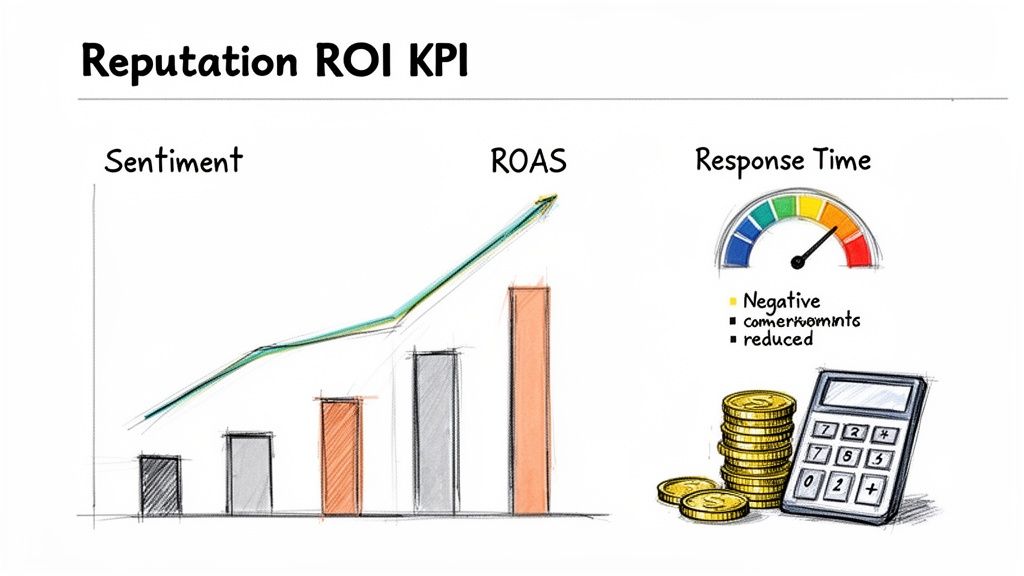
So, how do you actually prove that social media reputation management is worth the time, effort, and money? To justify the investment, you have to get past the fuzzy metrics and zero in on the numbers that tie directly back to the bottom line. It’s all about drawing a straight line from managing online conversations to driving real business growth.
The whole point is to demonstrate value, not just activity. Nobody cares how many comments you replied to. What they care about is how that activity impacts revenue, customer loyalty, and even operational efficiency. This is how you shift the perception of reputation management from a necessary cost to a genuine growth driver.
Key Metrics That Prove Your Worth
If you want to build a convincing case, you need to track the right data. Vanity metrics like follower counts are nice, but they don't tell the real story. What you need is a simple, powerful dashboard focused on KPIs that show how your work is protecting ad spend and strengthening customer relationships.
Start by getting a handle on these core metrics:
Sentiment Score Trends: Is the conversation about your brand getting more positive over time? A rising sentiment score is a fantastic leading indicator of stronger customer loyalty and, ultimately, more sales.
Average Response Time: How fast are you getting back to people? Shaving your response time from a few hours down to a few minutes can do wonders for customer satisfaction and stops small complaints from turning into big problems.
Reduction in Negative Comments on Ads: For any e-commerce brand running paid social, this is a huge one. Tracking the percentage drop in spammy or toxic comments on your ads directly proves you're protecting ad spend and improving your Return on Ad Spend (ROAS).
It's all about connecting the dots. When you can walk into a meeting and show that a 15% reduction in negative comments on your ads lines up with a 5% increase in ROAS, the value of what you do becomes crystal clear. A cleaner comment section leads to more profitable campaigns.
Calculating the Cost of Inaction
Sometimes, the best way to show the ROI of doing something is to calculate the cost of doing nothing. A single social media crisis that spirals out of control can cause serious financial damage—we're talking lost sales, a dip in stock price, and the hefty price tag of a full-blown PR recovery campaign.
Frame the conversation by comparing the modest cost of a proactive management tool and a bit of dedicated staff time against the catastrophic expense of a reputation meltdown. The proactive vs. reactive cost model makes the business case for you. It’s a much easier conversation to have.
The table below breaks down the key metrics you should be watching, how to track them, and what they really tell you about your strategy’s impact on the business.
Tracking Your Reputation Management ROI
This table breaks down key metrics, how to measure them, and what they indicate about your strategy's success and its impact on the bottom line.
Metric | How to Measure | What It Tells You |
|---|---|---|
Sentiment Score | Use a tool to track the ratio of positive to negative brand mentions. | Indicates overall brand health and customer perception. |
Lead Quality from Social | Tag and track leads originating from social media DMs and comments. | Shows how engagement directly contributes to the sales pipeline. |
Customer Retention Rate | Analyze cohorts of customers who have interacted with your brand on social. | Demonstrates the link between positive engagement and loyalty. |
ROAS on Monitored Ads | Compare the performance of ads with active moderation to those without. | Proves that a positive comment environment boosts conversions. |
By keeping a close eye on these KPIs, you can build a data-backed story that proves social media reputation management isn't just a "nice-to-have." It’s a critical investment that actively protects revenue and fuels sustainable growth.
Frequently Asked Questions About Reputation Management
Even with the best plan, you're going to have questions. This is where we tackle the most common ones that brands and agencies run into when they get serious about social media reputation management. Think of this as the practical advice to back up the principles we've covered so you can move forward with confidence.
How Can Small Teams Manage Reputation Effectively?
It's a huge myth that you need a massive team to handle your brand's reputation online. For small businesses or lean agencies, the answer isn't throwing more people at the problem—it's about having smarter processes and the right tech. It’s all about efficiency, not headcount.
First, don't try to be everywhere at once. Zero in on the channels where your customers actually hang out. For most e-commerce brands, that’s going to be your ad comments on Facebook and Instagram. Then, make automation your new best friend. Use it to clear out all the low-level noise so your team can spend their time on conversations that actually matter.
A small team can be a powerhouse with the right setup:
Unified Inbox: Pull all your DMs and comments into one place. No more jumping between a dozen tabs.
AI-Powered Filtering: Let AI automatically hide the spam, trolls, and profanity. Your team shouldn't have to wade through junk to find real customers.
Response Templates: Build out a library of pre-approved replies for the usual questions. This keeps your responses fast and consistent, freeing up your team for the tricky stuff.
Why Shouldn't I Just Delete Negative Comments?
I get it. The gut reaction to a negative comment is to just make it disappear. But hitting that delete button is almost always a mistake that backfires. It feels like a quick fix, but you're usually just pouring gasoline on the fire. Remember: screenshots are forever.
When a customer sees their legitimate complaint was just erased, their frustration quickly turns to anger. They feel ignored and censored, which is a powerful motivator to take their story elsewhere. That one comment you deleted from a Facebook ad can easily become a viral Reddit post or a scathing one-star Google review.
A public, negative comment isn't just a problem—it's an opportunity. When you respond with genuine empathy and professionalism, you're not just talking to one person. You're showing every single person who sees that thread that you stand by your product and care about your customers. That builds way more trust than a perfectly curated, all-positive comment section ever could.
Instead of deleting, use the Acknowledge and Escalate method. Drop a short, empathetic public reply acknowledging their issue, and immediately offer to solve it in a private channel like DMs. You show public accountability while moving the messy details offline.
What Is the Difference Between Monitoring and Management?
People often use "monitoring" and "management" interchangeably, but they're two very different sides of the same coin. Nailing the difference is key to building a strategy that actually works. It's the difference between listening to a conversation and actively shaping it.
Here’s a simple way to think about it:
Social Media Monitoring is the listening part. This is where you use tools to track mentions of your brand, your competitors, and important keywords. It’s all about gathering the data and knowing what people are saying. Monitoring tells you what is being said.
Social Media Reputation Management is the acting part. This is what you do with the information you gathered. It’s engaging with your audience, responding to feedback, handling crises, and proactively building a positive image. Management is about deciding what to do about what’s being said.
In short, monitoring is passive intelligence gathering, while management is active, strategic engagement. You can't manage what you don't monitor, but monitoring alone does nothing to protect your reputation. One feeds the other.
How Quickly Do I Need to Respond to a Comment?
On social media, speed is everything. Customer expectations have shot through the roof, and a slow response feels like you just don't care. Not every comment needs a reply in 60 seconds, but your team absolutely needs clear benchmarks.
A good rule of thumb is to answer within a few hours during the business day. A Sprout Social study found that 40% of consumers expect a response within the first hour, and 79% expect one within 24 hours. When it comes to negative feedback or urgent problems, the faster, the better. A quick reply can shut down a brewing storm before it gets out of control.
But speed can't come at the cost of quality. A rushed, unhelpful answer can be even worse than a slightly delayed but thoughtful one. This is where prioritization tools are a game-changer. By using sentiment analysis, your team can instantly spot the highly negative comments that need a human touch right away, while routine questions can be handled in the normal queue. It's all about striking the right balance between speed, empathy, and accuracy.
Ready to protect your ad spend and turn social comments into sales? Meet Alto AI centralizes your Facebook and Instagram DMs and comments into one smart inbox, using AI to filter noise and surface high-intent leads 24/7. Stop manually managing your reputation and start scaling your conversations. Learn more and book a demo today at meetalto.ai.