Best Time to Post on Instagram: 2025 Data-Driven Guide
Discover the powerful features that will transform how your team collaborates and manages projects.

Alto AI
on
Jan 13, 2026
Social media moderation is the process of monitoring, reviewing, and acting on user-generated content across a brand's social channels to keep things in line with community guidelines. But it's so much more than just deleting spam. Think of it as a strategic move to protect your brand's reputation, build a thriving community, and actually drive business growth.
Why Social Media Moderation Is a Business Imperative
Picture this: you have a beautiful physical storefront, but it's constantly getting vandalized while customers are trying to shop. That’s what an unmoderated social media page feels like to your audience. Today, moderation has moved from a simple clean-up chore to a critical business function. Ignoring comments, DMs, and mentions just isn't an option anymore.
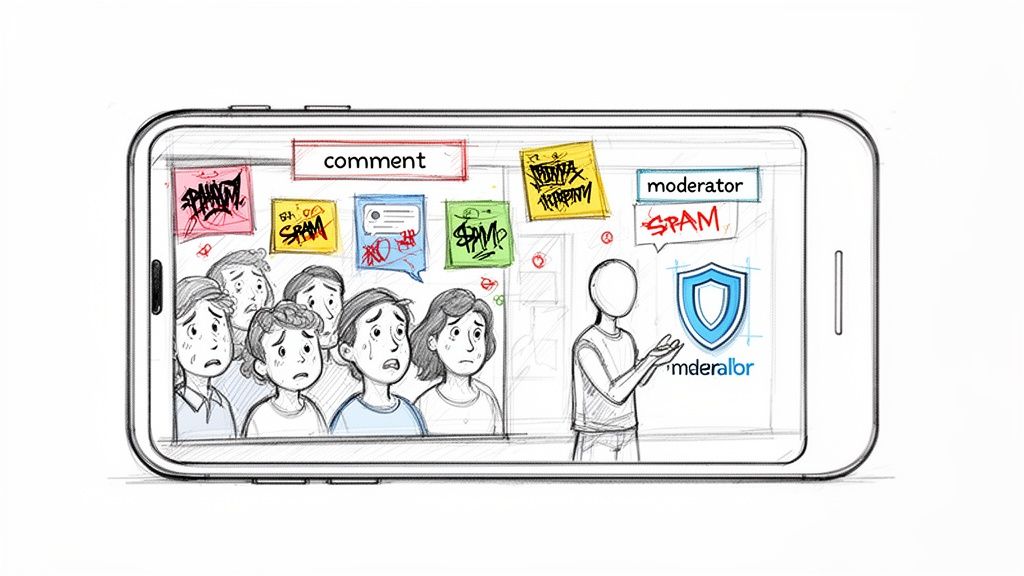
Good moderation is the frontline defense for your brand's digital identity. It’s all about consistently managing online conversations to maintain a space that feels safe, welcoming, and productive for your followers. This kind of proactive engagement has a direct impact on how customers see your brand.
Protecting Your Brand and Investment
Every social media post, especially a paid ad, is like a digital storefront. If the comment section is a wasteland of spam, scams, or hateful messages, it scares off potential customers and completely tanks your marketing spend. Effective moderation acts as the security guard for these digital spaces, making sure your investment pays off.
This protection goes way beyond just comments. It covers a whole range of interactions that can make or break your brand's standing:
Brand Reputation: Actively removing harmful content stops your brand from being associated with negativity, misinformation, or toxicity.
Customer Trust: A well-moderated page shows you actually care about your community's experience. That builds real loyalty and confidence.
Return on Ad Spend (ROAS): When you clear out the junk under your ads, genuine prospects see positive engagement, which directly boosts campaign performance.
A brand's online community is a direct reflection of its values. Unmanaged comment sections signal neglect, while actively moderated spaces demonstrate commitment to customer experience and safety.
From Reactive Firefighting to Proactive Growth
Too many brands are stuck in "reactive firefighting" mode—only stepping in after a problem has already blown up. That approach is costly and often too late to prevent real damage. A modern moderation strategy is proactive, turning a defensive chore into an offensive advantage.
By consistently managing your social channels, you can catch customer service issues before they become crises, spot sales opportunities hidden in conversations, and gather priceless feedback to improve your products. This guide will give you a clear roadmap to move beyond simple damage control. We'll show you how to build a moderation system that not only nurtures your community but also drives real, tangible revenue. It's time to turn your comments and DMs from a potential liability into a powerful asset.
The Hidden Costs of Unmanaged Social Engagement
Pouring money into a social media ad campaign without moderating the comments is like buying a billboard in a bad neighborhood and hoping for the best. You've nailed the perfect message and targeted the right audience, but the space around your ad—the comment section—is just as important as the ad itself.
When that space gets clogged with spam, scams, and hateful comments, the value of your entire investment tanks. This isn't just a PR headache; it’s a direct hit to your bottom line.
An unmanaged comment section creates a toxic first impression, scaring off potential customers before they even think about clicking. Each spam link or nasty reply is like digital graffiti on your brand’s storefront, chipping away at the trust you’ve worked so hard to build.
The Financial Drain of Negativity
The damage from poor moderation isn't theoretical—it's real and you can measure it. Every paid ad is an investment meant to guide someone down your sales funnel. A comment section filled with phishing links, crypto scams, or even a competitor's promo link completely blows up that journey.
Buyers who were genuinely interested are now distracted or, worse, disgusted. They start to associate your brand with the chaos they see, which leads to some pretty clear financial consequences:
Wasted Ad Spend: Your budget is spent reaching users who are immediately turned off by the toxic environment under your ad. Kiss your return on ad spend (ROAS) goodbye.
Lost Sales Opportunities: Real questions and buying signals from actual prospects get buried under a mountain of junk. Your team ends up missing obvious chances to convert leads.
Increased Customer Churn: Existing customers can feel ignored or unprotected, causing them to disengage from your brand and maybe even take their business elsewhere.
When a potential customer sees an ad followed by a stream of unmoderated spam, they don't just distrust the commenters—they distrust the brand for allowing it to happen.
The Domino Effect on Brand Reputation
Beyond the immediate financial hit, the long-term damage to your reputation can be even more severe. In today’s world, social proof is everything. A single, highly visible negative comment or a thread of hateful arguments can spiral fast, creating a negative perception of your brand that sticks.
And this toxic environment doesn't just stay on one post; it poisons the well for your entire online community.
This is especially critical when you consider the scale of social media. In 2023, nearly half the world's population used social networks, making these platforms a primary way customers interact with brands. For a company like Meta, which earned approximately 98% of its $132 billion revenue from advertising, user trust is everything. A spike in visible hate speech or scams under ads is a direct threat to that model, which is why brand safety has become an economic necessity. You can explore more about the impact of harmful content on social media platforms on Statista.com.
This reality forces brands to take control. Effective social media moderation is no longer a "nice-to-have" but a core function of digital marketing. It protects your ad spend, preserves customer trust, and makes sure your brand’s voice is heard above the noise. Without it, you're leaving your most valuable digital assets completely unprotected.
How to Build Your Moderation Framework
Moving from chaotic, reactive social media management to a controlled, strategic operation requires a solid framework. This isn't just about putting out fires; it's about building a system that empowers your team, protects your brand, and actually fosters a healthy community.
A well-defined framework is what turns moderation from a stressful, unpredictable task into a well-oiled machine.
The bedrock of this whole system is a clear, public set of rules for your community. Think of these not as legal disclaimers, but as a public declaration of your brand's values and the kind of conversations you want to host. This simple step sets expectations for users and gives your moderators a North Star for every decision they make.
Establish Clear Community Guidelines
Your community guidelines are the constitution for your social media presence. They need to be simple, easy to find, and written in plain English. They are the house rules everyone agrees to follow when they step into your space.
These guidelines should leave no room for interpretation, clearly stating what is and isn't acceptable. While the specifics will vary by brand, most effective policies cover the same core ground:
Respect and Safety: Prohibit hate speech, harassment, bullying, and personal attacks. Make it known that your page is a safe space.
Spam and Self-Promotion: Define what you consider spam—repetitive comments, irrelevant links, or unsolicited promotions. This keeps conversations focused.
Relevance: Encourage comments that are relevant to the original post. This stops threads from getting derailed by off-topic arguments.
Consequences: State exactly what happens when someone breaks the rules. This could be anything from a warning to comment deletion or a block.
Coming up with these rules from scratch can feel daunting. For some practical inspiration, check out the examples in our guide to community guidelines for Facebook and Instagram. A strong set of guidelines is the first line of defense for consistent and fair social media moderation.
To help you get started, we’ve broken down the essential components every moderation policy should have. Think of this as your foundational checklist.
Key Pillars of a Moderation Policy
Policy Component | Description | Example Guideline |
|---|---|---|
Respect & Safety | Prohibit harassment, hate speech, and personal attacks to create a welcoming environment. | "We do not tolerate bullying, threats, or hate speech of any kind. Such comments will be removed, and users may be banned." |
Spam & Self-Promotion | Define what counts as spam (e.g., repetitive posts, irrelevant links) to keep the conversation clean. | "Please avoid posting repetitive comments or external links for self-promotion. Such content will be deleted." |
Relevance | Keep discussions on-topic and relevant to the original post and community. | "We encourage you to keep comments relevant to the post. Off-topic conversations may be removed to keep the discussion focused." |
Legal & Privacy | Forbid sharing of private information or illegal content to protect your community and brand. | "Do not post personal information about yourself or others. Any content that violates privacy or is illegal will be removed immediately." |
Consequences | Clearly state the actions taken for rule violations, ensuring transparent enforcement. | "Violating these guidelines may result in comment deletion, a temporary suspension, or a permanent ban from our pages." |
Having these pillars in place gives your team the confidence and clarity they need to act decisively and fairly, every single time.
Letting spam and abuse run rampant does more than just clutter your feed. It actively undermines the trust you’ve built and the money you’ve invested in your social channels.
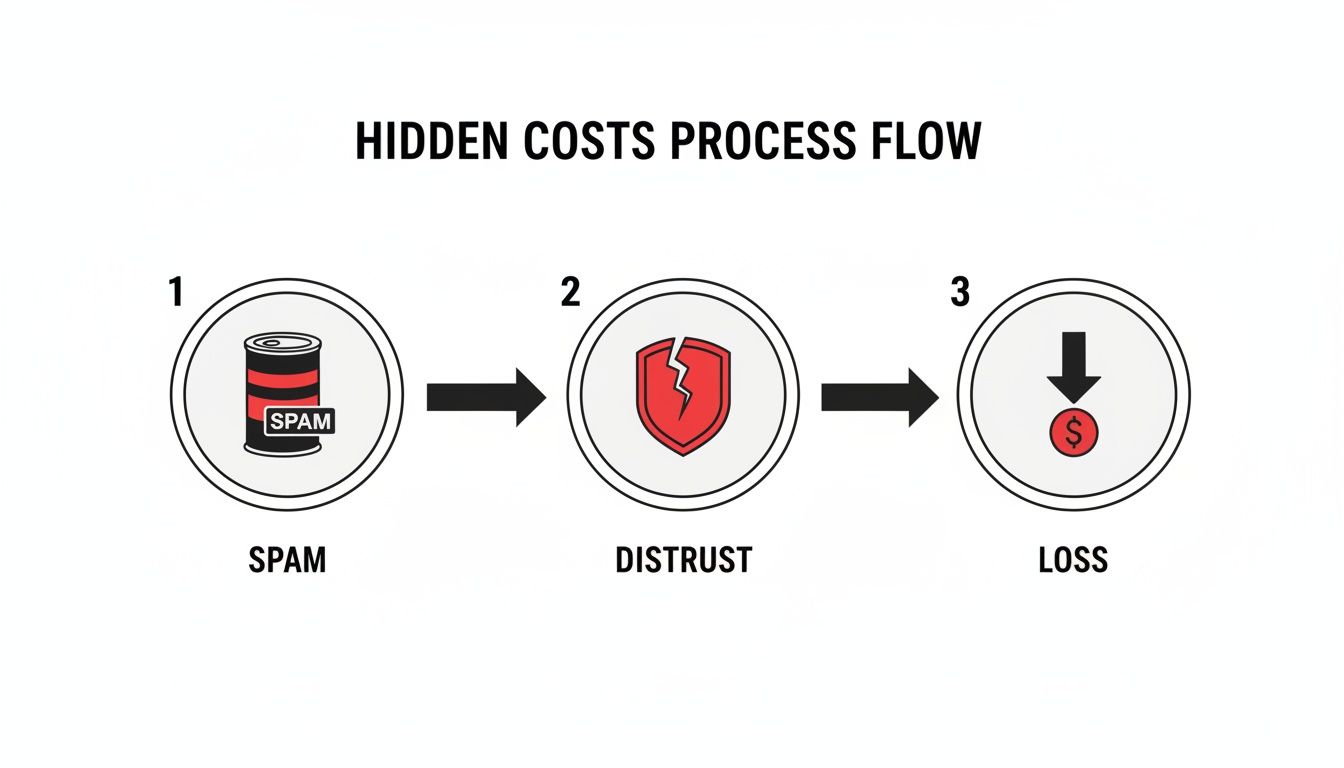
As you can see, failing to manage that first stage—the spam—isn't a minor issue. It's the starting point of a value-destroying chain reaction.
Design an Escalation Workflow
Once you have your rules, you need a playbook for enforcing them. An escalation workflow is just that: a clear, step-by-step plan that tells your team what to do in different situations. It covers everything from a simple customer question to a full-blown PR crisis.
The goal is to eliminate guesswork and ensure a consistent response, no matter who is on duty. Think of it as a decision tree. If a user posts X, the moderator does Y. If the situation becomes Z, it gets passed to a specific person or team.
An escalation workflow isn't about bureaucracy. It's about speed and clarity. In a crisis, the last thing you want is your team debating who should handle the response.
To build a workflow that actually works, you need to map out the process for different types of incoming content. This ensures routine issues are handled efficiently while serious threats get immediate attention.
Define Triage Levels: Categorize incoming comments and DMs into tiers. For example, Level 1 could be general questions or positive feedback. Level 2 might be customer service complaints. Level 3 would be serious rule violations or potential PR crises.
Assign Ownership: Clearly designate who is responsible for each level. A junior community manager might handle Level 1, while a senior support agent handles Level 2. Anything at Level 3 should go straight to a manager or the PR team.
Set Response Time Goals (SLAs): Establish realistic Service Level Agreements for each category. You might aim to respond to customer complaints within two hours and general questions within 24 hours. Tracking this is key.
Create Response Templates: For common questions and issues, develop pre-approved response templates. This saves a ton of time and keeps the brand voice consistent. Just be sure to encourage your team to personalize them so you don't sound like a robot.
With these two pillars in place—clear guidelines and a structured workflow—your moderation efforts become predictable, scalable, and far less stressful. Your team can operate with confidence, knowing they have a clear mandate and a plan for whatever comes their way. This framework is what transforms moderation from a reactive chore into a strategic asset.
Choosing the Right Moderation Approach for Your Brand
Picking a social media moderation strategy isn't a one-size-fits-all deal. Think of it like setting up security for a physical store. Do you need a guard at the door checking everyone who enters, cameras to review incidents after they happen, or an automated alarm that goes off when a rule is broken?
What's right for you boils down to your brand’s goals, the size of your community, and how much risk you're comfortable with. A global brand pouring money into a massive ad campaign has different needs than a startup trying to build its first real community. Each approach has its trade-offs, and frankly, the best setups usually borrow from all three.
Proactive Moderation: The Gatekeeper
Proactive moderation, sometimes called pre-moderation, is the strictest you can get. It means every single user-generated comment, photo, or post gets reviewed and approved by a human moderator before it ever sees the light of day. Nothing gets past the gatekeeper without a manual thumbs-up.
This method gives you the highest level of brand safety, period. You have total control, which pretty much eliminates the risk of spam, hate speech, or a rogue inappropriate comment ever hitting your page.
But that control has a price. Pre-moderation can grind conversations to a halt, making real-time engagement a non-starter. For brands that thrive on spontaneous, back-and-forth community chatter, this approach can feel like a straitjacket, completely stifling the natural flow of dialogue.
Reactive Moderation: The Watchful Guardian
On the flip side, reactive moderation (or post-moderation) lets content go live instantly. Moderators then circle back to review it, taking action—like hiding, deleting, or replying—based on your community guidelines. This is the standard playbook for platforms like Instagram and Facebook.
The biggest win here is that it keeps the conversation moving in real time. Users get instant feedback, which helps create a more dynamic, interactive, and lively community.
The catch? There's an inherent risk. A nasty comment could be live for minutes—or even hours—before a moderator spots and removes it. In that window, it can do real damage to your brand’s reputation or upset other users, making this a higher-risk, higher-reward game.
Automated Moderation: The 24/7 Sentry
Automated moderation is all about using software and AI to filter content without a human having to click a button. These systems can instantly hide comments with certain keywords, block known spam accounts, or flag posts based on sentiment analysis.
The obvious benefit is scale and speed. An AI-powered system works around the clock, handling a volume of comments and messages that would be completely overwhelming for a human team. This is a must-have for protecting ad spend and maintaining a baseline of safety 24/7.
The most powerful social media moderation strategy is a hybrid one. Automation handles the volume, filtering out 80% of the noise, while skilled human moderators focus on the nuanced 20% that requires empathy, critical thinking, and genuine connection.
This hybrid model creates a powerful synergy. For instance, you can use automation to instantly hide comments with profanity or spam links. This frees up your human team to do what they do best: answer customer questions, engage with positive feedback, and build real relationships.
For brands ready to dive in, exploring tools for Instagram comment automation is a great first step toward blending AI efficiency with human oversight. Ultimately, the sweet spot is combining proactive, reactive, and automated methods to build a system that’s both safe and engaging—protecting your brand while you grow your community.
How to Scale Moderation with AI and Automation
When your brand’s social media takes off, so does the tidal wave of comments, DMs, and mentions. Trying to keep up manually isn't just a tough job; it's a flat-out impossible one. This is the point where AI and automation go from being a "nice to have" to a core part of your moderation strategy.

But let's get one thing straight: scaling isn't about firing your human team. It's about giving them superpowers. By letting AI handle the high-volume, low-stakes stuff, you free up your best people to focus on what they do best—building relationships, solving tricky customer problems, and spotting high-intent leads.
Think of automation as your 24/7 frontline defense, tirelessly sifting through the noise so your team can focus on the conversations that actually build your business.
The Power of Automated Filtering and Triage
Imagine a smart bouncer for your comment sections. That's what automated tools are. They can instantly spot and deal with content based on rules you set, offering a level of control that native platform tools just can't match.
This first line of defense is absolutely critical for keeping your brand safe, especially on paid ads where every single impression matters. Some common automated moves include:
Spam and Profanity Filters: Automatically hiding or zapping comments with specific keywords, sketchy links, or foul language. This keeps your community spaces clean and professional, day or night.
Troll and Bot Detection: Sniffing out and blocking accounts that act like bots or have a history of causing trouble.
Sentiment Analysis: Reading the room by gauging the emotional tone of a comment. It can then automatically tag messages as positive, negative, or neutral.
By letting AI handle the endless stream of spam and repetitive questions, human moderators can dedicate their time to high-value interactions that require empathy and strategic thinking—transforming a cost center into a customer experience hub.
This intelligent triage system sorts the digital mail before it ever clutters your team's inbox. Upset customer? Flagged as urgent and sent straight to support. Raving fan? Routed to marketing for some social proof gold.
From Defense to Offense With Smart Workflows
Great automation doesn’t just play defense; it helps you go on the offense. It’s about finding and acting on the opportunities buried in all that social chatter. This is how you turn moderation from a cost of doing business into an engine for growth.
Just look at the transparency reports from major platforms—they all lean heavily on automated systems as their first move. For brands, that's a signal. While platforms filter out the worst of the worst, brand-side AI is what closes the gap between their generic rules and your specific business goals, like protecting ad spend and capturing leads.
With smart workflows, you can build a system that doesn't just filter out junk but actually surfaces value.
Building Your Automated Workflow
Integrate a Unified Inbox: First things first, pull all your comments and DMs—from every ad and organic post on Facebook and Instagram—into a single dashboard. No more jumping between accounts, and no more missed messages.
Set Up Keyword-Based Rules: Create rules to automatically hide comments that mention competitors, unauthorized discount codes, or common scam phrases. A tool like Facebook’s own Moderation Assist is a decent starting point. For a deeper dive, check out our guide on how to use Facebook Moderation Assist.
Implement Sentiment and Intent Tagging: This is where it gets really smart. Use AI to automatically tag what messages are about. A comment like "How much is this?" gets tagged #SalesLead, while "My order never arrived" becomes #UrgentSupport. Your team can see what’s important at a glance.
Route and Assign Conversations: Based on those tags, you can automatically send conversations to the right people. Sales leads pop up for the sales team, and support issues land in the customer service queue. This move alone can drastically slash your response times.
When you put these systems together, you build a scalable framework that not only protects your brand but actively helps it grow. It means that even while you sleep, your digital storefront is safe, professional, and ready to do business.
Measuring the ROI of Your Moderation Efforts
How do you prove that putting time and money into social media moderation is actually worth it? In a world that runs on data, saying it “feels” better just doesn’t cut it. To justify the team, tools, and hours spent, you have to connect your day-to-day work to real business results.
This means looking past surface-level vanity metrics, like how many followers you have. We need to focus on the key performance indicators (KPIs) that actually show value. Good moderation isn’t just a cost; it's a way to drive profit, and the right data proves it.
Key Moderation KPIs to Track
To build your case, start tracking the numbers that show how well your team is managing your social channels. These KPIs give a clear picture of your team’s performance and the overall health of your online community.
Average Response Time: How fast are you getting back to comments and DMs? Quick replies, especially for customer questions, are directly tied to happier customers.
Sentiment Score Improvement: Are you turning negative comments into positive experiences? Tracking the overall mood of conversations about your brand shows if your work is improving how people see you.
Volume of Hidden/Deleted Comments: This number shows how much spam, hate speech, and other toxic content you’re removing. It’s a straight-up measure of how much risk you’re getting rid of.
Leads Captured from Social: How many comments like "Where can I buy this?" are you spotting and sending over to the sales team? This draws a direct line from moderation to revenue.
Proving ROI is all about telling a story with data. It starts with showing how moderation cleans up the community (fewer spam comments) and ends by showing how it helps the business grow (more sales leads captured).
These metrics are your starting point. They show what your team is doing. The next step is to connect these actions to the bottom-line results that your boss and other stakeholders really care about.
Connecting Moderation KPIs to Business Goals
This is where you translate your team’s daily grind into the language of business growth. When you link your moderation KPIs to the company’s bigger goals, you make the financial impact of your work impossible to ignore. A solid framework helps map these connections, making your value crystal clear.
The table below shows how specific moderation metrics directly influence core business goals, giving you a clear way to report on your success.
Connecting Moderation KPIs to Business Goals
Moderation KPI | What It Measures | Impact on Business Goals |
|---|---|---|
Reduced Response Time | The speed at which your team addresses customer questions or complaints. | Lowers customer churn and increases Customer Lifetime Value (CLV) by improving satisfaction and loyalty. |
Increased Lead Capture Rate | The number of sales opportunities identified and routed from comments and DMs. | Directly boosts sales pipeline and revenue, demonstrating a clear contribution to the bottom line. |
Higher Sentiment Score | The overall positive, neutral, or negative tone of conversations around your brand. | Improves brand reputation and can lead to a higher Return on Ad Spend (ROAS) as positive social proof builds trust. |
Spam Removal Volume | The quantity of spam, scams, and harmful links hidden from your posts and ads. | Protects ad spend from being wasted on fraudulent clicks and preserves the integrity of your marketing campaigns. |
By tracking these numbers consistently, you build an undeniable case for your social media moderation. You can show stakeholders with confidence that your team isn't just deleting comments—they are actively protecting the brand, making customers happier, and bringing in measurable revenue.
Your Top Social Media Moderation Questions, Answered
Even with the best strategy, you’re bound to have questions about social media moderation. Here are some quick, no-nonsense answers to the things we get asked most often.
How Do I Create a Moderation Policy?
Think of your policy as your community’s rulebook. Start with your brand’s core values—what do you stand for? Then, get specific.
Clearly outline what’s not okay on your channels (like hate speech, spam, or harassment) and, just as importantly, what kind of conversations you want to encourage. Spell out the consequences for breaking the rules and create a simple escalation path for your team to follow when things get tricky. Once it’s done, get your legal and PR teams to give it a final once-over before you publish it somewhere easy for everyone to find.
What's the Difference Between Platform and Brand Moderation?
This one trips people up, but it’s pretty simple. Platform moderation is the big-picture stuff handled by giants like Meta or TikTok. They enforce massive, universal community standards to remove illegal content and shut down dangerous accounts. Think of it as the basic safety net for everyone online.
Brand moderation, on the other hand, is your game, played on your turf. It’s about enforcing your rules to protect your brand’s reputation. You’re the one filtering spam from your ad comments, spotting sales opportunities in a busy thread, and handling customer support questions. You need both working together.
AI should be viewed as a powerful assistant, not a replacement. The best approach is a hybrid model where AI handles the scale and humans provide the wisdom.
Can AI Just Handle All of This for Me?
Nope, and you wouldn't want it to. AI is a fantastic workhorse for high-volume, repetitive tasks. It can hide obvious spam, flag profanity, and work 24/7 without a coffee break.
This frees up your human team to do what they do best: navigate tricky customer complaints, spot the subtle nuances in a potential sales lead, and manage a crisis that requires real empathy. AI gives your team superpowers; it doesn't replace them.
How Fast Do We Really Need to Respond?
It depends, but a solid goal is to reply to public comments within a few hours and direct messages in under an hour, especially if it's a support issue.
The most important thing is consistency. Set a clear Service Level Agreement (SLA) for your team so everyone knows what’s expected, and use tools to track how you’re doing. A quick, helpful response can flip a bad experience into a great one before it ever has a chance to escalate.
Ready to stop wasting time on spam and start capturing more leads? Meet Alto AI centralizes your social inbox, uses AI to filter noise, and surfaces high-intent conversations so your team can focus on what drives revenue. Protect your ad spend and scale your social selling with Alto.