A Complete Guide to Social Media Listening for E-commerce
Unlock the power of social media listening to boost sales and protect your brand. This guide covers strategies, tools, and workflows for e-commerce success.

Alto AI
on
Feb 11, 2026
A Complete Guide to Social Media Listening for E-commerce
Social media listening isn't just about tracking notifications. It’s the art of tuning into the massive, unfiltered conversation happening online about your brand, your competitors, and your entire industry to pull out real, strategic insights.
It goes way past simple monitoring by digging into the why behind every mention, helping you understand how customers really feel, spot trends before they take off, and make smarter decisions for your business.
So, What Is Social Media Listening, Really?
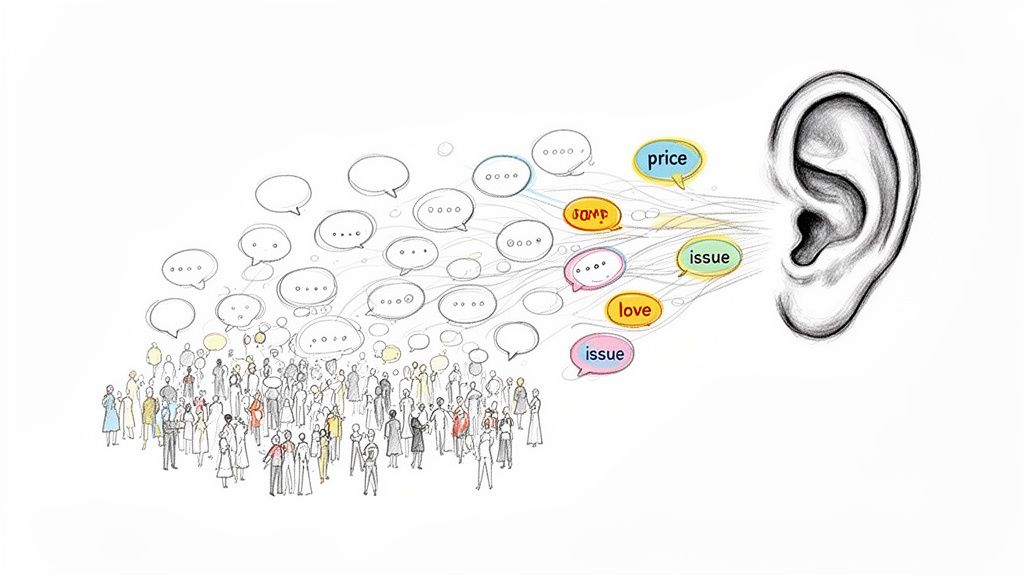
Think of it like this: your brand is at a giant digital party where millions of conversations are buzzing all at once. Basic social media monitoring is like hearing someone shout your name across the room—you react to that one mention. You collect your tags and notifications as they pop up. It’s purely reactive.
Social media listening, on the other hand, is like having a superpower. It lets you zero in on the specific conversations that truly matter, understand the context, and get a read on the collective mood of the room. It’s less about what someone said and much more about why they said it and what that means for you.
This proactive approach turns the raw, messy data from comments and DMs into clear, actionable intelligence. For any e-commerce or DTC brand, that's where the magic happens.
Moving Beyond Just Tracking Mentions
The real difference between monitoring and listening boils down to a mindset shift: moving from being reactive to proactive. Monitoring simply collects data points; listening connects those dots to show you the bigger picture.
It's one thing to see your mentions, but it's another thing entirely to understand them. Here’s a quick breakdown of what makes them so different.
Social Media Monitoring vs Social Media Listening
Aspect | Social Media Monitoring (Reactive) | Social Media Listening (Proactive) |
|---|---|---|
Primary Goal | Track and respond to individual brand mentions, tags, and direct messages. | Analyze the entire conversation around your brand, industry, and competitors. |
Focus | "What was said?" | "Why was it said, and what does it mean?" |
Data Scope | Gathers specific, direct interactions with your brand. | Collects broad data, including indirect mentions and competitor conversations. |
Timeframe | Looks at the past and present (what has already happened). | Looks to the future (what trends are emerging, what opportunities exist). |
Output | A list of notifications, mentions, and engagement metrics. | Strategic insights, sentiment analysis, competitive intelligence, and lead generation. |
Example | Responding to a customer complaint in a comment. | Noticing a pattern of complaints about shipping and fixing the root cause. |
Ultimately, monitoring helps you manage your day-to-day interactions, while listening gives you the intelligence to shape your long-term strategy.
Here’s how social listening delivers those deeper insights:
Understand Customer Sentiment: It automatically deciphers the emotion behind a comment. Is a customer asking about the price because they're eager to buy, or are they complaining it's too expensive?
Pinpoint High-Intent Leads: Listening tools can flag comments like "Where can I get this?" or "Do you have this in blue?" on your ads, turning passive viewers into genuine sales opportunities.
Get Ahead of Customer Service: It helps you find and solve customer issues before they blow up into public complaints, safeguarding your brand’s reputation.
Discover Your Next Big Product Idea: These conversations reveal what customers absolutely love about your products and, just as importantly, what they wish you offered. This is a goldmine for product development.
Social media listening is the art of translating unstructured online chatter into structured business strategy. It’s about finding the signals in the noise—the sales leads, the service issues, and the next big market trend.
The Scale of the Conversation
The need for smart social listening is driven by the sheer volume of these online interactions. By 2026, there will be 5.66 billion active social media identities—that’s nearly 69% of the world's population. This audience creates a staggering amount of content every single minute, with users watching 138.9 million Reels on Facebook and Instagram alone.
For brands, this translates to a flood of comments and DMs that no team could ever sort through manually. Without a listening strategy, you’re essentially flying blind, ignoring your most valuable and vocal customers.
For DTC brands on platforms like Instagram, where adults spend over an hour every day, each comment section is a free, real-time focus group. This is where you can dig deeper with social media sentiment analysis tools to process these conversations at scale and pull out the insights that matter.
The Building Blocks of a Powerful Listening Strategy
A great social listening program isn't just about having the right software; it's about knowing what to listen for. Think of yourself as a detective. To crack the case—which for e-commerce brands is always understanding the customer—you need to know which clues matter.
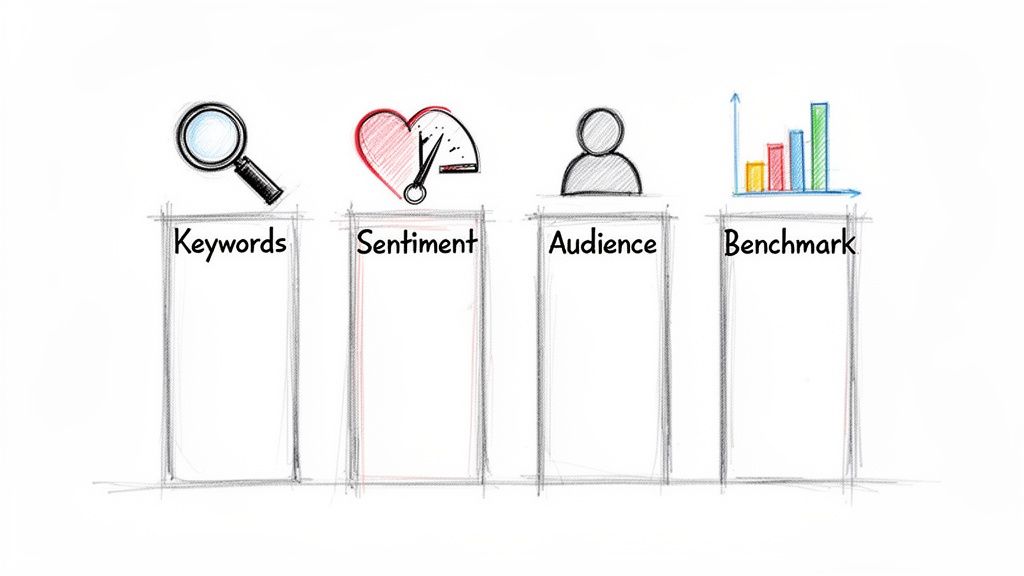
To build a strategy that actually works, you need to focus on four essential pillars. These pieces work together to turn messy social media chatter into a clear roadmap for growth, better customer relationships, and smarter decisions. Each one gives you a different lens to view the massive landscape of online conversation.
Keyword and Topic Tracking
The absolute foundation of any listening strategy is tracking specific keywords and topics. This goes way beyond just your brand name. A smart strategy keeps an ear out for a wide range of terms to capture the full picture of conversations that matter to your business.
It’s like casting a wide net. Instead of only catching fish that swim right up to your boat (tagged mentions), you’re actively seeking them out where they live and feed.
Here’s what this usually covers:
Brand Mentions: This includes your company name, product names, and even common misspellings. A skincare brand, for example, would track "GlowUp Serum" and "Glow Up Serum."
Competitor Mentions: Keeping tabs on your rivals’ names and products uncovers their customers' pain points, how their marketing campaigns are landing, and service gaps you can jump on.
Industry Terms: Tracking broader topics like "sustainable packaging" or "vegan leather" helps you spot emerging trends and find your place in the larger conversation.
Campaign Hashtags: Following your unique hashtags (like #GlowUpChallenge) and more general ones (#skincareroutine) lets you measure campaign reach and discover awesome user-generated content.
By tracking all these different terms, you graduate from a narrow, brand-centric view to a panoramic understanding of your entire market.
Sentiment Analysis
Okay, so you've collected the conversations. Now what? The next move is to figure out the emotion behind them. This is the heart of sentiment analysis. When someone comments on your new Facebook ad, are they complaining about the price, or are they an eager buyer asking a question?
Modern AI-powered tools do this automatically, slapping a sentiment score (positive, negative, or neutral) on every mention. This is a game-changer. For media buyers, it means instantly flagging high-intent comments on ads, like "I need this!" or "Do you ship to Canada?"
Sentiment analysis is your brand's emotional radar. It instantly tells you if a conversation is a sales opportunity, a looming customer service fire, or a glowing review you should amplify.
This lets your team prioritize engagement like never before. Instead of wading through hundreds of comments, they can jump on negative feedback first to put out fires, then pivot to the positive, purchase-intent comments to drive sales.
Audience and Trend Identification
This pillar is all about the who and the what hiding in the conversations you're tracking. You’re zooming out from single comments to see the bigger patterns. Audience identification helps you build rich customer personas by looking at the demographics, interests, and habits of the people talking about your brand.
At the same time, trend identification is about spotting recurring themes or topics that are picking up steam. A fashion brand might notice a sudden surge in chatter about a specific color or style, signaling a new micro-trend they can capitalize on.
Combine these two, and you can answer crucial questions like:
Who are our most passionate advocates?
What frustrations do our customers keep bringing up?
Are they asking for new product features?
Which influencers are making waves in our industry?
This process turns scattered data points into strategic intelligence that can guide everything from your next content piece to your next product launch.
Competitive Benchmarking
Finally, no social listening strategy is whole without competitive benchmarking. This is where you use all the data you’ve gathered to see how you stack up against your direct competitors. It adds critical context to your own numbers.
You can track key metrics such as:
Share of Voice (SOV): Of all the conversation happening in your industry, what percentage is about your brand versus your competitors?
Sentiment Score Comparison: How does the public feel about your brand compared to others in your space? Are you seen more positively?
Engagement Rates: How do your posts and campaigns perform in terms of likes, comments, and shares when measured against your rivals?
This final pillar keeps your goals grounded in reality. Knowing your competitor gets 50% more positive mentions gives you a clear, measurable target to aim for. It transforms social listening from a passive monitoring task into an active, competitive weapon.
Turning Social Conversations Into E-commerce Sales
A smart social listening strategy does more than just collect data—it carves a direct path to revenue. For e-commerce and DTC brands, this is where listening stops being a buzzword and starts making you money. It’s all about building simple, repeatable workflows that turn everyday comments and DMs into real business outcomes, making your social channels a reliable growth engine.
This isn’t some abstract concept. It’s about connecting specific social interactions to the right people on your team—media buyers, customer support, product developers—and giving them what they need to act on it. When you automate how these conversations are found and routed, you turn raw social chatter into sales, loyalty, and your next big idea.
Supercharge Ad Performance and Lead Generation
Your media buyers are on the front lines, constantly tweaking ad spend to squeeze out a better return. Social listening is their secret weapon for boosting ROAS, right from the comment section of their ads. What was once a chaotic mess of questions, complaints, and spam suddenly becomes a goldmine of sales opportunities.
With sentiment analysis, the right tools can automatically tag comments that scream purchase intent.
Buying Questions: Comments like "Do you have this in a size medium?" or "How much is shipping?" get flagged immediately.
Positive Feedback: Someone posting "I love this, ordering now!" is a hot lead showing strong interest.
Competitor Mentions: When a user says, "This looks much better than [competitor brand]," you’ve got an open door.
These high-intent comments can be sent straight to a sales or engagement team, who can jump in with a quick, personal response and close the deal. This simple workflow prevents valuable leads from getting buried in the noise and directly makes your ad campaigns more efficient. If you want to dial this in further, exploring different social media lead generation tools can give you even more ways to capture and convert these moments.
By treating ad comments as a real-time sales channel, brands can directly attribute revenue to their social listening efforts. It’s the difference between hoping for conversions and actively creating them.
Transform Customer Support From Reactive to Proactive
Great customer service builds loyalty, and social listening lets your support team get ahead of problems before they escalate. Instead of just waiting for angry emails or support tickets, your team can spot and solve issues right where they pop up—in public comments.
Think about it: a user commenting "My package still hasn't arrived" on your latest ad is a potential PR fire waiting to happen. A listening tool can catch that negative sentiment and ping your support team instantly.
This proactive approach is a triple win:
Reduces Public Complaints: Solving an issue right in the comments stops it from blowing up into a negative review or a viral complaint thread.
Builds Brand Loyalty: Customers are often blown away when a brand proactively reaches out to help. You just turned a bad experience into a memorable, positive one.
Lowers Support Costs: When you address a problem publicly, you might be answering the same question for dozens of other customers, cutting down on the total number of support requests.
This workflow shifts your support team from being a cost center to a powerhouse for managing your brand’s reputation.
Uncover Market Gaps for Product Innovation
Your product team is on a constant hunt for the next big thing or the perfect product tweak. Social listening gives them an unfiltered, 24/7 focus group, showing them exactly what customers love, what they hate about your competitors, and where the market is dropping the ball.
By tuning into conversations about competitor products, your team can find incredible insights. For instance, they might notice a recurring complaint that a rival’s product is missing a key feature. That’s not just feedback; it’s a bright, flashing sign pointing to a market gap your brand can fill. To really dig into this, see how tools like ChatGPT Brand Monitoring for E-commerce can reveal deeper consumer trends.
This data-first approach takes the guesswork out of product development. Instead of just relying on surveys, your team can use real, unsolicited customer feedback to dream up new features and products that you already know people want.
Modern consumer behavior makes this kind of listening non-negotiable. An incredible 72.3% of online audiences now turn to social media for brand research, with platforms like Instagram being a top spot for shaping their opinions. This habit directly impacts what they buy, making it crucial for brands to be part of the conversation. Turning this chatter into clear, actionable steps is how you build a system that consistently drives sales, boosts customer happiness, and fuels your next wave of growth.
Your Step-By-Step Listening Workflow Implementation
All the theory in the world doesn't matter without a clear, repeatable workflow. A solid implementation plan is what separates social listening from being a neat experiment to being a core part of how you grow your business. This is your roadmap for building a professional listening program from the ground up, one where every piece of data you collect actually drives an action.
The whole point is to create a system that consistently turns random social chatter into measurable results—more sales, happier customers, and better products. Let’s walk through the four essential phases to make that happen.
Phase 1: Define Your Core Objectives
Before you even think about tracking a keyword, you have to know what you're trying to achieve. What does a "win" look like? Your social listening goals need to be specific, measurable, and tied directly to what the business actually cares about. Otherwise, you’ll just be collecting data for the sake of it.
Start by looking at your biggest challenges. Are you trying to get more out of your ad spend? Cut down on customer support tickets? Or maybe just protect your brand's reputation?
For e-commerce brands, the objectives usually fall into a few common buckets:
Lead Generation: Finding and jumping on conversations with people who are ready to buy.
Customer Service Excellence: Proactively spotting and solving customer problems before they blow up.
Brand Health Monitoring: Keeping a finger on the pulse of your brand's sentiment and share of voice compared to competitors.
Crisis Management: Creating an early-warning system for sudden negative spikes or potential PR nightmares.
Product Innovation: Digging through conversations for raw, unfiltered feedback and ideas for your next product drop.
My advice? Pick one or two to start. Trying to do everything at once is a recipe for getting overwhelmed. Focusing your initial efforts ensures you can deliver clear, tangible results that get everyone excited.
Phase 2: Select and Configure Your Tools
Once you know your goals, it's time to pick your tech. The tool you choose should be a direct match for your objectives. For example, if you're laser-focused on generating leads from ad comments, you need a platform with top-notch sentiment analysis and real-time alerts.
When you're setting up the tool, precision is everything. This is where you translate your high-level goals into specific tracking rules. To really dig deep, especially on community-focused platforms, you might even use specialized tools like a Reddit Threads Finder tool to make sure you're not missing anything.
Your initial setup should include:
Keyword Tracking: Go way beyond just your brand name. Track your competitors, product categories, campaign hashtags, and even common misspellings of your brand.
Sentiment Rules: Don't just rely on the out-of-the-box settings. Teach the AI to understand the slang and context of your industry. What's negative for one brand might be totally neutral for another.
Alerts and Notifications: Set up automated alerts for the stuff you can't miss—a sudden nosedive in sentiment, a comment from a massive influencer, you name it.
Phase 3: Establish Team Workflows and Protocols
A great tool is useless without a great team process behind it. You need to map out exactly who does what when a certain type of conversation pops up. This cuts out the confusion and makes sure your responses are fast and consistent.
A well-defined workflow turns insight into action. It’s the bridge between knowing what someone said and doing something meaningful about it.
Create a simple response matrix to get started. For instance, a comment tagged with "high purchase intent" could be automatically routed to your social selling team. A comment with "negative sentiment" that includes keywords like "shipping" or "broken" should go straight into the customer support queue. This ensures the right person is handling every single interaction.
Phase 4: Analyze and Report on Your Findings
Your listening platform is going to collect a mountain of data. The final, and arguably most important, step is to analyze that information and turn it into insights that prove the program's value. Your reports should tie directly back to the objectives you set back in Phase 1.
This simple diagram shows how a listening-driven workflow can connect conversations directly to revenue. It’s not just talk; it's a real business process.
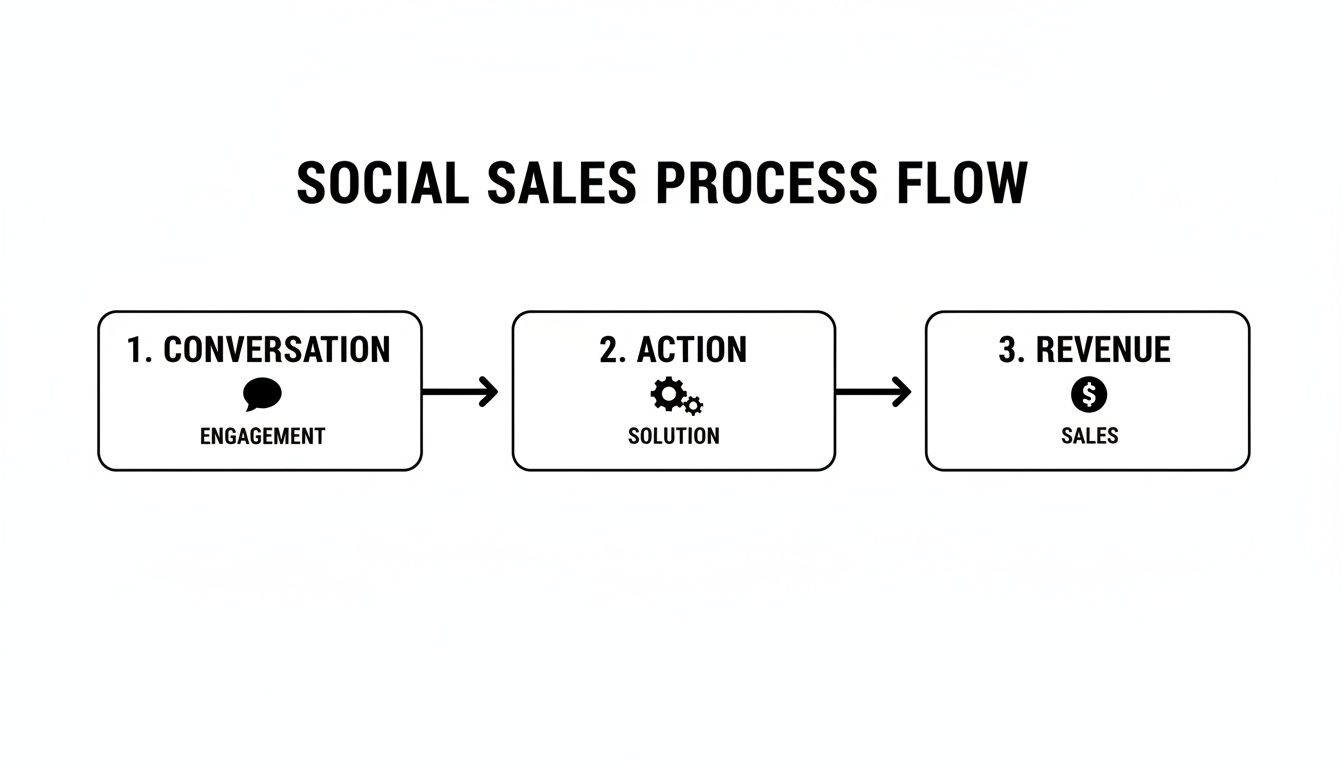
This visual makes it crystal clear: you start with engagement, move to a solution, and end with a sale. It’s the perfect way to show the ROI of what you're doing.
Focus your reporting on the metrics that leadership actually cares about. This is where you need to build your dashboard.
Key Metrics to Track in Your Listening Dashboard
Every e-commerce brand's dashboard will be a little different, but there are a few core metrics that are almost always essential for showing the impact of your listening efforts.
Metric | What It Measures | Why It Matters for E-commerce |
|---|---|---|
Leads Generated | The number of sales opportunities identified and qualified through social listening. | Directly links listening activity to revenue. This is your primary ROI metric. |
Response & Resolution Time | How quickly your team responds to and resolves issues found on social media. | Faster resolution leads to higher customer satisfaction and reduces churn. |
Sentiment Trend | The overall positive, negative, or neutral perception of your brand over time. | A leading indicator of brand health and the effectiveness of marketing campaigns. |
Share of Voice (SOV) | Your brand's percentage of the total conversation compared to competitors. | Shows your market presence and brand awareness within your industry. |
Engagement Rate | The rate at which users interact with your brand's proactive engagement efforts. | Measures how well your team's outreach is resonating with the audience. |
Cost Per Resolution | The average cost to resolve a customer issue identified through social listening. | Helps prove that social support can be more cost-effective than traditional channels. |
Tracking these metrics gives you a powerful story to tell.
Regularly share these findings with stakeholders across the company—from marketing and sales to product and the C-suite. This doesn't just prove ROI; it starts to weave social intelligence into the very fabric of how your entire organization makes decisions.
How AI Amplifies Your Listening Capabilities
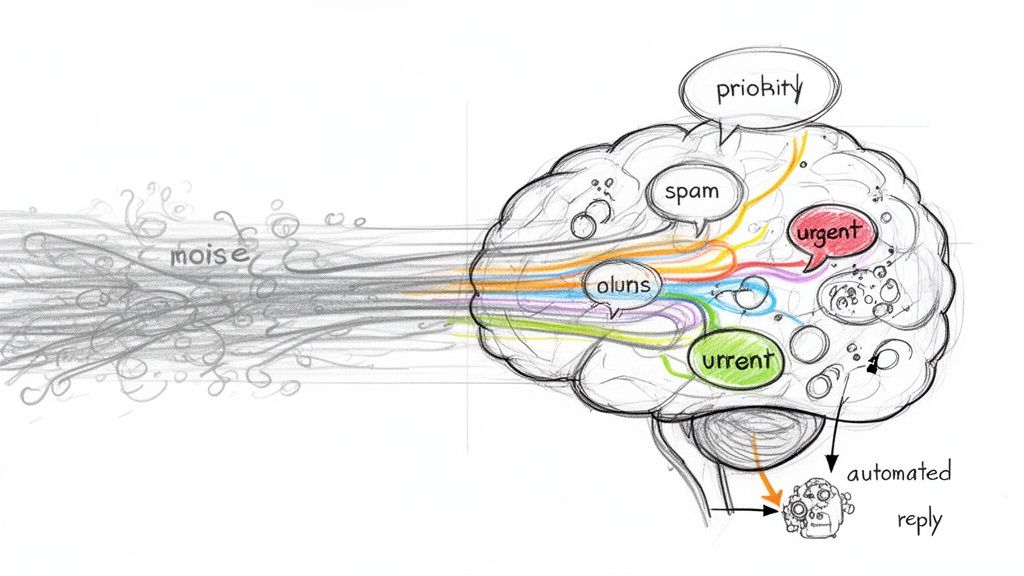
Let's be honest: trying to manually keep up with social media conversations is a losing battle. The sheer volume of comments, mentions, and DMs makes it impossible for even the best human teams to catch everything.
This is where AI changes the game. It doesn't just make the job easier; it transforms an overwhelming firehose of data into a strategic advantage. Think of it as an intelligent filter—a superhuman assistant who never sleeps, dedicated to spotting your next customer and protecting your brand's reputation.
Automating the Heavy Lifting
The first thing you'll notice when you bring in AI is how much cleaner your social feeds become. AI-powered tools instantly identify and hide spam, troll comments, and other junk, creating a safer, more positive space for your community. This alone frees up your team from the soul-crushing task of manual moderation.
But that's just scratching the surface. AI is the engine that drives modern social listening, handling complex work at a scale humans simply can't match.
Here’s how AI gives your team superpowers:
Intelligent Noise Filtration: It automatically weeds out irrelevant mentions, bot activity, and spam, so your team only spends time on conversations with real people.
Real-Time Opportunity Surfacing: AI instantly flags the messages that matter most—from an urgent customer complaint on a post to a high-intent sales question buried in your ad comments.
Automated Response Generation: The best AI can draft personalized replies in your brand’s voice, dramatically cutting down response times while keeping everything on-brand.
AI isn't here to replace your team. It’s here to empower them. By taking over the repetitive, time-sucking tasks, it gives your people the space to focus on what they do best: building relationships, solving complex problems, and driving sales.
Understanding Nuance with Advanced NLP
One of the most critical roles AI plays in social listening comes down to Natural Language Processing (NLP). This is the tech that allows a machine to grasp the subtleties of human language—things like context, emotion, and even sarcasm.
Think about the difference between someone commenting, "That price is insane!" versus "This new feature is insane!" A person immediately knows one is negative and the other is positive. NLP is what teaches an AI to make that same call, ensuring your sentiment analysis is actually accurate.
This is huge for categorizing conversations correctly. It means your listening tool can tell the difference between a genuine sales question and a sarcastic remark, sending each one to the right person for the right action. Getting user intent right is everything.
Fueling a Multi-Billion Dollar Market
The hunger for these advanced listening tools is pushing massive growth in the market. While you might associate this tech with big media companies, the same principles are gold for e-commerce brands on Instagram and Facebook—which is exactly where platforms like Meet Alto AI shine.
In 2024, the global social media listening market in media and entertainment alone hit USD 1.5 million and is on track to double by 2030, thanks to a powerful 13.1% CAGR. This explosion is a direct response to brands trying to manage interactions from nearly 5.42 billion social media users. When you consider the 138.9 million Reels being watched every single minute on Meta's platforms, you realize only AI can handle that kind of volume.
Want to dive deeper into the numbers? Check out the full social media listening market analysis.
The Future of Brand Engagement
Ultimately, bringing AI into your workflow turns social listening from a passive monitoring task into a proactive engagement engine. It helps you get out in front of a crisis, jump on sales opportunities the second they appear, and maintain a consistent brand voice everywhere.
By automating the grunt work, AI lets you scale your engagement without having to scale your team. For any brand serious about its online presence, these tools are no longer a "nice-to-have." They're essential.
To see how this technology fits into your wider strategy, take a look at our guide on integrating AI for social media management. It's the key to unlocking what social listening was always meant to be: hearing every important conversation and acting on it with speed and precision.
Got Questions? We’ve Got Answers.
Even with the best strategy in place, jumping into social media listening brings up a few practical questions. Let's tackle the most common ones we hear from e-commerce brands, social media managers, and media buyers.
How Much Should I Budget for Social Media Listening?
This is a classic "it depends" question, but the best way to think about it is as an investment, not a cost. Your budget really hinges on the scale of your brand, how many mentions you need to track, and what features you absolutely need.
For smaller brands or those just dipping their toes in, you can find basic plans for under $100 a month. These usually cover keyword tracking and some simple sentiment analysis. As you grow, mid-tier tools with stronger analytics and team features typically fall in the $200 to $800 per month range.
Enterprise-level platforms—the kind with advanced AI, crisis management, and deep competitive insights—can easily run into the thousands. The trick is to match the tool's horsepower (and price tag) to the goals you've set.
Pro Tip: Don't just stare at the monthly fee. Think about the potential ROI. If a tool helps you snag just a handful of high-intent customers or sidesteps one PR headache a month, it often pays for itself, and then some.
How Can I Measure the ROI of Social Media Listening?
Measuring the return on your listening efforts is how you prove its value and keep the budget coming. You need to connect your listening activities to tangible business outcomes—"brand awareness" is too fuzzy.
Here’s how you can tie it to real numbers:
Lead Generation: Track how many sales opportunities you spot in comments and DMs. Assign a value to each lead and see how many convert. Simple as that.
Customer Support Savings: Are you solving problems on social before they turn into support tickets? Measure the drop in ticket volume or calls. You can even calculate the cost-per-resolution on social versus your helpdesk to show direct savings.
Ad Campaign Efficiency: If you're a media buyer, this one's for you. Track the lift in conversion rates or ROAS when you engage with high-intent commenters on your ads. This is a direct line from listening to ad performance.
Brand Sentiment Lift: This one's a bit softer, but still powerful. Track the percentage increase in positive sentiment over a quarter. A 10% lift isn't just a vanity metric; it’s a strong signal of brand health that often correlates with loyalty and sales.
What Is the Best Way to Handle Negative Feedback?
Seeing negative comments can be tough, but ignoring them is not an option. This is your moment to turn a frustrated customer into a loyal fan and show everyone else watching that you actually care.
Keep it simple with this three-step playbook:
Acknowledge Promptly and Publicly: Jump on that negative comment right where it was posted. A quick, "We're really sorry you had this experience," goes a long way in validating their frustration.
Move to a Private Channel: After that first public reply, offer to sort it out in DMs or over email. This shows you're taking it seriously while moving the nitty-gritty details out of the public spotlight.
Address the Root Cause: Use that feedback! If you see a pattern—like multiple people complaining about slow shipping—it's time to flag it for the right team. This is how listening helps you fix the actual problem.
Research shows that 36% of U.S. customers point to "great customer service" as a top reason they recommend a brand. How you handle one complaint can win over dozens of potential buyers.
Can Social Media Listening Find Sales Leads?
Absolutely. In fact, it's one of the most direct ways for e-commerce brands to drive revenue from listening. By tracking keywords that signal buying intent, you can pop into conversations right when someone is ready to pull out their wallet.
Just keep an eye out for phrases like:
"Where can I buy this?"
"How much is it?"
"Do you ship to [location]?"
"I need one of these!"
Someone complaining about one of your competitors.
When your tool flags these comments, your team can swoop in with a helpful answer and a direct link to the product. You're not just waiting for clicks anymore; you're actively turning curious followers into paying customers.
Ready to turn your comments into customers and protect your brand 24/7? Meet Alto AI centralizes your Instagram and Facebook conversations, filters out the noise, and uses smart AI to surface sales leads and automate on-brand replies. Stop missing opportunities and start driving revenue. Learn more and get started with Meet Alto AI today.