Best Time to Post on Instagram: 2025 Data-Driven Guide
Discover the powerful features that will transform how your team collaborates and manages projects.

Alto AI
on
Jan 19, 2026
In 2026, the battle for e-commerce dominance isn't just about ads or landing pages; it's won and lost in the DMs and comment sections. For social-first brands, customer service is no longer a reactive cost center but the primary engine for growth, reputation, and direct revenue. While many teams remain stuck in a cycle of slow, manual replies and missed opportunities, high-growth brands are deploying an entirely new playbook. This strategic approach transforms customer interactions from a daily chore into a powerful competitive advantage.
This guide moves beyond generic advice to provide a concrete, actionable framework for building a high-performance social customer service operation. We will explore 10 essential best practices that turn chaotic inboxes into predictable conversion funnels, protect your brand's reputation 24/7, and unlock the true return on investment of your social media presence. These strategies are specifically designed for teams managing high volumes of interactions on platforms like Instagram and Facebook, where every comment is a potential lead and every DM is a sales conversation waiting to happen.
Inside, you will find detailed instructions for implementing systems that deliver a superior customer experience at scale. We will cover everything from omnichannel inbox management and AI-powered personalization to proactive issue resolution and converting casual comments into sales. Each section provides a clear roadmap, ensuring you have the tools to implement a truly effective best practice for customer service. Get ready to transform your customer support from a defensive necessity into your most valuable offensive asset.
1. Omnichannel Inbox Management
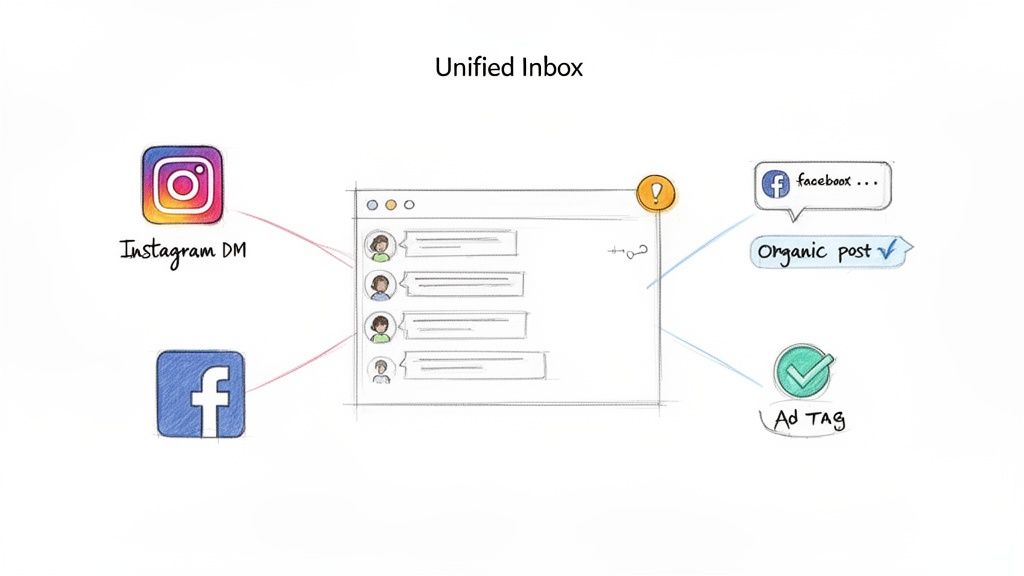
For social-first e-commerce brands, customer conversations happen everywhere at once: Instagram DMs, Facebook comments, organic posts, and paid ads. A crucial best practice for customer service is to stop managing these channels in silos. Omnichannel inbox management centralizes every customer interaction from multiple social platforms into a single, unified dashboard. This approach eliminates the need for your team to constantly switch between apps, preventing missed messages and ensuring a consistent brand voice.
It allows your team to see the full context of a customer's journey, whether they first commented on an ad and later sent a DM. By unifying these touchpoints, you streamline your workflow, drastically reduce response times, and ensure no potential lead or critical customer issue falls through the cracks. This consolidated view is foundational for scaling support and sales operations on social media.
Why It's a Top-Tier Practice
This strategy is particularly vital for teams running multiple ad campaigns or managing several client accounts. For example, direct-to-consumer brands use tools like Alto AI to capture and qualify leads from both organic content and paid ads simultaneously without losing context. Similarly, digital agencies can efficiently handle dozens of client Instagram accounts from one dashboard, maintaining service level agreements (SLAs) without needing a proportionally larger team.
Actionable Implementation Tips
To get the most out of your unified inbox, start by implementing smart workflows.
Filter and Tag: Set up custom filters and tags (e.g., "high-intent lead," "shipping issue," "refund request") to automatically sort and prioritize incoming messages.
Automate Routing: Create team rules to route conversations to the right person based on priority or topic, ensuring specialists handle relevant inquiries.
Analyze Sentiment: Use built-in sentiment analysis to flag messages from upset or frustrated customers, allowing your team to intervene immediately and turn a negative experience around.
By implementing these strategies, you can transform a chaotic stream of notifications into an organized and efficient customer engagement engine. To dive deeper into this topic, you can learn more about effective social media inbox management strategies and see how it can directly impact your team's performance.
2. AI-Powered Personalized Responses & Brand Voice Consistency
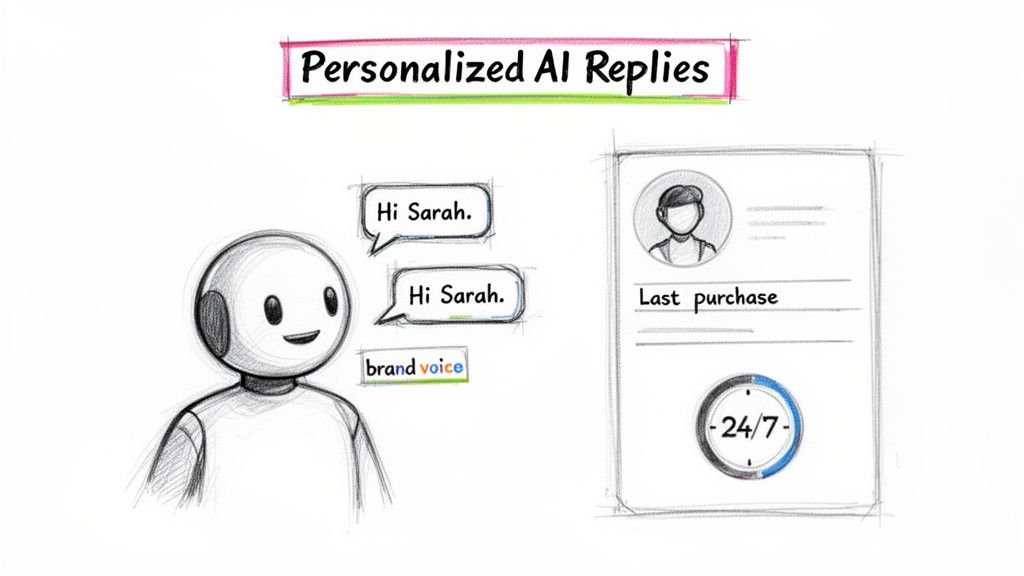
Automation is no longer synonymous with robotic, impersonal interactions. A core best practice for customer service today involves leveraging AI to deliver personalized, context-aware responses that maintain your unique brand voice 24/7. This technology taps into customer data like purchase history and past interactions to craft replies that feel authentic and human, not canned. It’s about scaling genuine engagement, not just replies.
This allows your team to automate answers to high-frequency questions, such as "Do you ship to Canada?" or "What's your return policy?" with responses that are not only accurate but also aligned with your brand’s personality. For example, a DTC fitness brand can answer product questions with a motivational tone, while a luxury fashion brand can maintain an air of exclusivity. This approach frees up human agents to handle complex, sensitive, or high-value conversations.
Why It's a Top-Tier Practice
This strategy is a game-changer for brands running high-volume paid social campaigns where a large percentage of comments are predictable inquiries. Instead of manually typing the same answer hundreds of times, AI can handle the initial triage, qualifying leads and resolving issues instantly. For examples of tools that leverage AI for personalized customer interactions and maintaining brand voice, you might explore platforms like supportGPT's AI solutions. They empower teams to automate effectively without losing the personal touch that builds customer loyalty.
Actionable Implementation Tips
To effectively integrate AI while preserving brand integrity, focus on a structured rollout.
Define AI Personas: Create 3-5 distinct AI personality profiles that align with your brand voice (e.g., "Helpful & Professional," "Enthusiastic & Friendly," "Witty & Sassy").
Set Escalation Triggers: Establish clear rules for when a conversation should be handed off to a human agent. Flag keywords related to sensitive topics like billing errors, severe product defects, or public complaints.
Start with Basic Personalization: Begin by training the AI to use simple variables like the customer's first name or referencing their most recent purchase to make interactions feel more individual.
Review and Refine: Regularly audit the AI's responses and provide feedback to improve its accuracy, tone, and overall performance.
By implementing AI thoughtfully, you can provide instant, personalized support at scale, ensuring every customer feels heard and valued. To master this balance, it's also crucial to understand how to handle different types of customer feedback, including the negative ones. You can get more insights on developing a robust strategy for responding to customer feedback and see how it fits into a larger engagement plan.
3. Smart Lead Scoring and Sentiment Analysis
For brands operating at scale on social media, not all customer messages carry the same weight. A critical best practice for customer service is to move beyond a "first come, first served" model by automatically categorizing conversations based on their value. Smart lead scoring and sentiment analysis assign a priority level to each incoming message, ensuring high-intent, high-value interactions are handled immediately. This system automatically flags purchase inquiries as hot leads while deprioritizing spam or low-intent comments.
This approach transforms your inbox from a chronological list into a strategic queue, empowering your team to focus their energy where it drives the most revenue. By identifying sentiment, you can also proactively engage frustrated customers before a situation escalates. This ensures your most valuable opportunities, whether for sales or service recovery, receive the fastest response.
Why It's a Top-Tier Practice
This strategy is indispensable for maximizing return on ad spend (ROAS) and team efficiency. For example, e-commerce brands use this to instantly flag comments like "How much is this?" or "Do you ship to Canada?" on their ads as high-priority sales opportunities. Similarly, a digital agency can track which client campaigns are generating the highest quality leads by analyzing the scores of incoming messages, providing clear data on campaign performance.
Actionable Implementation Tips
To effectively implement lead scoring and sentiment analysis, focus on defining clear criteria.
Define Scoring Rules: Establish clear criteria based on your sales funnel. Assign higher scores to messages containing keywords like "buy," "price," or "order," and lower scores to general inquiries.
Create Urgency Workflows: Set up automated alerts and assignments for high-scoring leads. When a message is flagged as a "hot lead," route it directly to your top sales agent for immediate follow-up.
Use Sentiment Tags: Automatically tag messages as "positive," "negative," or "neutral." This allows your support team to quickly identify and address upset customers, turning a potentially negative review into a positive resolution.
Calibrate and Refine: Regularly review your scoring rules against actual conversion data. If certain keywords consistently lead to sales, increase their score. This ensures your system remains accurate and effective over time.
4. Content Moderation and Spam/Troll Filtering
In the fast-paced world of social media, protecting your brand's community is as important as engaging with it. A critical best practice for customer service is implementing robust content moderation and spam/troll filtering. This involves automatically detecting and managing harmful, off-topic, or spammy content like profanity, scams, and coordinated abuse across your organic posts and paid ads. This strategy protects your brand reputation and ensures a safe, positive environment for your audience.
By combining rule-based systems with modern AI, you can filter out negativity before it harms your community or derails productive conversations. This proactive approach significantly reduces the manual burden on your team, allowing them to focus on genuine customer interactions rather than constantly deleting malicious comments. It’s about creating a healthy digital space where your customers feel comfortable engaging with your brand and each other.
Why It's a Top-Tier Practice
This practice is non-negotiable for brands running high-volume ad campaigns where comment sections can quickly become toxic. For instance, a beauty brand can automatically hide comments containing body-shaming language on its ads, protecting both its brand image and its audience. Similarly, a financial services firm can block comments that promote scams or phishing links, safeguarding its customers from fraud. This level of control is essential for maintaining brand integrity and ensuring a positive return on ad spend.
Actionable Implementation Tips
To effectively moderate your social channels, you need a balanced and transparent approach.
Define Clear Policies: Create an internal guide that clearly defines what constitutes spam, harassment, or off-topic content for your specific brand and industry.
Create Separate Rules: Tailor your moderation rules differently for organic content versus paid ads. Ads often attract a wider, less-vetted audience and may require stricter filtering.
Review and Refine: Schedule weekly reviews of filtered content to identify false positives. Legitimate customer feedback or criticism can sometimes be caught by overly aggressive filters.
Train for Edge Cases: Equip your team to handle nuanced situations that AI might misinterpret. Human oversight is crucial for understanding context and making fair judgment calls.
By implementing a smart moderation strategy, you build a resilient and welcoming online community, which is a cornerstone of exceptional customer service. You can explore moderation tools like Alto AI to see how automated systems can be customized to fit your brand's unique needs.
5. Real-Time Team Collaboration and Message Assignment
As e-commerce teams grow, managing customer conversations in a shared inbox can quickly become chaotic, leading to duplicate replies or missed messages. A vital best practice for customer service is implementing real-time collaboration with clear message assignment. This system provides transparent ownership, assignment workflows, and status tracking, allowing multiple team members to work simultaneously without stepping on each other's toes.
This approach transforms your inbox from a free-for-all into an organized command center. When a new message arrives, it can be manually assigned or automatically routed to the right person or department. This ensures accountability, prevents customer issues from being ignored, and facilitates seamless handoffs, such as escalating a technical problem from a general support agent to a specialist.
Why It's a Top-Tier Practice
This strategy is indispensable for remote teams coordinating across different timezones or for businesses with specialized departments. For example, a multi-location DTC brand can route a comment about a specific store directly to that store’s manager. Similarly, e-commerce support teams use platforms like Alto AI or Zendesk to assign complex shipping inquiries to logistics experts while sales-related DMs go to the sales team, ensuring customers always interact with the most qualified agent.
Actionable Implementation Tips
To effectively implement team collaboration, focus on building a clear operational framework.
Establish Clear Routing Logic: Create rules upfront to automatically assign messages based on keywords (e.g., "refund," "broken"), customer history, or social channel.
Use Internal Notes for Context: Leave private notes on conversations to provide context for teammates during handoffs without the customer seeing the internal discussion.
Implement Status Workflows: Define and use statuses like "New," "Assigned," "In Progress," and "Resolved" to track the lifecycle of every conversation and ensure nothing is forgotten.
Monitor Team Capacity: Use dashboards to view agent workloads, reassigning conversations as needed to balance responsibilities and prevent burnout.
By structuring team collaboration, you eliminate confusion and empower your team to resolve customer issues faster and more effectively. This systematic approach is key to maintaining high-quality support as your brand scales.
6. Proactive Customer Service and Issue Resolution Before Escalation
The most effective customer support resolves problems before the customer has a chance to complain. A critical best practice for customer service is to shift from a reactive to a proactive model, where your team identifies and addresses issues before they escalate. This involves actively monitoring customer sentiment, spotting patterns of frustration, and reaching out with a solution, often before the customer even thinks to contact you.
This approach is especially powerful on social media, where a single negative comment about a shipping delay or product issue can quickly go viral. By preemptively contacting a customer who posted an ambiguous comment like "Still waiting for my order..." with a direct update and a solution, you not only prevent a public complaint but also create a memorable "wow" moment. This transforms a potential detractor into a loyal advocate, demonstrating that your brand is truly paying attention.
Why It's a Top-Tier Practice
Proactive service is a game-changer for brands focused on customer lifetime value. For instance, an e-commerce store can use order data to identify all customers affected by a known carrier delay and send a personalized DM with an apology and a discount code before a wave of "Where is my order?" comments hits their ads. Similarly, SaaS companies can monitor user activity to spot signs of friction, like repeated failed actions, and offer targeted guidance to prevent churn. This strategy directly reduces support ticket volume and protects your brand's public reputation.
Actionable Implementation Tips
To build a proactive support engine, you need to turn monitoring into action.
Set Up Sentiment Alerts: Use tools to automatically flag negative keywords, emojis, or shifts in comment tone, allowing your team to investigate and intervene immediately.
Monitor Comment Velocity: A sudden spike in comments on a specific post or ad often signals a widespread emerging issue. Investigate these spikes immediately to get ahead of the problem.
Train for Indirect Cues: Coach your team to recognize subtle signs of frustration. A comment like "It finally arrived!" might indicate a shipping delay that warrants a follow-up to check on their experience.
Offer Solutions, Not Just Apologies: When reaching out, always lead with a tangible solution. Instead of just saying, "We're sorry for the delay," say, "We noticed your order is delayed and have already issued a 10% refund for the inconvenience."
7. Performance Analytics and Data-Driven Optimization
You can't improve what you don't measure. A fundamental best practice for customer service is to move beyond guesswork and implement a system of performance analytics. This means tracking key metrics like first response time, resolution rate, customer satisfaction (CSAT), and even lead quality from social interactions. By collecting and analyzing this data, you transform your customer service from a reactive cost center into a proactive, data-driven revenue engine.
This approach allows you to pinpoint bottlenecks, identify top-performing team members, and understand which strategies are actually working. For example, by tracking which ad comments convert fastest into sales, media buyers can optimize their creative and targeting. Similarly, support teams can identify which canned responses lead to the highest satisfaction scores and refine their templates accordingly. Data provides the objective truth needed to continuously improve processes, training, and tools for a high-performing team.
Why It's a Top-Tier Practice
Data-driven optimization is crucial for scaling teams and proving ROI. A social media agency, for instance, can use response time metrics to show clients tangible improvements after implementing a new tool like Alto AI. E-commerce brands can directly correlate faster lead capture from DMs to an increase in ROAS, justifying further investment in their social engagement team. It shifts the conversation from "we feel busy" to "we generated X% more qualified leads this month with an average response time of Y minutes."
Actionable Implementation Tips
To leverage analytics effectively, focus on a few key metrics and build from there.
Define Key Metrics: Start by defining 3-5 core metrics that align directly with your business goals (e.g., Lead Conversion Rate from DMs, Average Response Time, Customer Satisfaction Score).
Create Dashboards: Build simple, visual dashboards for different audiences. Executives might want a high-level overview of revenue from social, while team managers need to see individual agent performance.
Track Quality and Volume: Don't just optimize for speed. Track both quantitative metrics (response time, messages handled) and qualitative ones (resolution rate, CSAT) to ensure quality doesn't suffer.
A/B Test Responses: Systematically test different opening lines, offers, or troubleshooting steps in your DMs. Measure the impact on conversion or satisfaction before rolling out changes to the entire team.
8. Multi-Channel Consistency and Brand Voice Training
Whether a customer interacts with your brand via an Instagram DM, a Facebook ad comment, or a live chat widget, the experience should feel seamless and cohesive. A core best practice for customer service is establishing and training your team on a consistent brand voice across all channels. This ensures that every communication, whether from a human agent or an automated system, reflects your brand’s personality, values, and messaging.
This practice prevents disjointed or contradictory customer experiences, which can erode trust and create confusion. When your voice is consistent, customers feel they are interacting with a unified entity, not a collection of disconnected departments. This builds a stronger brand identity and fosters deeper customer loyalty. Achieving this level of harmony requires adhering to fundamental client communication best practices that govern tone and messaging.
Why It's a Top-Tier Practice
This strategy is non-negotiable for brands that want to build a memorable identity. For instance, a luxury brand must maintain a premium, sophisticated tone in every interaction to uphold its image, while a startup like Dollar Shave Club uses a consistently irreverent and witty voice to connect with its target audience. This consistency ensures that the brand promise made in marketing is delivered in every support interaction, reinforcing brand equity at every touchpoint.
Actionable Implementation Tips
To build a consistent voice, you need to document and train your team systematically.
Create a Brand Voice Playbook: Document your tone with clear examples (e.g., "Friendly but not casual," "Witty but not sarcastic"). Include sample responses for common scenarios like shipping inquiries or negative feedback.
Train on Values, Not Just Words: Ensure your team understands the "why" behind your brand's values, so they can embody the voice authentically rather than just reciting scripts.
Establish QA and Review Processes: Regularly review customer conversations to provide feedback and ensure alignment with brand voice guidelines. Use these examples in ongoing training sessions.
Use Templates with Guardrails: Develop response templates that provide a solid foundation but allow agents to inject personality within the defined brand voice, preventing robotic replies.
9. Conversion Optimization and Lead Nurturing Through Social Comments
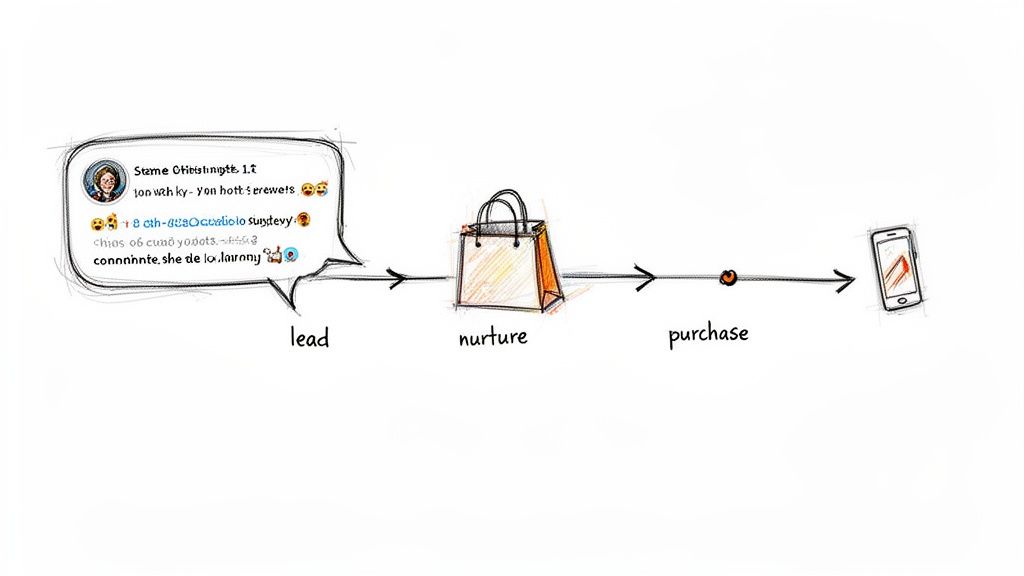
For social-first brands, comments and DMs are not just support tickets; they are high-intent sales opportunities. A transformative best practice for customer service is to shift from a purely reactive support mindset to a proactive sales-oriented one. This involves treating every relevant social interaction as a potential lead, identifying buying signals, and guiding the conversation toward a conversion.
This approach transforms your comment section from a simple engagement metric into a powerful sales funnel. Instead of just answering questions, your team actively nurtures interest, addresses purchase barriers, and creates a seamless path from comment to checkout. For e-commerce brands and media buyers, this directly links social media engagement to revenue, maximizing the return on ad spend and content creation efforts.
Why It's a Top-Tier Practice
This strategy is particularly effective for direct-to-consumer brands and info product creators. For example, a DTC brand can immediately convert a comment like "Does this come in blue?" into a sale by responding with a direct link to the blue variant and a limited-time discount code. Similarly, an agency can measure the conversion rate from ad comments for a client, providing clear data on which creative drives the most valuable interactions, not just likes or shares.
Actionable Implementation Tips
To turn your comments into a conversion engine, you need a clear framework.
Identify Buying Signals: Train your team to distinguish high-intent comments (e.g., asking about price, sizing, or availability) from general engagement.
Create Conversion Workflows: Develop specific response templates that answer the question while also encouraging the next step, like visiting a product page or entering a DM conversation.
Offer Exclusive Incentives: Use comment-based offers, such as a special discount code or early access, to motivate immediate action and make followers feel valued.
Track the Journey: Implement tools that connect social comments to your CRM or sales platform, allowing you to track the full customer journey from initial interaction to final purchase.
By systematically nurturing leads directly within your social channels, you can open up a significant and often overlooked revenue stream. You can dive deeper and learn more about effective Instagram comment automation to see how this can directly impact your sales performance.
10. Privacy, Compliance, and Ethical Customer Data Management
In the age of social commerce, customer trust is your most valuable asset. A foundational best practice for customer service is handling personal data with the utmost care, ensuring strict compliance with regulations like GDPR, CCPA, and Meta's platform policies. This involves more than just a privacy policy link; it means embedding ethical data management into every customer interaction, from comment replies to DM automation.
This practice requires a proactive approach to consent, security, and transparency. Customers must explicitly agree to receive marketing communications, understand how their information is used, and have easy ways to opt out or request data deletion. When you automate a response to a comment, for example, you are collecting and using data. Managing this process ethically and legally is non-negotiable for building long-term customer relationships and avoiding significant legal penalties.
Why It's a Top-Tier Practice
This practice is essential for any brand operating across different regions or using automation tools. For instance, a European e-commerce brand must implement GDPR-compliant consent flows before capturing an email from a social media comment. Similarly, Canadian businesses must adhere to CASL regulations for electronic messages. Platforms like Alto AI are built with these privacy controls in mind, allowing teams to create compliant automation workflows that respect user consent from the very first touchpoint.
Actionable Implementation Tips
To build a privacy-first customer service operation, focus on transparent and user-centric processes.
Implement Clear Consent Flows: Before sending automated DMs or adding users to a marketing list, always obtain explicit consent. Use clear language like, "Reply YES to get your discount code and join our list."
Create Easy Opt-Outs: Include a simple and clear opt-out mechanism (e.g., "Reply STOP to unsubscribe") in all automated communication sequences. Ensure this process is frictionless.
Train Your Team: Educate your entire customer-facing team on key privacy principles and the specific regulations relevant to your customer base (GDPR, CCPA, etc.). This ensures everyone handles data responsibly.
Audit Your Tools: Regularly review the privacy and compliance features of your customer service tools. Ensure they support data deletion requests and have robust security measures to protect customer information.
10-Point Customer Service Best Practices Comparison
Item | Implementation complexity | Resource requirements | Expected outcomes | Ideal use cases | Key advantages |
|---|---|---|---|---|---|
Omnichannel Inbox Management | Medium — integrations + setup | Unified inbox platform, training, integrations | Reduced response time; fewer missed messages | Social-first DTC, agencies with many accounts | Centralized context; consistent responses |
AI-Powered Personalized Responses & Brand Voice Consistency | High — AI training & tuning | AI models, customer data, monitoring staff | Instant, personalized replies; scalable coverage | High-volume campaigns; 24/7 support needs | Scales service; maintains brand tone |
Smart Lead Scoring and Sentiment Analysis | Medium — model calibration needed | Scoring rules, labeled data, CRM sync | Prioritized high-value conversations; better conversion | Media buyers, sales-driven social campaigns | Focuses reps on best opportunities |
Content Moderation and Spam/Troll Filtering | Medium — rules + ML tuning | Moderation rules, ML models, reviewer workflow | Less toxic feed; reduced manual review | Brands exposed to spam/trolls or high visibility | Protects reputation; reduces noise |
Real-Time Team Collaboration and Message Assignment | Low–Medium — process design | Assignment workflows, activity logs, training | Clear ownership; fewer duplicate replies | Multi-agent support teams; agencies | Improves accountability and throughput |
Proactive Customer Service and Issue Resolution Before Escalation | High — monitoring + workflows | Sentiment tools, alerting, outreach templates | Fewer public complaints; lower churn risk | Brands tracking sentiment spikes or delays | Prevents escalation; improves loyalty |
Performance Analytics and Data-Driven Optimization | Medium — dashboards & KPIs | Analytics platform, reporting, analyst time | Measurable improvements; better resource allocation | Teams aiming to optimize ROI and SLAs | Informs decisions; tracks ROI and quality |
Multi-Channel Consistency and Brand Voice Training | Medium — documentation + QA | Style guides, training, QA processes | Consistent customer experience across channels | Brands prioritizing distinct voice and scale | Cohesive brand identity; faster onboarding |
Conversion Optimization and Lead Nurturing Through Social Comments | Medium — tracking + sales workflows | CRM integration, offers, nurture sequences | Higher ROAS; more comment-to-sale conversions | DTC, ad-driven campaigns, media buyers | Turns service into revenue; captures hot leads |
Privacy, Compliance, and Ethical Customer Data Management | High — legal and technical controls | Consent systems, encryption, audits, training | Reduced legal risk; maintained customer trust | Multi-jurisdictional brands, regulated industries | Ensures regulatory compliance and trust |
From Chaos to Conversion: Activating Your Social Commerce Engine
The journey through the ten pillars of modern social customer service reveals a powerful truth: the line between support and sales has effectively disappeared. We've moved beyond simply answering questions. The new frontier is about building relationships, fostering loyalty, and driving revenue directly within the social platforms where your customers live and breathe. Adopting even a few of these strategies will spark a fundamental shift in your operations, transforming your social media presence from a reactive cost center into a proactive, high-performance growth engine.
The core principle underpinning every best practice for customer service we've discussed is intentionality. It's about consciously designing a system instead of letting chaos dictate your workflow. By unifying your inboxes, you stop context-switching and start seeing the full customer journey. By leveraging AI for initial responses and sentiment analysis, you free your human team to focus on the high-value, complex conversations that truly build brand affinity and close sales.
Bridging Theory and Actionable Strategy
Mastering these concepts is no longer a luxury reserved for enterprise-level brands; it is a critical competitive advantage for social-first e-commerce teams. The value extends far beyond simply keeping customers happy. It directly impacts your bottom line and brand equity.
Enhanced Brand Reputation: Proactive engagement and efficient troll filtering create a positive, safe community space that attracts and retains high-quality followers.
Increased Conversion Rates: Treating every comment and DM as a potential lead, and having a system to nurture it, turns your comment section into a predictable sales funnel.
Improved ROAS: When your team can effectively convert interest generated by ads into sales directly in the DMs, the return on your ad spend skyrockets.
Greater Team Efficiency: Clear workflows, smart automation, and real-time collaboration eliminate wasted effort, reduce burnout, and allow your team to handle a greater volume of interactions with less stress.
The ultimate takeaway is this: stop viewing your comments and DMs as a chore to be managed and start seeing them as the valuable, real-time signals they are. They are direct lines to your customers' needs, objections, and buying intent. Every interaction is an opportunity to reinforce your brand voice, solve a problem, or guide a potential customer toward a purchase.
Your Next Steps: From Insight to Implementation
To put this guide into action, don't try to boil the ocean. Start with a simple audit. Review your current social customer service process against the ten best practices outlined in this article. Identify the one or two areas that represent the biggest friction points or the most significant opportunities for your team.
Perhaps you're struggling with response times; focus on implementing an omnichannel inbox and setting clear SLAs. Maybe your team is overwhelmed by spam; prioritize a robust content moderation and filtering strategy. By choosing a specific area to improve, you can create a tangible win that builds momentum for broader change. The future of commerce is conversational, and it belongs to the brands that master the art of building relationships at scale, one comment and one DM at a time. The result will be a stronger brand, a more efficient team, and a healthier, more predictable revenue stream.
Ready to transform your social media from a chaotic support channel into an automated sales engine? Meet Alto AI provides the unified inbox, AI-powered automations, and team collaboration tools designed to implement every best practice for customer service discussed here. See how Meet Alto AI can help you convert more conversations into customers.