Best Time to Post on Instagram: 2025 Data-Driven Guide
Discover the powerful features that will transform how your team collaborates and manages projects.

Alto AI
on
Jan 18, 2026
Social media lead generation is all about turning casual interactions on platforms like Instagram and Facebook into real sales conversations. Forget just chasing likes—this is how you build a reliable pipeline of high-intent prospects for your business.
Your Untapped Goldmine for High-Intent Leads

Let's be honest, trying to manage social media comments and DMs feels like drinking from a firehose. It’s a chaotic mix of spam, genuine questions, and everything in between. But what if that chaos is actually your most valuable, untapped source of leads?
This guide will show you how to reframe that thinking. We’re moving beyond vanity metrics to see every comment as a sales opportunity just waiting to be seized.
We'll get into the real-world headaches of manual inbox management—the missed opportunities, the slow replies that kill deals, and the very real risks to your brand's reputation. You'll see exactly why Instagram and Facebook are killer platforms for direct-to-consumer (DTC) brands and how a structured, automated approach can turn passive interest into active, qualified leads without losing that essential human touch.
Why Your Comments and DMs Are So Valuable
Think of your comment section and DM inbox as a 24/7 focus group. When someone drops a comment like, "How much is this?" or "Do you have this in blue?" they're doing more than just asking a question. They're signaling purchase intent.
Ignoring these signals—or worse, taking hours to reply—is like watching a customer walk out of your store with cash in hand.
The core of effective social lead gen is speed and relevance. A potential customer's interest is at its absolute peak the moment they engage. A fast, helpful response can be the single difference between a sale and a lost customer.
There's a reason social media has become a cornerstone of growth for so many businesses. In fact, 64% of marketers say lead generation is its single biggest benefit. For e-commerce and DTC brands, the numbers on Facebook and Instagram are especially compelling. The average cost per lead on Facebook Ads is a competitive $23.10, making it a more affordable channel than many alternatives. That cost efficiency, combined with massive user bases, creates some seriously powerful targeting opportunities. You can discover more insights about lead generation statistics to see the full picture.
Ultimately, this guide is a playbook. It’s designed to help you transform your social media from a simple brand-building tool into a powerful, revenue-driving machine by focusing on the right conversations at exactly the right time.
Building Your Social Lead Funnel in Meta Ads
Throwing money at Meta ads without a solid game plan is a recipe for disaster. Before you even think about launching a campaign, you need to lay the strategic groundwork for a social funnel that actually converts.
This isn't about broad demographics. Forget "women ages 25-34." It’s time to get specific and define your ideal customer based on what they actually do online.
Think more along the lines of: "women who follow these three fitness influencers, engage with sustainable fashion brands, and recently browsed a competitor's site." That's the level of detail that turns an average ad into a lead-generating machine.
This deeper understanding of your audience is what fuels the powerful targeting layers inside Meta Ads Manager. The whole point isn't just to get clicks—it's to attract people who are ready and willing to start a real conversation.
Defining Your Ideal Customer Profile
Your Ideal Customer Profile (ICP) is the absolute blueprint for your entire ad strategy. It’s a crystal-clear picture of the person who's most likely to buy what you're selling. The best way to build this is by digging into your existing customer data and asking the right questions.
Behavioral Insights: What other accounts are they following on Instagram? What Facebook groups are they active in? What kind of content—Reels, Stories, long posts—do they consistently interact with?
Pain Points and Goals: What specific problem are you solving for them? What are they ultimately trying to accomplish? Your ad copy needs to hit these motivations head-on.
Purchase Triggers: What pushes them over the edge to buy? Is it a flash sale, a new product drop, or seeing an influencer they trust rave about you?
When you have these answers, you can craft ads that feel less like ads and more like personal recommendations. That's how you stop the scroll.
A well-defined ICP is the difference between shouting into the void and having a quiet, persuasive conversation with your perfect customer. It ensures your ad spend is focused on people who are already primed to listen.
Layering Audiences in Meta Ads Manager
Got your ICP locked in? Great. Now it’s time to translate that into actual audiences within Meta Ads Manager. The platform's real power comes from its ability to layer different audience types for hyper-specific targeting. Relying on just one is a rookie mistake.
Custom Audiences are your low-hanging fruit. These are folks who already know who you are. You can build these from a few key sources:
Website Visitors: People who have checked out specific product pages or even abandoned their carts.
Customer Lists: Simply upload a list of past buyers or email subscribers.
Engagement Audiences: Target users who have watched your videos, liked your posts, or slid into your DMs.
Next up, Lookalike Audiences. This is Meta’s secret sauce for finding new people who mirror the characteristics of your best customers. You can create a Lookalike from any of your Custom Audiences. For instance, a 1% Lookalike based on your "Top 25% Lifetime Value Customers" will find users who behave almost identically to your most valuable buyers.
Finally, you have Interest and Behavior Targeting. This is where your detailed ICP research really pays off. You can target users based on the pages they like, the apps they use, their job titles, and even their recent purchase behaviors.
Let’s say a DTC brand sells high-end, sustainable coffee. They could stack their targeting like this:
Lookalike: A 1% Lookalike Audience built from their existing customer list.
Interests: Layer on interests like "Fair trade coffee," "Third wave coffee," and "Chemex."
Behaviors: Then, narrow it down even further to users Meta classifies as "Engaged Shoppers."
This multi-layered approach makes sure your ads are seen by a super-relevant group, squeezing the most value out of every dollar and setting you up for real engagement that turns into sales. For a deeper dive into privacy-first tracking, check out guides on implementing advanced server-side tagging with Meta CAPI, Google Ads, and TikTok.
Crafting Ads That Spark Conversations
The final piece of this puzzle is the ad creative itself. If your goal is to generate leads through conversations, your ads need to do more than just show off a product. They need to invite a response. You're fishing for comments, not just clicks.
Instead of a tired "Shop Now" button, try a call-to-action that encourages interaction. An ad for a new skincare product could say, "Comment 'ROUTINE' below, and we'll DM you a personalized skincare quiz!"
This small change flips the script, turning a passive viewer into an active participant. Not only does this boost the engagement metrics that Meta's algorithm loves, but it also creates a frictionless entry point into your DM sales funnel. Handling that wave of comments is key, so check out our guide on Facebook Ads comment moderation to make sure no lead ever slips through the cracks.
Creating Content That Naturally Generates Leads
Once you've got your ad funnel and targeting dialed in, it's time to create content that actually makes people want to talk to you. Generic, bland posts just won't cut it anymore. If you want to generate leads on social media, you need content specifically designed to spark conversations and pull people into your pipeline.
Forget posting pretty pictures and hoping for the best. We're talking about specific, tactical content formats that consistently drive comments and DMs on Instagram and Facebook. The whole point is to make engaging with your brand feel like a natural, valuable exchange for your audience.
The Power of Interactive Content
The easiest way to start a conversation is simply to ask a question. Interactive content is built on this very idea, giving your audience super low-friction ways to signal their interest and start a dialogue.
These formats are especially powerful in Instagram Stories, where the barrier to entry is just a single tap.
Polls and Quizzes: Instead of just showing off a product, ask your audience what they think. A coffee brand could run a poll asking, "Light roast or dark roast?" or a quiz titled, "What's Your Perfect Coffee Profile?" Every single response is a golden opportunity for a follow-up DM offering a personalized recommendation.
"Ask Me Anything" (AMA) Sessions: Host an AMA with your founder or a product expert. Get people to ask questions about your products or your industry. This doesn't just provide value; it uncovers the specific pain points of your most engaged followers, giving you a direct line into what they want to know before they buy.
"This or That" Posts: Create a simple graphic comparing two products, styles, or use cases and ask followers to comment with their pick. This dead-simple prompt is an incredibly effective way to blow up your comment count and see which products are getting the most buzz.
These methods work because they transform passive scrolling into active participation. That engagement is the fuel for our next, even more powerful strategy.
Engineering Engagement with Comment-to-DM
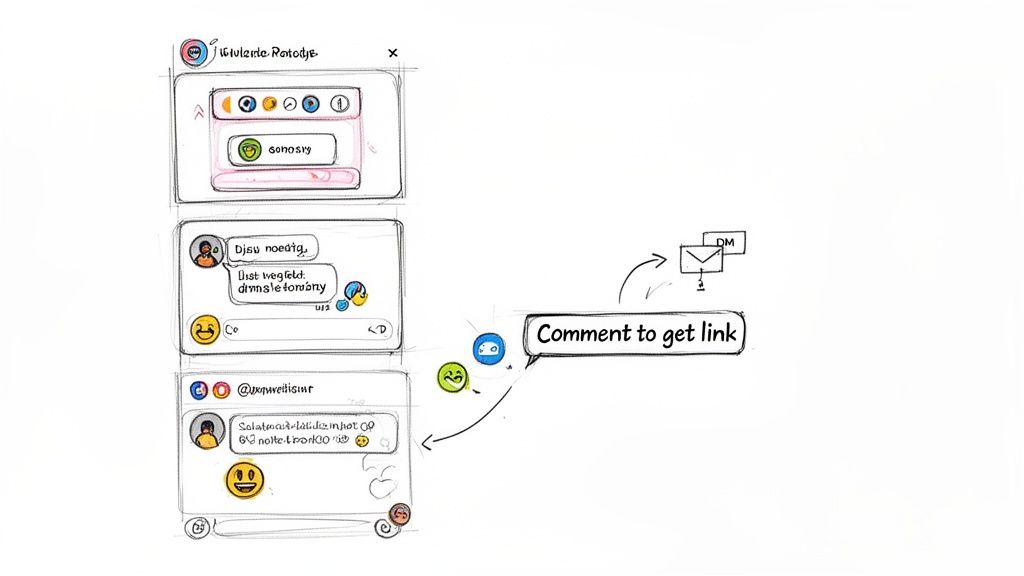
The real engine of a modern social lead gen strategy is the Comment-to-DM funnel. This is a deliberate, engineered system for turning public comments into private, one-on-one sales conversations.
The concept is simple but wildly effective. You create a compelling post with a very clear call-to-action (CTA), asking people to comment with a specific keyword. When they do, they automatically get a valuable resource—like a guide, discount code, or link—sent straight to their DMs.
This strategy is a game-changer. It meets customers where they are with immediate value, eliminating the friction of making them click a link in your bio. You capture their interest at its absolute peak and move the conversation to a private channel where you can build a real relationship.
Let’s walk through a real-world scenario for a DTC skincare brand launching a new vitamin C serum.
The Post: A high-quality Reel showing the serum's texture and application, with text overlays calling out the key benefits. The CTA: "Tired of dull skin? We formulated the ultimate glow-up serum. ✨ Comment 'GLOW' below, and we'll send our free '5-Step Morning Routine for Brighter Skin' guide straight to your DMs!"
This creates a win-win. The user gets something valuable, and the brand gets a direct line to a high-intent prospect. Even better, the public comment acts as social proof, encouraging more people to jump in. Of course, managing this flood of comments is critical, which is why understanding how to properly manage Instagram comments is a must for any team using this playbook.
This kind of conversational approach is proving to be a key tactic for improving lead quality. Research shows that interactive content can generate 2x more conversions and see 5x more pageviews than static posts. With average engagement rates hovering between 1.4% to 2.8% on these platforms, most brands are sitting on a goldmine in their comment sections. By automating intelligent responses, you can capture these leads the very moment their curiosity peaks.
How to Automate and Qualify Leads Instantly
So, you've got content that’s firing on all cylinders and sparking conversations. Awesome. Now comes the real challenge: building a machine to handle it all.
If you’ve ever had an ad campaign really take off, you know the feeling. The flood of comments and DMs can bury you in minutes. Opportunities get missed, replies lag, and all that hard-won purchase intent just evaporates. This is exactly where automation becomes your secret weapon.
And let's be clear—this isn't about replacing human connection with cold, robotic replies. It’s about using smart automation to handle the initial grunt work—the repetitive, time-sucking steps of engagement and qualification—instantly. This frees up your team to jump into the high-value conversations that actually close deals.
Unifying Your Inbox for Maximum Efficiency
First things first: you need to centralize your communications. Trying to manage notifications across the native Facebook, Instagram, and Meta Business Suite apps is a recipe for pure chaos. Leads slip through the cracks, response times crawl, and your team can't possibly stay in sync.
A unified inbox, powered by a tool like Alto AI, pulls every single comment and DM from all your organic posts and ads into one clean, manageable dashboard.
What you’re looking at is a command center that brings order to the chaos. It’s the only way to see every conversation in one place, which is the foundational step for scaling your social media lead generation without having to hire a small army of social media managers.
Crafting Your AI Personality for On-Brand Responses
The biggest fear most brands have with automation is sounding like a generic, impersonal bot. I get it. But modern AI has come a long way. The key is to create custom AI personalities trained specifically on your brand’s unique voice.
Think of it like building a digital twin of your best social media manager. You can feed the AI your marketing copy, examples of past customer service chats, and your brand style guide. The AI learns your specific tone, your phrasing, and even how you use emojis. The result? Every automated response feels completely authentic and on-brand.
Here’s what goes into building a solid AI personality:
Voice and Tone: Are you playful and witty, or more professional and informative? Get specific. A Gen Z fashion brand might lean into slang and memes, while a B2B software company would stick to a more formal, helpful tone.
Core Messaging: What are your key value props? What are the main product benefits? Your AI needs to know this stuff cold to answer common questions accurately.
Exclusion Rules: Just as important is what the AI shouldn't talk about. You can program it to never discuss pricing publicly or to immediately escalate any mention of a faulty product to a human agent.
This level of customization is what makes the magic happen. When a user comments "GLOW" on your post, the automated DM they get doesn't just feel instant—it feels like it came straight from you.
Designing Smart DM Flows for Lead Qualification
Once you've got them in the DMs, the real work begins. The goal is to quickly and efficiently separate the serious buyers from the casual browsers. This is where you design automated DM flows that ask smart, targeted qualifying questions.
Forget the generic "Thanks for your comment!" message. Your AI can kick off a multi-step conversation that actually gets you somewhere.
The key is to make the qualification process feel like a helpful, guided experience, not an interrogation. Each question should give the user a bit of value while gathering the intel your sales team needs to prioritize their outreach.
Let's imagine a brand that sells custom-fit dog harnesses. Their automated DM flow might look something like this:
Initial Response: "Hey! Thanks for your interest in our harnesses. To help find the perfect fit for your pup, I just have a couple of quick questions. First, what breed is your dog?"
Follow-up Question: "Great! And roughly how much do they weigh? This helps us narrow down the right size."
Final Qualification & CTA: "Perfect! Based on that, it sounds like our 'Adventure' harness in size Medium would be a great fit. You can check it out here [link]. Let me know if you have any more questions!"
In just three automated messages, the brand has qualified the lead by size and need, offered a personalized recommendation, and driven them directly to a product page. That's how you turn a simple comment into a sales-ready lead.
Filtering Out the Noise Automatically
One of the biggest time-sucks in social media management is dealing with all the junk: spam, trolls, and totally irrelevant comments. This stuff doesn't just clutter your inbox; it can actively damage your brand's reputation if you let it sit there.
This is another area where AI-powered automation can be your 24/7 moderator, instantly filtering out the noise so your team can focus on what matters.
Spam and Troll Detection: The AI can be trained to recognize and automatically hide or delete comments with spammy links, profanity, or hateful language. No more manual cleanup.
Sentiment Analysis: It can also tag comments based on sentiment (positive, negative, neutral). This lets you set up filters to surface only the most positive, high-intent comments for your team to engage with first.
Automating this cleanup doesn’t just protect your brand image—it ensures your team’s time is spent on actual revenue-generating activities. This is a crucial, and often overlooked, piece of building an efficient system for social media lead generation. For a deeper dive, our guide on social media inbox management has more strategies for keeping your communication channels clean and effective.
Tracking and Scoring Your Social Leads
Alright, so your DMs are buzzing. That's a great start, but a full inbox doesn't automatically equal revenue. The real magic happens when you have a smart system to sort, prioritize, and actually measure the value of those conversations. This is how you draw a straight line from your social media activity to your sales numbers.
It’s about ditching the reactive, "I'll just answer every DM as it comes in" mindset. Instead, you need a proactive strategy that spots your hottest leads and gets them in front of your sales team, fast. Without a system, you’re basically treating a customer ready to drop $5,000 with the same level of urgency as someone just asking for your store hours. Not ideal.
This final, crucial piece of the puzzle breaks down into two parts: scoring your leads to figure out who's serious, and tracking their entire journey to prove your social campaigns are actually working.
Here’s a simple look at how an automated system can turn a basic social interaction into a qualified lead ready for your sales team.
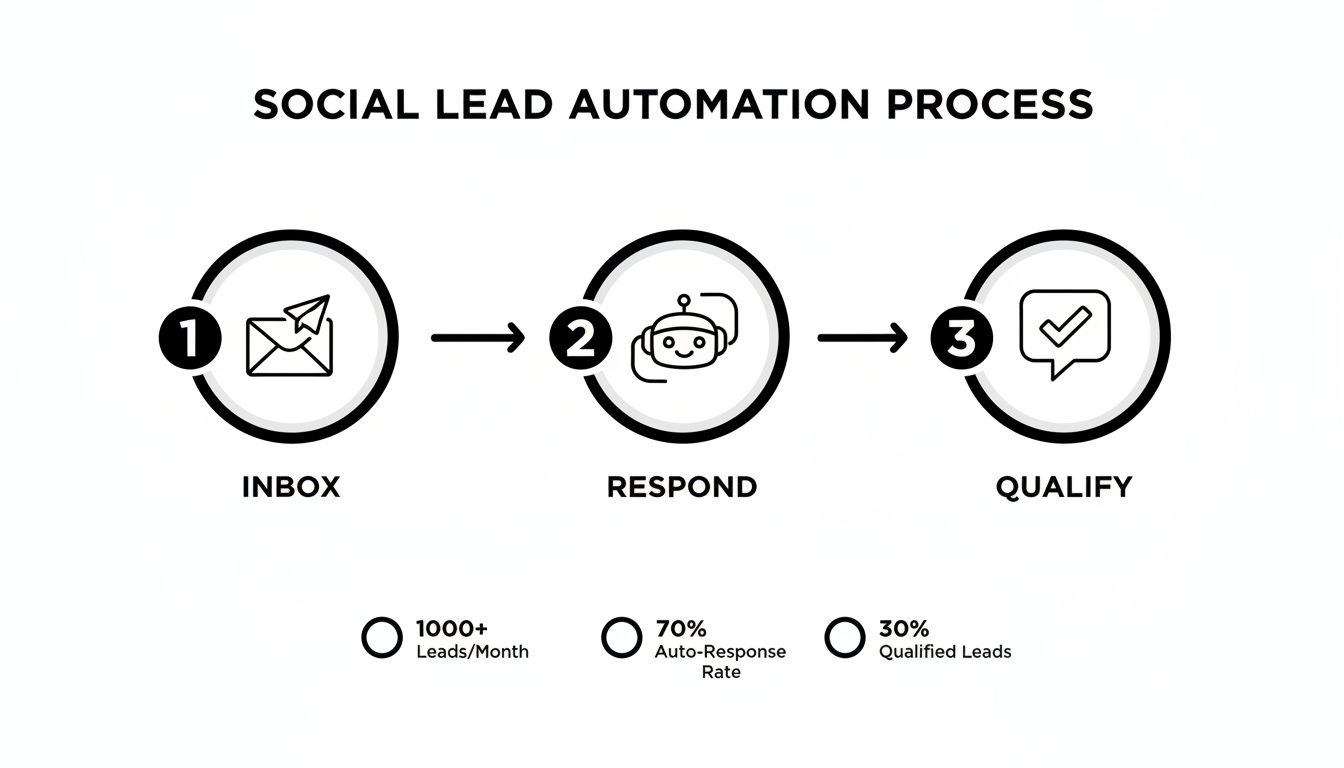
This flow shows how automation gives you the power to respond instantly and start qualifying leads the moment they hit your inbox, so you never miss a beat.
Building a Simple Lead Scoring Model
"Lead scoring" sounds intimidating, but it doesn't have to be. For social media, you can set up a surprisingly effective model based on what people say in your automated DM chats. The whole point is to assign points to leads based on their responses—the things that scream "I'm ready to buy!"
This simple system lets your team see at a glance who to call first, pouring their energy into the conversations that matter most. A simple 1-10 point scale works perfectly.
High-Intent Signals (Give these 3-5 points each):
Asking about pricing or availability: This is the clearest buying signal you'll ever get. Someone messaging, "How much is the Pro plan?" is miles ahead of someone asking what your company does.
Mentioning specific product features: If a prospect asks, "Does the new camera have 4K recording?" they've done their homework. They're in the final stages of making a decision.
Stating a direct need or problem: A DM like, "I need a solution to manage my team's projects," is basically an open invitation to make a sale.
Medium-Intent Signals (Assign 1-2 points each):
Engaging with a lead magnet: Someone who commented "GUIDE" to get your PDF is definitely interested, but they're likely still in the research phase.
Asking general questions: Inquiries like, "How do you stack up against [Competitor]?" show they're considering their options, but there’s no real urgency yet.
Following up on an old conversation: This shows they're still thinking about you, which is great for keeping your brand top of mind.
A good lead scoring system turns your DM inbox from a messy, chronological feed into a prioritized, revenue-generating machine. It gives your team the clarity to focus on conversations that are most likely to convert, which is a massive win for efficiency.
Proving Your ROI with Clear Attribution
So, which of your ads and posts are actually bringing in sales-ready leads? If you can't answer that, you’re just throwing money at the wall and hoping something sticks. Attribution is all about connecting the dots between a specific Instagram post, the DM chat it sparked, and the eventual sale.
This is where integrating your social inbox with your other business tools becomes non-negotiable. For the best results, you'll want to find a way to forward Instagram leads directly to your CRM.
Once a lead lands in your CRM, you can tag it with its source, creating a crystal-clear data trail.
Source Tagging: Every lead from a specific ad campaign (e.g., "IG-SummerSale24-Ad1") gets tagged. Simple.
UTM Parameters: Always use UTMs in the links you send in DMs. When someone clicks through to your website, those parameters tell your analytics exactly where that person came from.
Conversion Tracking: In your analytics platform, set up goals for key actions—a purchase, a demo request, a contact form submission.
When you connect all these pieces, you can finally answer the big questions like, "What was the ROAS (Return on Ad Spend) for our last Reels campaign?" or "Which ad creative drove the most qualified leads this month?"
This data isn't just nice to have; it's the ultimate proof that your social media efforts are paying off. It tells you where to double down, what to cut, and allows you to walk into any meeting and confidently report on the real business value you're creating.
Common Questions About Social Media Lead Generation
Once you start putting a social media lead generation strategy into practice, the questions start popping up. Moving from theory to execution can feel like a big leap, but the usual hurdles are smaller than they look. Let's walk through the most common questions I hear when businesses start building out this engine.
Getting solid, real-world answers will help you sidestep potential roadblocks and move forward with confidence.
How Can I Use AI Without Sounding Robotic?
The secret is deep customization. Forget the generic, out-of-the-box chatbots you’ve seen before. Modern tools let you build "AI personalities" by feeding them your own marketing copy, social media posts, and even transcripts of past customer chats. This trains the AI to mimic your unique brand voice, not some generic template.
The point isn't to have AI close your deals. It's to handle that first touchpoint instantly, 24/7. It acts as a super-efficient filter, gathering the basic info so your human team can jump into the high-value conversations that actually matter.
Think of it like a 24/7 front desk concierge. It greets every single person the second they walk in, asks what they need, and then immediately connects the most important inquiries to the right expert. No lead gets left hanging, and your brand voice stays perfect.
What Is the Most Important Success Metric?
Everyone talks about Cost Per Lead (CPL), and it's a decent starting point. But the metric that really tells you if your social media lead generation is working is your Lead-to-Conversion Rate. This is the number that answers the only question that matters: How many of these leads are actually turning into paying customers?
A super low CPL is just a vanity metric if none of those leads ever buy anything. To track this properly, you need to connect your social media activity directly to your sales data, which usually means integrating with your CRM. When you focus on your conversion rate, you naturally start optimizing for lead quality, not just quantity. You stop wasting ad spend on looky-loos and start attracting people who are ready to pull out their wallets.
At What Volume Does Automation Make Sense?
Honestly, this becomes a game-changer much earlier than most people think. Even if you're only getting 20-30 inquiries a day, trying to handle that manually gets messy, fast. Responses are slow, inconsistent, and it's way too easy for a good lead to get buried in the inbox.
The real magic of automation isn't just about handling volume—it's about providing an instant, perfect, on-brand response to every single person who reaches out. That immediate engagement is critical for conversions, whether you have 10 leads or 1,000. It also qualifies and filters on autopilot. So even at a lower volume, your team gets to spend their time talking only to the hottest, most qualified leads. It just makes the whole process smarter from day one.
Turn your social media chaos into a predictable revenue stream with Meet Alto AI. Centralize your DMs and comments, automate on-brand replies with custom AI, and instantly surface your hottest leads. Start turning comments into customers by visiting https://meetalto.ai.