AI for Social Media Marketing: Boost Engagement and ROI
Discover how ai for social media marketing can automate engagement, grow leads, and boost your ROI with practical tips.

Alto AI
on
Jan 23, 2026
When people talk about using AI for social media marketing, they're really talking about bringing in a smart assistant to help automate and sharpen up the daily grind. Think of it as a tool that handles the repetitive stuff—like creating content, targeting ads, and managing customer chats—so you don't have to. It's the key to taming a chaotic inbox and making sure you never miss a lead, freeing up your team to focus on big-picture strategy instead of getting buried in manual tasks.
Why AI Is Now Essential for Social Media Marketing
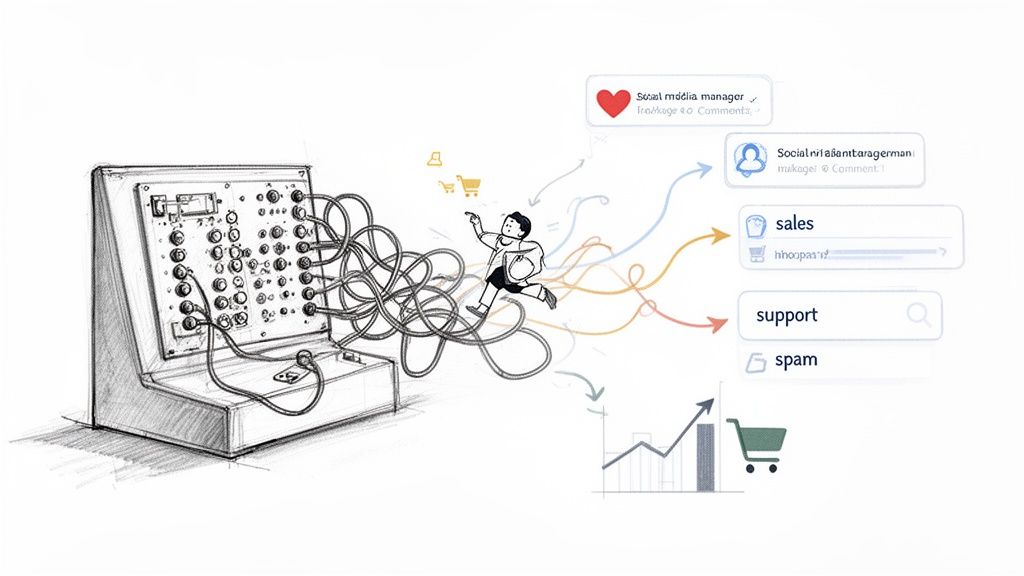
For years, managing social media felt like a losing battle. Marketers and agencies were drowning in a constant flood of comments, DMs, and questions, all needing an instant reply. Trying to handle it all manually is like trying to direct millions of phone calls through a single, old-school switchboard—it's just not possible to keep up, and you know good opportunities are slipping away.
This is exactly why AI for social media marketing went from a nice-to-have to a must-have. It’s not about replacing marketers; it’s about giving them superpowers. AI acts as an intelligent filter that cuts through the noise, routes conversations to the right place, and makes sure no high-intent comment gets lost in the shuffle.
The Shift from Manual Effort to Smart Automation
The expectation for 24/7 engagement has made purely manual management totally unsustainable. AI steps in to automate the most time-consuming jobs, which lets human teams get back to high-value work like campaign planning, creative brainstorming, and building real community relationships.
This isn't some future trend—it's happening right now. In fact, 43% of marketers already say AI is critical to their social media strategy, completely changing how they manage platforms like Instagram and Facebook. It's a direct response to the impossible demands of juggling multiple channels and non-stop posting schedules.
AI doesn't just make social media management faster; it makes it smarter. By handling repetitive tasks, it allows marketers to dedicate their expertise to creativity and strategy—the very things that build a brand people love.
To give you a clearer picture of this shift, let's compare the old way with the new.
Manual vs AI-Powered Social Media Management
This table breaks down the practical differences between sticking to traditional methods and bringing AI into your workflow.
Task | The Manual Approach | The AI-Powered Approach |
|---|---|---|
Comment Moderation | A community manager manually sifts through every comment, deleting spam and flagging questions. This can take hours each day. | AI automatically filters out spam, identifies urgent issues, and tags comments by sentiment, instantly cleaning up the feed. |
Lead Identification | Someone has to read every DM and comment, looking for phrases like "how much?" or "where can I buy?" Many get missed. | AI detects buying intent in real-time, tags the user as a "hot lead," and routes the conversation directly to the sales team. |
Customer Support | Simple questions ("What are your hours?") clog the inbox, forcing support reps to type the same answers repeatedly. | An AI chatbot provides instant answers to common questions, freeing up human agents to handle complex customer problems. |
Content Creation | A marketer spends a full day brainstorming post ideas, writing 10 captions, and finding matching images. | AI generates 20 caption variations in minutes, suggests relevant hashtags, and even helps create images from a simple text prompt. |
Ad Targeting | Marketers rely on broad demographic data (e.g., "women, 25-34") and hope for the best, often wasting ad spend. | AI analyzes thousands of data points to build hyper-specific audience segments based on behavior, interests, and past purchases. |
As you can see, AI doesn't just do the same tasks faster—it opens up a whole new level of efficiency and intelligence.
Platforms like Meet Alto AI are built for this new reality. They turn a messy social media inbox into an organized, revenue-generating machine. By automatically filtering out junk, tagging potential customers, and replying in a consistent brand voice, these tools transform a support cost center into a powerful sales channel.
Beyond Automation to True Intelligence
Modern AI does more than just schedule posts or send canned replies. It actually learns from every single interaction. Over time, it gets better at reading customer sentiment, qualifying leads, and personalizing responses.
It can tell the difference between a casual question and a strong buying signal, ensuring your team’s energy is focused where it matters most. If you want a deeper look at how this technology works in practice, this AI for advertisers playbook shows how it automates creative production and delivers personalization at scale.
The end goal is a seamless workflow where technology handles the volume, and humans provide the strategy and soul.
How AI Actually Works in Social Media
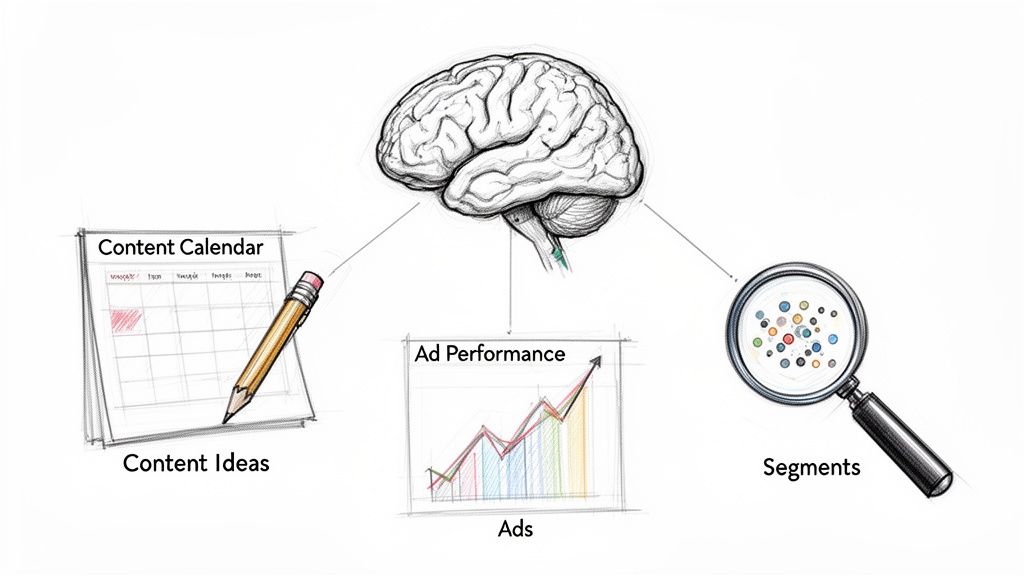
To get a real grip on AI for social media marketing, it helps to stop thinking of it as some magic, all-knowing robot. It’s more like a toolkit full of specialized gadgets, each designed to fix a specific headache that social media managers know all too well.
We’re talking about everything from the dreaded content drought to that sinking feeling you get when you’re burning through an ad budget with nothing to show for it.
So, let's ditch the vague buzzwords and look at how these tools actually work in the real world. This is where AI stops being a concept and starts becoming a practical part of your workflow, driving results you can actually see.
Generating Smarter Social Media Content
One of the first places AI makes a difference is in tackling the endless demand for fresh content. Think of an AI content generator as a tireless brainstorming partner—one that never needs a coffee break. It can scan your past posts, learn your brand’s voice, and spit out a week's worth of solid ideas in minutes.
For instance, you could tell an AI tool, "Give me five Instagram post ideas for a new vegan leather handbag, aimed at millennial women who care about sustainable fashion." It won't just give you one-liners; it'll flesh out distinct concepts, often with starter captions and hashtag suggestions. That's hours of creative heavy lifting off your plate.
It goes beyond just spitting out ideas. Many great AI ad copy tools can write compelling text built to grab your audience's attention and get them clicking. This lets you quickly test multiple ad variations to find the winner without having to write every single one from scratch.
Optimizing Ad Spend for Maximum ROI
Running paid ads on platforms like Facebook and Instagram can feel like a gamble. You set your budget, target an audience, cross your fingers, and hope for the best. AI replaces that hope with cold, hard data, acting like a financial analyst who works 24/7 to squeeze the most out of every dollar.
Picture an AI algorithm plugged into your Facebook Ads account. It’s constantly sifting through performance data in real-time—click-through rates, cost per acquisition, you name it. If it sees a particular ad creative is bombing with one demographic, it can instantly shift your budget over to the ads that are actually making sales. It’s a dynamic, hands-off way to make sure your money is always in the right place.
AI-powered ad optimization isn't just about saving money; it's about investing it more intelligently. It finds the hidden opportunities and cuts the losses faster than any human team possibly could.
Uncovering Hidden Audience Segments
Your ideal customers are out there, but they’re not always where you think. They often hang out in niche groups that broad demographic targeting just can't find. While you might manually identify a segment like "women aged 25-34," AI can dig much, much deeper.
It finds subtle patterns in behavior that reveal highly specific and profitable micro-audiences. An AI platform might analyze thousands of data points and discover that your best customers aren't just into "fitness" but are specifically obsessed with "at-home HIIT workouts" and also follow the same three eco-friendly influencers. That's pure gold. This kind of insight lets you create hyper-targeted campaigns that speak directly to what motivates them, which almost always means better conversion rates.
Automating Inbox and Comment Management
Finally, AI is a lifesaver when it comes to managing the sheer volume of DMs and comments. It acts as the intelligent front line for your community management, filtering out the noise and flagging what actually needs a human touch.
Here’s a quick breakdown of how it works in practice:
Sentiment Analysis: The AI reads a comment and instantly tags it as positive, negative, or neutral. This helps you jump on customer complaints before they blow up or amplify the good vibes from happy followers. To go deeper, check out our guide on social media sentiment analysis tools.
Spam Filtering: It automatically identifies and hides spam, profanity, or troll comments. This keeps your comment sections clean and protects your brand’s reputation without you having to manually delete every "DM me for a collab" post.
Lead Qualification: A smart system can be trained to recognize buying signals. When someone comments, "How much is this?" or "Do you ship to Canada?" the AI can tag it as a "Hot Lead" and shoot a notification to your sales team. No more missed opportunities.
Turning Conversations into Customers with AI
While AI’s knack for creating content and fine-tuning ads is a huge deal, one of its most immediate and profitable uses is managing the flood of social media conversations. We’re not talking about the clunky, basic chatbots from a few years ago. Modern AI for social media marketing is more like an intelligent communications hub, turning your chaotic inbox and comment sections into a well-oiled customer acquisition machine.
This isn’t just about keeping up; it’s about getting ahead. Every single comment and DM holds potential, but when you're manually sifting through thousands of them, you’re bound to miss the golden opportunities. An AI-powered system makes sure every conversation is seen, understood, and acted on—instantly.
Automating Engagement With a Personal Touch
The first order of business for a conversation AI is to tackle the sheer volume of routine interactions that eat up a social media manager's day. It works around the clock in the background, freeing up your team to focus on bigger-picture strategy.
Here’s what that looks like in action:
Smart Replies in Your Brand Voice: An AI like Meet Alto AI can be trained on your brand’s past conversations to learn its unique tone. It can then automatically handle common questions like "Do you ship to Australia?" or "How much is this?" with answers that sound like they came straight from your team.
Intelligent Spam and Troll Filtering: A wave of spammy or negative comments can tank your brand's reputation fast. AI instantly identifies and hides profanity, spam, and other harmful content before it pollutes your community, essentially standing guard 24/7.
Sentiment Tagging: The AI doesn't just read words; it understands the emotion behind them. It can automatically tag messages as positive, negative, or urgent, helping your team prioritize who to respond to first, jump on complaints before they escalate, and amplify glowing reviews.
This level of automation doesn't make your brand feel robotic. It makes it feel incredibly responsive and on top of things, ensuring no customer ever feels ignored.
From Casual Comment to Qualified Lead
But here's the real game-changer: turning passive comments into active sales opportunities. For any e-commerce or DTC brand running paid ads on Instagram or Facebook, the comment section is a goldmine of buying signals—if you can get to them quickly enough. This is where AI-driven lead qualification really shines.
Let’s say you're running an ad for a new pair of sneakers. Someone comments, "Wow, I need these! Where can I buy them?"
Manually, a social media manager might see this hours later. By then, the user's excitement has probably cooled, and they've scrolled on to something else. With AI, that high-intent comment is recognized and acted upon the second it's posted.
An intelligent system like Meet Alto AI understands intent, not just keywords. You can set it up to watch for specific phrases that signal a strong desire to buy. The moment a comment like that pops up, the AI kicks off a workflow. If you want to dive deeper into turning social interactions into sales, our guide on social media lead generation has a ton of actionable strategies.
This automation forges a direct, measurable link between your social engagement and your revenue.
A Practical Lead Capture Workflow
Let's walk through exactly how this AI workflow transforms a simple comment into a sales-ready lead, often in just a few seconds.
Identify High-Intent Comments: The AI is always scanning comments on your ads and organic posts, looking for trigger phrases like "how much," "where to buy," "link please," or "I want this."
Tag and Prioritize Automatically: Once it spots a high-intent comment, the AI automatically tags it as a "Hot Lead" or "Sales Opportunity" right inside your smart inbox.
Alert the Right Team: The system then fires off an immediate notification—through Slack, email, or whatever tool you use—straight to your sales or community management team.
Enable a Swift, Personalized Response: Your team can jump right into the conversation with all the context they need, ready with a purchase link or a discount code to close the deal while the lead is still hot.
This process completely closes the gap between interest and action, eliminating the lag time that kills so many potential sales. It ensures your most valuable prospects get immediate attention, which massively boosts the odds of a purchase.
This capability is becoming even more essential as influencer marketing grows. Research shows that over 50% of marketers plan to use AI in their influencer campaigns by 2026. This creates a perfect storm where AI can flag leads from influencer-driven traffic and automate the nurturing process for maximum return. By connecting conversations directly to conversions, AI for social media marketing becomes a core driver of your bottom line.
How to Implement AI in Your Social media Strategy
Adding AI to your social media workflow isn't about flipping a switch and watching the magic happen. It's a strategic move that starts with a simple question: "Where will this make the biggest impact?"
Treating AI like just another tool on the pile is a recipe for frustration. A clear roadmap, however, turns it from a buzzword into a practical asset that actually grows your business.
The journey begins by looking at your current operations. Before you can even think about picking a solution, you need an honest diagnosis of your problems. This is the foundation—it ensures you're investing in AI to solve real pain points, not just for the sake of it.
Audit Your Current Social Media Process
Get real about your day-to-day social media management. Where are the bottlenecks? What tasks make your team want to pull their hair out? Pinpointing these friction points is the first step. A good audit reveals the hidden costs of doing things manually, from wasted hours to straight-up missed sales.
Start tracking the time your team spends on specific tasks. How many hours a week go into deleting spam comments, answering the same five DMs over and over, or digging for leads in a mountain of notifications? These are your prime candidates for automation.
Here are a few key areas to zoom in on:
Response Times: How long does it take your team to get back to a comment or DM? Slow replies can cause a 7% drop in customer advocacy. Ouch.
Lead Capture: How many comments like "How much is this?" or "Where can I buy?" get missed or answered too late? This is money left on the table.
Team Burnout: Is your team drowning in the sheer volume of interactions? Those high-volume, low-value tasks are a fast track to burnout and employee turnover.
Brand Safety: How often does spam, profanity, or a nasty comment sit on one of your ads for hours? This stuff can seriously tarnish your brand's image.
Define Your Primary Objectives
Okay, you've identified the pain points. Now, let's set some clear, measurable goals. What, exactly, do you want AI to accomplish for you? "Improve engagement" is way too vague. Get specific with outcomes that tie directly to business results.
Your goals will steer the entire process, from which platform you choose to how you measure success. For example, if your audit showed you missed dozens of sales DMs last month, your objective could be to capture 95% of all high-intent comments within minutes. Now that's a goal.
A well-defined objective is your north star. It makes sure every feature you use and every workflow you build is pushing you toward a meaningful business outcome, not just automating tasks for the sake of it.
Think about it like this: AI can turn a simple comment into a qualified lead, directly hitting the goal of turning more social conversations into actual customers.
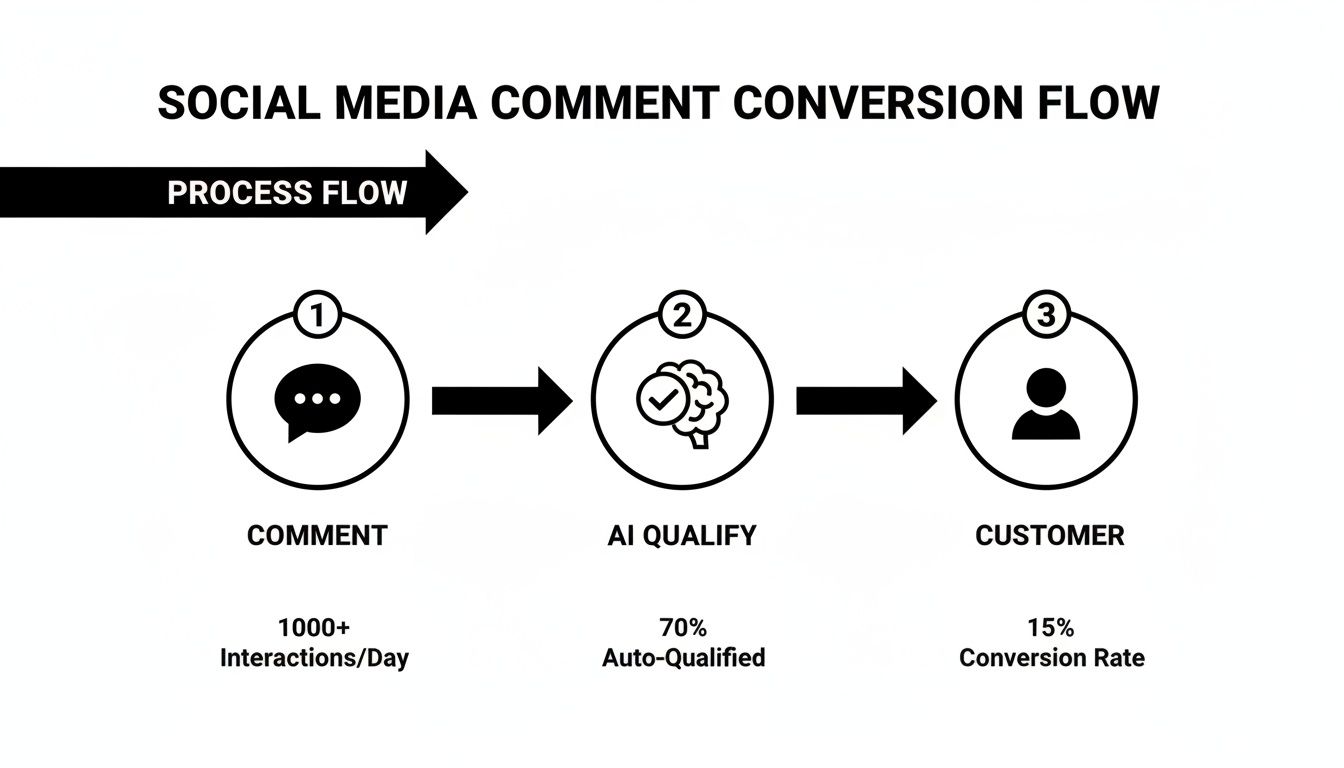
This workflow shows the real value of AI in social selling—it closes the gap between someone showing interest and you making a sale by automating the tedious qualification part.
Choose the Right AI Platform
With your goals locked in, it's time to shop for tools. Be picky here. Not all AI platforms are built the same, and the right one should feel like a natural extension of your team, not another clunky piece of software.
Look for a solution that takes security and reliability seriously. For example, a platform like Meet Alto AI that's an official Meta partner has already been vetted for strict data and API compliance, which gives you peace of mind. Beyond that, check for customization options that let the AI learn and adopt your unique brand voice. Nobody wants a robot that sounds like a robot.
Finally, think about growth. The platform you pick today should be able to scale with you tomorrow, handling more comments and complex workflows as your brand's social presence gets bigger.
Track Key Performance Indicators
The final piece of the puzzle is measuring your success. To prove the ROI on your shiny new AI for social media marketing, you need to track the right metrics—the ones that directly reflect the goals you set earlier.
Ditch the vanity metrics. We're talking about data that shows real business impact. Here are a few essential KPIs to keep an eye on:
Average Response Time: How fast is your AI-powered workflow replying to comments and DMs?
AI-Assisted Conversion Rate: What percentage of conversations touched by AI end up as a sale?
Spam and Profanity Block Rate: How effectively is the AI cleaning up your comments and protecting your brand's reputation?
Leads Captured: How many high-intent comments and DMs is the AI actually identifying and flagging for your sales team?
By watching these numbers, you can continuously tweak your strategy, optimize your AI's performance, and clearly show everyone how it's making a difference to the bottom line.
Best Practices for Using Social Media AI
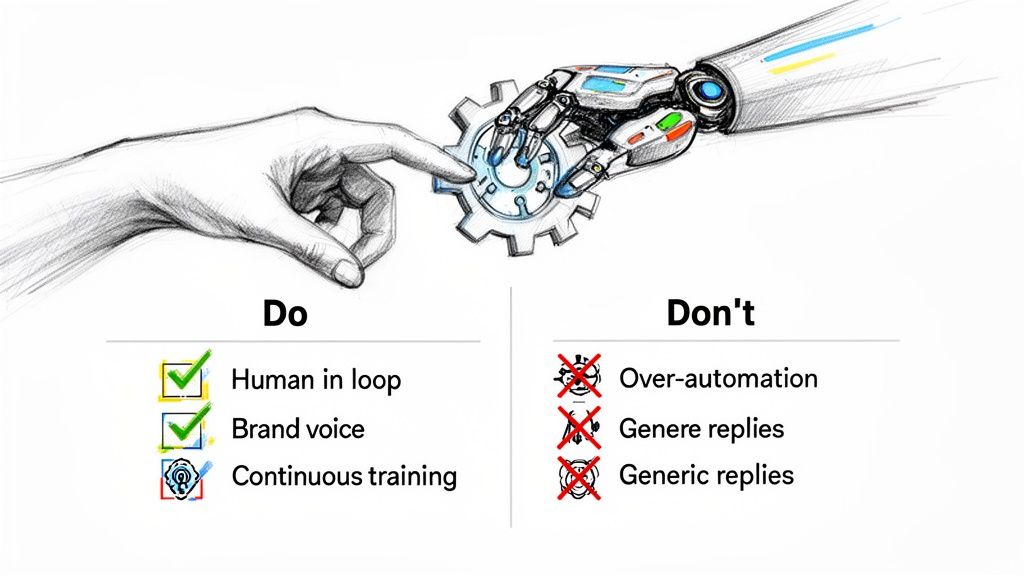
Bringing AI into your social media workflow isn't just about flipping a switch on new software. It’s about creating a smarter system where technology and human insight work hand-in-hand. To really get the most out of it, you need a strategy that leans into the strengths of both.
Getting a few key practices right from the start will make sure your AI integration is a home run, boosting your efficiency without stripping away your brand’s personality.
Keep a Human in the Loop
The golden rule is to always, always keep a human involved. Think of your AI as the world's fastest, most tireless assistant, not as a replacement for your team. Its job is to chew through the repetitive, high-volume tasks—like weeding out spam comments or answering the same five questions over and over.
This frees up your team to focus on what they do best: handling nuanced conversations that require empathy, critical thinking, and a personal touch. This collaborative approach is your best form of quality control and keeps your brand feeling human.
Avoid the Siren Song of Over-Automation
It’s tempting to automate everything, but that's one of the biggest traps you can fall into. While AI delivers incredible speed and scale, letting it handle every single interaction will make your brand feel cold and distant. Your audience can spot a generic, robotic reply from a mile away, and it can sour the trust you've worked so hard to build.
To sidestep this, give your AI clear boundaries. Let it take care of the simple, straightforward stuff, but program it to flag any complex, sensitive, or emotionally charged comments for a real person to review. This hybrid model gives you the best of both worlds—efficiency and the authentic connection that helps you genuinely improve social media engagement.
Customize Your AI to Your Brand Voice
An out-of-the-box AI will sound… well, out-of-the-box. To make your automation feel like a natural extension of your team, you have to invest time in training it to mirror your brand’s unique voice. The best tools, like Meet Alto AI, let you feed the system your past successful conversations, so its replies match your specific tone, phrasing, and personality.
This process involves a few key steps:
Create a Custom AI Personality: Give the AI a library of your best replies and brand guidelines to learn from.
Build a Knowledge Base: Equip it with accurate, approved answers to common questions about your products, services, and policies.
Refine Over Time: Regularly review the AI's responses and tweak them to sharpen its performance.
A well-trained AI doesn't just spit out answers; it becomes a true ambassador for your brand. It reinforces your identity consistently across thousands of conversations, turning a simple utility into a powerful branding tool.
Continuously Train and Analyze Your AI's Performance
Your AI is a learning machine, not a static piece of software. To keep it effective, you need to treat it like a new team member who needs ongoing coaching. Regularly feed it fresh data, update its knowledge base with new product info or promotions, and dive into its performance metrics to spot areas for improvement.
Don't let the data your AI tool collects go to waste. Those analytics are a goldmine of insights into customer sentiment, common pain points, and which types of conversations are turning into leads. This information is invaluable for fine-tuning not just your AI's performance, but your entire social media strategy. Ignoring it is like having a focus group running 24/7 and choosing to wear earplugs.
To help you get started on the right foot, here's a quick look at the essential do's and don'ts.
AI for Social Media Do's and Don'ts
This table is a quick-reference guide to help you implement AI successfully while avoiding common mistakes.
Do | Don't |
|---|---|
Do keep a human in the loop for quality control and complex issues. | Don't over-automate every interaction and risk sounding robotic. |
Do customize the AI to perfectly match your unique brand voice. | Don't use generic, out-of-the-box replies that feel impersonal. |
Do continuously train the AI with new data to improve its accuracy. | Don't set it and forget it; performance requires ongoing attention. |
Do analyze the performance data to refine your overall strategy. | Don't ignore the valuable insights your AI uncovers about your audience. |
By sticking to these guidelines, you'll be well on your way to building a smarter, more effective social media presence powered by AI.
Common Questions About AI in Social Media
Jumping into AI for social media marketing is exciting, but it definitely brings up some big questions. If you’re wondering about brand personality, budget, or security, you’re not alone. These are the right things to be thinking about before you go all in.
Let’s clear the air and walk through the most common questions marketers have. Getting these answers straight will give you the confidence to move forward, knowing you’re making a smart call for your brand.
Will AI Make My Brand Sound Robotic and Impersonal
This is probably the number one fear marketers have, and it’s a good one. Nobody wants their brand to sound like a cheap chatbot from 2015. The good news? Modern AI is built to avoid exactly that.
The best tools today let you create a custom AI personality. This isn't just some generic template. It’s an AI model that learns from your brand’s actual history of successful conversations—your tone, your specific phrasing, even the way you use emojis. The whole point is to make sure that when the AI responds, it sounds like it came straight from your team.
The goal of AI isn't to replace your brand's voice, but to amplify it at scale. It handles the routine stuff with perfect consistency, freeing up your human team for the high-touch conversations that really matter.
To really nail this, you need a "human-in-the-loop" approach. Let the AI handle the simple, repetitive questions and filter out the noise. But set it up to flag complex or sensitive conversations for a real person to handle. This blend of AI speed and human oversight keeps you responsive without losing that authentic touch.
Is AI for Social Media Only for Large Companies
Not anymore. A few years back, you’d need an enterprise-level budget to even think about this kind of tech. That world is long gone. Today, AI tools are way more accessible and affordable, making them a game-changer for everyone from solo e-commerce founders to growing agencies.
Plenty of AI platforms, including Meet Alto AI, offer scalable pricing that grows with you. But honestly, when you look at the return on investment, the cost often becomes a non-issue.
Think about what it means for a small team:
Time Savings: Automating comment replies and moderation can literally give you back dozens of hours every single week. What could you do with that time?
Lead Capture: An AI is on the clock 24/7. It never misses a high-intent comment, which translates directly into more sales opportunities.
Brand Protection: Round-the-clock spam and profanity filtering protects your reputation without someone having to manually stand guard.
For a smaller business, the efficiency alone can make an AI tool one of the smartest investments you can make. It lets a lean team punch way above its weight.
How Do I Measure the ROI of an AI Social Media Tool
Measuring the return on your investment is everything. A good AI platform should have analytics baked in, but you need to know what you’re looking for. ROI isn't just one number; it's a mix of efficiency wins, direct sales lifts, and a healthier brand community.
I recommend breaking your measurement into three core areas:
Efficiency Metrics: This is all about time and effort saved. Track the drop in your Average Response Time and the total Number of Manual Actions Saved (think: comments hidden, replies sent). These are your "time is money" metrics.
Performance Metrics: Here’s where you see the direct impact on revenue. Keep an eye on the Increase in Qualified Leads Captured from social comments and the Conversion Rate from conversations the AI handled or helped with.
Brand Health Metrics: This shows how the AI is protecting your community. Track your overall Sentiment Score to see if it’s trending up, and measure the Reduction in Visible Spam Comments on your posts and ads.
By tracking these specific KPIs, you can build a crystal-clear, data-backed picture of how your AI tool is helping you grow.
What Security and Privacy Standards Should I Look For
Security has to be at the top of your list. You're giving a tool the keys to your social accounts and customer conversations, so trust is non-negotiable.
First, and this is a big one, make sure any tool you’re looking at for Instagram or Facebook is an official Meta Partner. This certification is your proof that the platform has been put through the wringer by Meta and follows their strict rules on API use and data privacy. It’s a must-have stamp of approval.
Beyond that, dig into the platform's data privacy policies. Look for clear language and compliance with major regulations like GDPR. Your AI tool should be a partner in protecting not just your brand, but your customers' private information. Never trade security for a flashy feature.
Ready to see how a secure, smart AI can transform your social media engagement and actually drive sales? Meet Alto AI brings all your comments and DMs into one smart inbox, automates replies in your unique brand voice, and captures high-intent leads 24/7. See how top e-commerce brands are turning conversations into customers by exploring Meet Alto AI.