Social Media Marketing Automation: A Guide That Actually Works
Discover how social media marketing automation saves agencies and brands 30+ hours a week. Learn strategies to boost engagement and convert leads on autopilot.

Alto AI
on
Feb 17, 2026

Social Media Marketing Automation: A Guide That Actually Works
Let's be honest: most social media marketing automation is glorified post scheduling. True automation is about building a smart, responsive system that’s on the clock 24/7—engaging customers, capturing leads, and protecting your brand's reputation. At its core, it's about using technology to handle the repetitive, high-volume conversations so your team can focus on strategy and growth.
This guide breaks down exactly how to build an automation engine that turns your social media comments from a chaotic time-sink into a predictable revenue stream.
What Is Social Media Marketing Automation, Really?
Social media marketing automation is the use of software to manage and execute marketing tasks on social media platforms without constant human intervention. It goes far beyond scheduling posts, focusing instead on managing engagement, moderating comments, qualifying leads, and analyzing performance through intelligent, rules-based workflows.
Think of it like an expert air traffic controller for your brand. This controller works around the clock, skillfully managing every single message coming in across all your social channels. They instantly sort genuine customer questions from spam comments, guide interested buyers toward a sale, and ensure no critical message ever gets lost in the noise.
That's the real power of social media marketing automation. It’s a strategic game-changer, especially for managing the conversations that happen after you post, like in the comment sections of your paid ads on Instagram and Facebook.
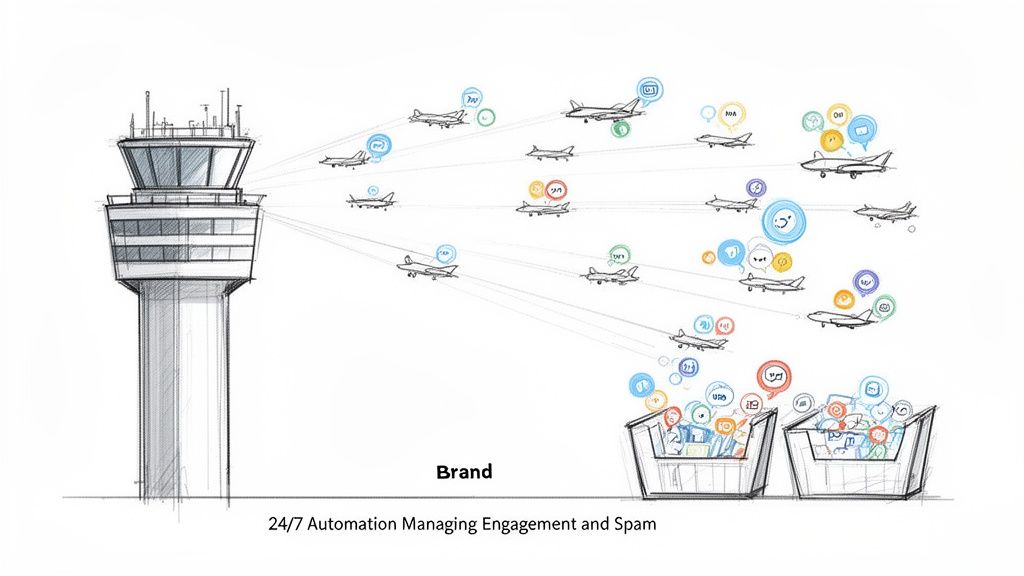
Beyond Scheduling to Conversational AI
For most marketers, the biggest headache is drowning in manual, repetitive tasks. We're talking about replying to the same questions over and over, deleting spam, and trying to spot a real sales opportunity in a tidal wave of notifications. This is precisely where modern automation steps in to create intelligent workflows.
Let’s say a potential customer comments "How much is this?" on one of your ads. An automated system can immediately spring into action:
Publicly reply to the comment, showing everyone else how responsive you are.
Send a private DM with a direct link to the product page.
Tag the user as a "hot lead" in your system so the sales team can follow up.
This immediate, personalized interaction turns a passive comment section into an active conversion machine. You meet customers at their peak moment of interest, cutting out the delays that cause hot leads to go cold. To see how deep this goes, it's worth understanding how AI for Social Media Marketing is making these complex tasks simpler and more efficient than ever.
Key Takeaway: Automation transforms your social media from a megaphone (broadcasting content) into a magnet that pulls in qualified leads and nurtures customer relationships at scale.
To really drive this home, let's look at a side-by-side comparison of manual versus automated workflows.
Manual Effort vs. Automated Workflow
This table breaks down the stark difference between the old way and the new, intelligent way.
Task | Manual Approach | Automated Approach |
|---|---|---|
Comment Response | Team member manually types replies; response time can be hours. | Instant public reply and personalized DM are sent within seconds. |
Lead Identification | Someone has to read every comment to spot potential buyers. | Keywords ("price," "how to buy") automatically trigger lead-capture flows. |
Spam Management | Manually hiding or deleting spam comments, often after they've been seen. | Spam comments are identified and hidden automatically, 24/7. |
Scalability | Hire more people as ad spend and comment volume increase. Very costly. | System scales effortlessly, handling thousands of comments a day. |
Data Collection | No systematic way to track leads from comments. | Every interaction is tagged and logged, providing clear data on ROI. |
The difference is clear. One path leads to burnout and missed opportunities, while the other creates an efficient, scalable engine for growth.
The Growing Need for Intelligent Automation
This shift isn't just a trend; it's a strategic necessity fueled by massive market growth. The market for social media automation tools is on track to hit an incredible USD 12.8 billion by 2033. This explosion shows how much businesses are betting on automation to maintain their competitive edge.
For brands trying to manage 4-5 different platforms, manual management can easily eat up over 30 hours a week—a huge burden automation is perfectly designed to lift.
Ultimately, this technology acts as a force multiplier for your marketing team. You can dive deeper into these concepts in our complete guide to AI for social media marketing. By letting machines handle high-volume, low-complexity interactions, it frees up your human experts to do what they do best: build authentic relationships and close sales.
The Pillars Of A Powerful Automation Engine
A solid social media marketing automation strategy isn't about a single magic bullet feature. It’s a system built on three core pillars that must work together seamlessly. Think of it like a high-performance engine where every part has a specific, critical job. When all parts fire in sync, you get a machine that runs smoothly, turning simple social media chatter into real business results.
This isn't just about saving your team a few hours. It's about building an intelligent workflow that captures every opportunity, protects your brand’s reputation, and gives customers a fantastic experience—all without burning out your staff.
Let’s break down each foundational pillar.
Pillar 1: Unified Smart Inbox
First things first: you need a single source of truth for all your social media conversations. Brands are hammered with comments, DMs, and messages from every direction—organic posts, paid ads, Instagram DMs, and more. Juggling all of that across native apps is a fast track to missed messages and frustrated customers.
A Unified Smart Inbox fixes this by funneling every comment and DM into one central dashboard.
This isn’t just about being tidy; it's about taking back control. When you see every interaction from ads and organic posts in one stream, you get a complete, unfiltered look at what people are actually saying about your brand.
With this unified view, your team can finally stop playing whack-a-mole with browser tabs and start managing conversations strategically. Getting your social media inbox management under control is the bedrock—it sets the stage for everything that follows.
Pillar 2: AI-Powered Engagement
With all your conversations flowing into one place, the next pillar is about handling that volume with speed and intelligence. This is where AI-Powered Engagement comes in, acting as your 24/7 frontline support. It provides instant, helpful responses and filters out junk so your human team can focus on the conversations that actually matter.
We're not talking about generic, robotic replies. Modern automation lets you customize the AI to communicate in your unique brand voice. Here's what that looks like in practice:
Instant FAQ Handling: Train the AI to immediately answer common questions like, "Do you ship to Canada?" or "What are your return policies?" Customers get instant answers, and your team is freed up.
Spam and Troll Filtration: The system can automatically spot and hide comments loaded with spam links, profanity, or hate speech. This protects your brand’s reputation around the clock, even while you sleep.
Brand Voice Consistency: You can create custom AI personalities that match your brand’s vibe—whether that’s friendly and casual or more formal and professional.
This layer of automation ensures every customer is acknowledged quickly while toxic comments never see the light of day.
Pillar 3: Intelligent Lead Routing
The final pillar is what turns your automation from a simple management tool into a proactive sales machine. Intelligent Lead Routing uses AI to analyze the sentiment and intent behind every comment and DM, automatically flagging high-value opportunities for your sales team.
Picture this: a customer comments on your ad, "OMG, I need this for my sister's birthday next week!" Instead of that comment getting buried, the automation engine instantly does three things:
Sentiment Analysis: It recognizes the urgency and clear buying intent in the message.
Smart Tagging: It automatically slaps a "Hot Lead" or "Urgent Inquiry" tag on the conversation in the smart inbox.
Team Notification: It pings the sales team, who can jump in immediately to answer questions and close the sale.
This process ensures your best leads never fall through the cracks. By automatically sorting and prioritizing conversations, you create a direct pipeline from your social media comments to your sales team, squeezing every last drop of ROI from your ad spend.
How Automation Turns Ad Spend Into Revenue
For e-commerce brands and media buyers, this is where the magic happens. Smart social media marketing automation isn't just another community management tool; it's a powerful sales engine that directly connects the money you spend on ads to the revenue you generate. It closes the critical gap between a customer seeing an ad and making a purchase.
We’ve all seen it: you're running a killer Instagram ad campaign. A potential customer loves it and comments: "I want this!" Without automation, that comment gets buried. By the time your team sees it hours later, the excitement is gone. The lead is cold.
Automation flips this entire scenario on its head.
A well-built system can instantly spot the buying intent in that comment. Within seconds, it kicks off a workflow:
It posts a public reply: "Awesome! Just sent the details to your DMs." This shows everyone else how incredibly responsive you are.
It sends a private DM: This message contains a direct link to the product, a special discount code, or a quick question to start a conversation.
This immediate, 24/7 engagement catches people at the absolute peak of their interest. It cuts out the friction and delays that kill conversions, effectively turning your ad's comment section into a real-time sales pipeline.
From Ad Impressions to Sales Conversations
Every dollar you put into ads is an investment in grabbing attention. Automation ensures that attention doesn’t go to waste. With global social ad spend hitting an eye-watering USD 219 billion, maximizing your return is non-negotiable.
Brands that get this right see incredible results. Social campaigns using automation can bring in an average of $5.20 for every $1 spent. Better yet, AI-powered responses can drive 30% higher engagement, which directly boosts ad performance and conversion rates.
The diagram below shows how a smart automation hub connects all the dots—managing your inbox, optimizing engagement, and routing leads to the right place.
As you can see, it's not about a single feature. A successful system is a connected flow that captures interest, qualifies leads, and converts them smoothly.
Answering Sales-Blocking Questions Instantly
Beyond just pouncing on high-intent comments, automation excels at answering the small questions that can stop a sale in its tracks. Think about common queries like "Do you ship to Australia?" or "Is this available in blue?"
These are simple questions, but a slow reply can easily mean the difference between a sale and an abandoned cart.
An automated system is your always-on sales assistant. It gives instant answers to frequently asked questions, removing purchase barriers and building customer confidence at the most critical moment in their buying journey.
By pre-loading answers to your most common questions, you ensure customers get the info they need to click "buy" without a second thought. This is especially vital for paid campaigns, where every unanswered question is wasted ad spend. For anyone running paid ads, mastering Facebook ads comment moderation is a core strategy for protecting your investment and brand reputation.
Ultimately, by creating this automated feedback loop between your ads and your sales process, you build a scalable system that turns interest into revenue far more efficiently than any manual approach ever could.
Measuring The True Impact Of Your Automation
Likes and follower counts feel good, but they don't pay the bills. To prove the value of your social media marketing automation, you must connect your efforts directly to business outcomes. Moving past surface-level vanity metrics is the only way to justify the investment and demonstrate its ROI to stakeholders.
It's about shifting your mindset. Instead of asking, "How many people saw our post?" the real question is, "How many qualified leads did our automated workflow generate?" We're measuring actions, not just eyeballs.
Key Performance Indicators That Actually Matter
To get a clear picture, you need to track KPIs that tell the story of efficiency, lead generation, and customer satisfaction. It's time to ditch the fluff and start measuring what actually moves the needle.
These are the core metrics you should build your dashboard around:
First Response Time (FRT): This is the average time it takes your system to reply to a person's first comment or DM. A low FRT—ideally under a minute—is a huge win. It shows you're engaging people right when their interest is at its peak.
Social Lead Conversion Rate: What percentage of automated interactions turn into a qualified lead? This could be someone clicking a link in a DM, using a discount code, or getting flagged for a sales follow-up. This metric draws a straight line from your social activity to your sales pipeline.
Cost Per Qualified Inquiry: This one is simple but powerful. Divide your monthly tool costs and any related ad spend by the number of qualified leads your automation generated. This KPI gives you a hard number on how efficiently you're creating real sales opportunities.
Building Your Performance Dashboard
Tracking these KPIs doesn't need to be complicated. A simple dashboard, whether in a spreadsheet or your analytics tool, can provide a clear, at-a-glance view of your automation's impact. This transparency is what you need to make smart, data-backed decisions instead of just guessing.
Your dashboard should tell a simple story: "We invested X in automation and generated Y in qualified leads, which ultimately resulted in Z in revenue." That's the language executives and stakeholders understand.
The numbers back this up. Teams that master social media automation often see a 20-30% lift in engagement and slash content creation time by 30%. More importantly, automation can boost overall marketing productivity by 14.5% and drive up revenues by an average of 34%. With 73% of consumers ready to switch to another brand if their social messages are ignored, you can't afford not to track this.
Connecting Social Sentiment to Business Goals
Beyond the hard numbers, you also need to keep a finger on the pulse of customer perception. How is automation affecting the way people feel about your brand?
This is where sentiment analysis tools come in, giving you invaluable data on whether interactions are positive, negative, or neutral. You can check out our deep dive on the best options in our guide to social media sentiment analysis tools.
Monitoring sentiment helps you understand if your automated replies are hitting the right tone and genuinely improving the customer experience. A rising positive sentiment score paired with a high lead conversion rate? That's the ultimate proof that your automation strategy isn't just efficient—it's building real brand loyalty.
Common Automation Mistakes That Kill Your ROI
Implementing social media marketing automation is a huge step up, but it's not a silver bullet. Without a smart strategy, even the best tools can go sideways, hurting your brand’s reputation and burning through your ad budget. The real win isn’t just automating; it’s automating the right way by sidestepping the common traps that turn a helpful assistant into a robotic headache.
Plenty of brands stumble into these pitfalls, resulting in off-brand, clunky interactions that push customers away. By getting ahead of these mistakes, you can build an automation strategy that feels human, captures more leads, and delivers a real return.
The 'Set It And Forget It' Syndrome
This is the big one. It's tempting to treat your automation like a crockpot—set it up, turn it on, and check back later for results. But that "set it and forget it" mindset is a recipe for disaster. Conversations move fast, trends change, and customer feelings can flip on a dime. An automated reply that was perfect last week could be completely tone-deaf today.
If no one's watching, your system can't adapt. It might keep firing off replies to a failing ad campaign or give a clumsy, automated response to a genuinely upset customer, making a bad situation worse.
Key Takeaway: Automation is there to support your team, not replace it. You always need a human in the loop to monitor performance, tweak responses, and jump into the complex conversations that AI just can't handle.
Over-Automating And Losing The Human Touch
Efficiency feels good, so it's easy to get carried away and try to automate every single interaction. But when you do that, you lose the one thing that makes social media work: real, authentic connection. The moment your customers feel like they're just talking to a machine, they check out.
Here are a few red flags that you're overdoing it:
Generic, one-size-fits-all replies that dance around the user's actual question.
A total lack of personality or empathy, especially when a customer is frustrated or needs help.
Automated DMs that feel spammy or jump straight to a hard sell.
The smart move is to use automation for repetitive, high-volume tasks—like answering common questions or filtering out junk comments. This frees up your team to handle the important conversations and create genuine moments that build loyalty. You also need to be careful that your outreach doesn't come across as unwanted; learn more in our guide on what potential spam means on Instagram and how to avoid it.
Choosing The Wrong Or Unapproved Tools
This last mistake can be the most damaging. Not all automation tools are created equal, and using a platform that isn't an official Meta Business Partner is playing with fire. These unapproved tools often use sketchy, unofficial methods to connect to the platform, which can trip security alarms.
Going down this road can lead to serious consequences:
Your ad account gets flagged or shut down completely.
Your page’s organic reach gets throttled.
You get hit with a permanent ban from the platform.
Always choose a Meta-approved tool. It’s the only way to guarantee the platform is using the official API, keeping your account secure, compliant, and safe from suspension. For the health of your brand and your ad spend, this is non-negotiable.
Real-World Examples Of Automation Done Right
Theory is great, but seeing social media marketing automation in the wild is where its real power becomes clear. Let's step away from the abstract and look at how actual businesses are using these systems to get tangible results.
Think of these examples as practical playbooks you can borrow from. Whether you're a growing e-commerce brand or an agency juggling multiple clients, these workflows show how to turn a stream of social media comments into a reliable source of revenue.
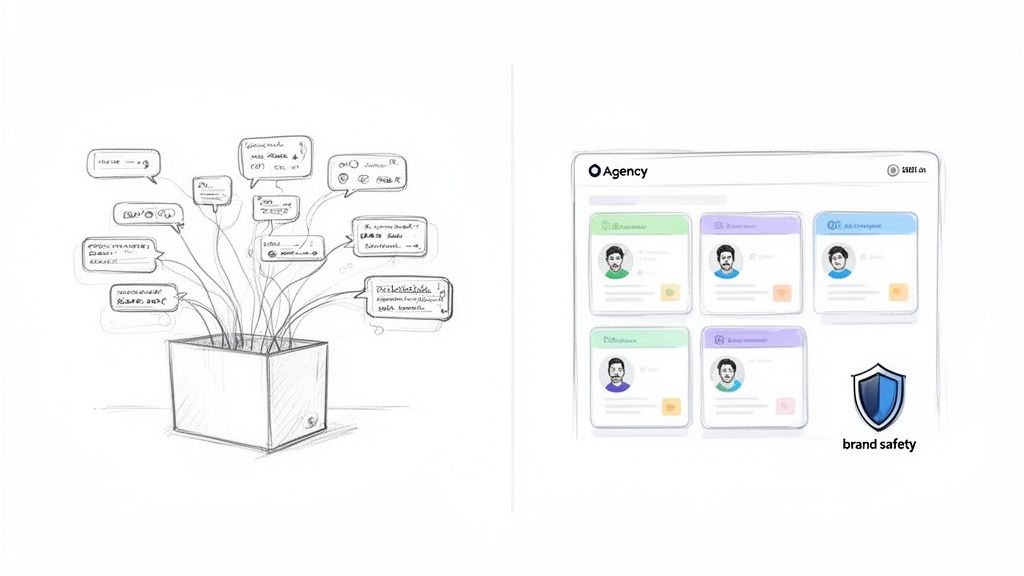
Case Study 1: The Direct-To-Consumer Product Launch
Picture a DTC beauty brand dropping a new, viral product. They've put a hefty budget behind their Instagram and Facebook ads, and the response is overwhelming. Within hours, their ads are flooded with thousands of comments: "Where can I buy this?" and "How much is it?"
Without automation, their small social team would be drowning, trying to manually reply to every single comment. Leads would go cold. Sales would be lost.
But with an automated system, the story changes completely. The second a user comments with clear purchase intent, a workflow kicks in:
Instant public reply: The system posts a comment like, "So glad you love it! We just sent a link to your DMs." This shows every other person scrolling that the brand is highly responsive.
Immediate, personalized DM: A direct message lands in the user's inbox with a link straight to the product page. To sweeten the deal, it includes a limited-time launch discount code.
Lead tagging: That user is automatically tagged as a "Hot Lead" in the smart inbox, making it simple for the sales team to track who converts.
The result is a frictionless path from an ad comment to a completed checkout. The brand converts a massive volume of inquiries directly into sales, maximizing its ad spend ROI.
Case Study 2: The Digital Marketing Agency
Now, let's look at a digital marketing agency managing a dozen client accounts. Each client has its own brand voice, active ad campaigns, and unique customer service needs. Manually keeping tabs on every comment and DM across all those accounts is practically impossible.
This agency uses a platform like Alto AI to manage its entire workflow from one central dashboard.
Their biggest challenges are protecting client reputations and qualifying leads. Their automation strategy is built around brand safety and smart lead qualification.
By automatically hiding spam, negative comments, and profanity 24/7, the agency provides a critical service that protects its clients' brand image and ad performance. This proactive moderation is a key selling point.
They also set up custom AI personalities for each client. This ensures every automated reply—whether it’s a quick answer or a lead nurturing message—perfectly matches that brand’s unique tone of voice. If you're curious to see more ways this can be implemented, you can find several actionable marketing automation workflow examples to get your ideas flowing.
This approach saves the agency hundreds of hours every month and lets them deliver a much higher-value service. They can back up their success with hard data, showing clients exactly how many leads were generated and nurtured through their social channels.
Automation Impact Breakdown By Industry
To see how this plays out across different business models, the table below breaks down the primary use cases and benefits for each.
Business Type | Primary Use Case | Key Benefit | Example Tool Feature |
|---|---|---|---|
E-commerce Brand | High-volume ad comment management | Maximizing sales conversions from ad spend | Automated DMs with product links and discount codes |
Digital Agency | Multi-client account management | Increased efficiency and brand safety | Unified inbox with custom AI personalities per client |
Info Product Seller | Lead generation from organic content | Qualifying and nurturing potential customers | Sentiment analysis to tag high-intent inquiries |
Local Business | Answering frequently asked questions | Improved customer service and saved time | Pre-set replies for hours, location, and services |
As you can see, the core idea is the same—using automation to handle repetitive tasks—but the application is tailored to solve the specific pains of each industry.
Frequently Asked Questions
Diving into social media marketing automation always brings up a few big questions. As you start thinking about your options, it's normal to wonder about the cost, what it means for your team, and how you keep your brand from sounding like a robot.
Here are straightforward answers to the questions we hear most often.
How Do Social Media Automation Tools Price Their Services?
There’s no single answer here, but most automation tools fall into a few pricing buckets. The most common model is a tiered subscription based on your contact volume or the features you need. Basically, you pay a monthly or annual fee that grows with your audience and the complexity of your needs.
A few things usually factor into the final price tag:
Number of Contacts/Conversations: Many platforms base their pricing on how many unique people you engage with each month.
AI Credits: If the tool uses generative AI to write replies, you'll often get a certain number of "AI credits." Each time the AI generates a response, it uses a credit.
Feature Tiers: You’ll see different plans. A basic one might just cover inbox management, while premium tiers add sentiment analysis, deep analytics, and more team collaboration tools.
Number of Seats: The price can also go up depending on how many team members need to log in and use the platform.
My advice? Always look for a tool with clear, scalable pricing. You don't want a surprise bill when your brand starts to take off.
Will AI Automation Replace My Social Media Manager?
No, absolutely not. Think of AI automation as a powerful assistant for your social media manager, not a replacement. It’s built to handle repetitive, high-volume tasks so your human team can focus on what actually requires a brain and a heart.
Automation handles the noise so your team can focus on the nuance. It zaps spam and answers easy questions, freeing up your social media manager to build community, dream up new strategies, and have meaningful conversations.
An AI can instantly answer, "What are your hours?" But you still need a human for:
Strategic Planning: Coming up with big ideas for campaigns and content.
Community Building: Creating real relationships and turning customers into fans.
Crisis Management: Handling tricky situations with empathy and tact.
Creative Content Creation: Making awesome videos, graphics, and copy that people actually want to see.
The magic happens when you pair them up. Automation brings speed and scale; your team brings quality and authenticity.
How Can I Make Sure My Automated Replies Sound Authentic?
This is the big one. Nothing screams "I don't care about you" like a generic, robotic response. The key is using tools that allow deep customization and sticking to a few simple rules to keep it real.
First, find a platform that lets you create custom AI personalities. This is a game-changer. You can "train" the AI on your brand's specific tone of voice, whether it’s witty, professional, or casual. You feed it examples of how you've replied in the past, and it learns to mimic your style.
Second, don't try to automate everything. That's a rookie mistake. Create rules that automatically flag complex or emotional comments and send them straight to a human. This ensures that sensitive issues get the personal touch they need.
Finally, check in on your automated replies regularly. Look at the data and see how people are responding. If a certain reply feels a little off, tweak it. A little bit of human oversight goes a long, long way in making automation feel surprisingly personal.
Ready to turn your social media comments into sales-ready conversations? With Meet Alto AI, you can deploy a 24/7 AI assistant that filters spam, captures leads, and replies in your unique brand voice. Stop letting leads slip through the cracks and see how our Meta-approved platform can maximize your ad ROI.