Mastering Reputation Management on Social Media
A practical guide to reputation management on social media. Learn to protect your brand, manage crises, and build customer trust on Facebook and Instagram.

Alto AI
on
Jan 22, 2026
When someone talks about "reputation management" on social media, they're talking about the active, hands-on process of watching, shaping, and defending how your brand shows up on places like Facebook and Instagram. It's so much more than damage control. It's a proactive game plan for building real trust, connecting with your audience, and turning all that social chatter into something that actually helps your business grow.
Why Social Media Reputation Is Your Most Valuable Asset
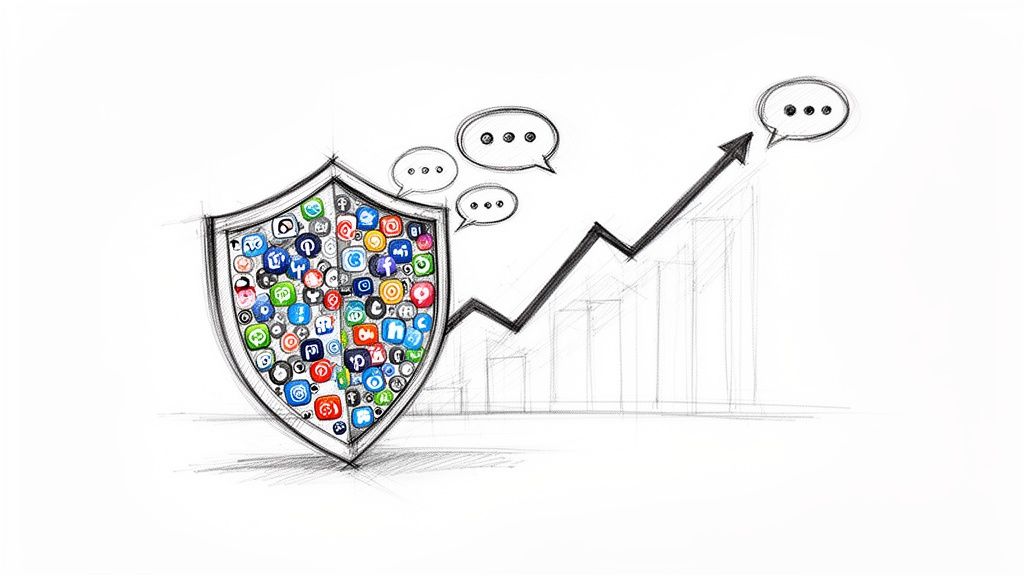
Let's get one thing straight: managing your reputation isn't just a "nice-to-have." In today’s world, how people see your brand on social media directly hits your bottom line. It sways everything from your ad performance to customer loyalty and, yes, your sales.
Think about it. A single negative comment that catches fire can completely derail a well-funded campaign. A string of unanswered questions can slowly but surely chip away at the trust you've worked so hard to build.
This isn't meant to be scary—it's about seeing the opportunity. The cost of ignoring this stuff is very real, but the payoff for getting it right is massive. For any e-commerce or DTC brand, where social proof is basically currency, this is even more critical. Your Facebook comments and Instagram DMs aren't just support tickets anymore. They're your new storefront.
The Real-World Business Impact
The line connecting online perception to actual revenue has never been clearer. Let's look at the numbers and what they mean for your business.
The High Stakes of Social Media Reputation
Statistic | Impact on Your Business |
|---|---|
90% of consumers say online reputation influences their buying choices. | A negative perception means you're losing customers before they even consider your product. |
Brands that actively engage see a 20-40% increase in customer spending. | Responding and building community directly translates into higher customer lifetime value. |
A single viral negative comment can derail an entire campaign. | One unchecked issue can wipe out your ad spend and damage brand equity overnight. |
Unanswered questions and DMs erode consumer trust. | Silence is perceived as indifference, pushing potential customers toward more responsive competitors. |
These figures tell a simple story: every single interaction is a chance to either build up that trust or watch it crumble. Leaving this to chance is like leaving cash on the table for your competitors to scoop up.
Your brand's reputation isn't built by what you say about yourself. It's built from thousands of tiny interactions—the replied-to DMs, the resolved complaints, and the acknowledged compliments—that happen every single day on your social channels.
From Defense to Offense
A solid approach to reputation management on social media shifts your presence from a potential liability to one of your strongest assets. It’s about building a system that doesn't just put out fires but actively hunts for chances to make a customer's day and cement their loyalty.
Here's why having a clear playbook is a must:
Better Ad ROI: When people see positive sentiment and real engagement in your ad comments, it can actually lower your CPCs and boost conversion rates. Social proof works.
Stronger Customer Loyalty: A quick, empathetic response can turn someone who's frustrated into one of your biggest fans. I've seen it happen time and time again.
Actionable Business Intel: Social media conversations are an absolute goldmine. You get raw, unfiltered feedback that can guide everything from product tweaks to your next big marketing campaign.
To really get into the weeds on tactics, this actionable guide to reputation management in social media is a great resource. By getting a structured plan in place, you can finally turn that unpredictable social chatter into a reliable engine for growth.
Building Your Social Listening and Monitoring System
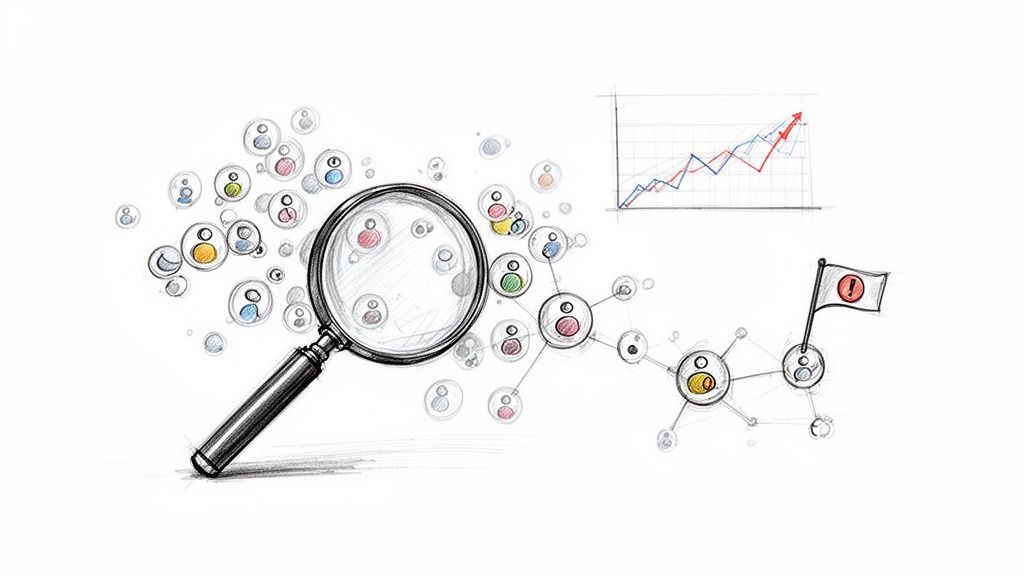
You can't manage your reputation if you don't know what people are saying, where they're saying it, and what it all means. This isn't just about catching direct @mentions. It's about building an early warning system that captures the entire conversation happening around your brand.
Think of it like setting up a radar. Without one, you're flying blind, only reacting to problems after they’ve already lit up your dashboard. A solid monitoring system turns random social chatter into organized, actionable intelligence.
Configuring Your Listening Tools
First things first: you need to tell your tools exactly what to listen for. A classic mistake is to only track your main brand handle. This leaves massive blind spots where valuable feedback—and potential crises—can quietly fester.
To build a truly comprehensive net, you need to track a much wider range of keywords and phrases. To get a handle on what's being said and automate some of the initial grunt work, implementing robust systems for AI brand monitoring is a game-changer. This approach ensures you catch conversations even when you aren't directly tagged.
Your tracking list needs to cover a few key categories:
Brand and Product Names: Get everything in there—official names, common abbreviations, and even frequent misspellings. If your customers often type "AltoAI" instead of "Meet Alto AI," you need to be listening for both.
Executive Names: Key public-facing figures like your CEO or founder are extensions of your brand. Monitoring their names helps you stay ahead of PR opportunities or personal criticisms that could spill over and affect the company.
Campaign Keywords and Hashtags: Track any unique slogans or hashtags tied to your marketing efforts. This is crucial for measuring resonance and spotting any negative sentiment that might be hijacking your campaign.
Competitor Mentions: Keep an eye on conversations about your direct rivals. This is an absolute goldmine for finding their customers' pain points—problems you might be able to solve—and highlighting broader industry trends.
Understanding Sentiment at a Glance
Once your tools are pulling in mentions, the next step is adding a layer of intelligence with sentiment analysis. This is all about using technology to automatically tag mentions as positive, negative, or neutral, giving you a real-time pulse check on your brand's health.
A sudden dip in sentiment can be your very first sign that something’s wrong, long before it blows up into a full-blown crisis. For instance, if you launch a new feature and your sentiment score tanks by 15%, that’s a flashing red light telling you to dig into user feedback immediately.
A sudden shift in sentiment is the digital equivalent of a smoke alarm. It doesn't tell you the exact size or location of the fire, but it screams that you need to start looking for the source right now.
Most modern social media tools have this feature built-in, and frankly, it's non-negotiable for any serious reputation management on social media strategy. If you're looking to really get into the weeds of this tech, exploring different https://meetalto.ai/blog/social-media-sentiment-analysis-tools can show you what's possible. This is how your team moves beyond just counting mentions and starts understanding the feeling behind them.
Spotting Trends and Emerging Crises
Your listening system isn't just a defensive tool; it's also a powerful source of business intelligence. When you analyze conversation volume and sentiment over time, you can spot patterns that should inform your entire strategy.
For example, you might notice a recurring set of questions about your shipping policy popping up every single month. That's not a crisis, but it's a crystal-clear signal that your shipping info is confusing. This insight allows you to proactively create an FAQ post or update your website, which reduces customer friction and frees up your support team.
Likewise, an unusual spike in mentions—even neutral ones—is always worth investigating. Did an influencer post about your product? Is a new trend taking off in your industry? Staying on top of these shifts lets you join relevant conversations authentically and jump on organic opportunities. This proactive mindset is what separates basic monitoring from a truly strategic listening program.
Using Automation as Your First Line of Defense
Let's be real: managing a brand's reputation is a 24/7 gig, but your team can't be plugged in around the clock. This is where automation stops being a buzzword and becomes your most valuable player. It's an always-on filter, handling the background noise so your team can jump into the conversations that actually matter.
Think of automation less as a replacement for your team and more as a smart triage system. It's your first line of defense against the daily flood of spam, trolls, and the same five questions you get every day. It keeps your social channels clean and productive, freeing up your people to handle the tricky, high-stakes interactions where a human touch is non-negotiable.
Setting Up Smart Automation Rules
The goal isn't to automate every single interaction—that's how you sound like a robot and alienate your audience. The key is to be strategic. You're aiming to automate the predictable, high-volume stuff that eats up the most time.
Here are a few of the most effective rules you can put in place right now:
Instantly Hide Spam and Profanity: This is ground zero. Set up rules that automatically hide comments packed with spammy links, hate speech, or profanity. This one move cleans up your comment threads in real-time, protecting both your community and your brand before a human ever has to get involved.
Auto-Reply to Common Questions: Get a handle on your top 3-5 most frequently asked questions. You know the ones: "Do you ship to Canada?" or "What's the return policy?" Create saved, AI-powered replies that deliver instant, accurate answers. It’s a quick win that satisfies customers and shrinks your team’s to-do list.
Flag and Escalate Urgent Issues: This is where automation really shines. You can create keyword triggers for high-stakes terms like "scam," "broken," "unsafe," or "never received." When a comment or DM pops up with one of these words, the system can instantly flag it as high priority and shoot a notification to the right person for immediate review.
Using AI for Triage and Prioritization
Modern tools go way beyond basic keyword flags. With AI-driven sentiment analysis, you can automatically sort and categorize incoming messages, which is a massive step up for reputation management on social media.
The point of automation isn’t to build a wall between you and your customers. It's to build a smart, efficient bridge that gets the right people to the right conversations, faster than ever before.
An AI, for instance, can tell the difference between a sarcastic comment and a genuinely furious one, tagging each accordingly. This lets your team open their inbox and immediately see what's on fire, what can simmer for a bit, and what's positive feedback they can amplify. A well-tuned system for Instagram comment automation can turn an inbox nightmare into a clear, prioritized workflow.
And the stakes are only getting higher. By 2026, the volume of fake reviews is projected to hit 30-40% across online platforms, and we know social media crises spread 1200% faster than traditional news. Couple that with the fact that 73% of users expect a brand to reply within 24 hours, and you can see why AI-powered filtering is no longer a "nice-to-have." For more on the evolving landscape of social reputation, Sprout Social offers some great insights.
This blend of rules-based automation and AI intelligence creates a powerful shield for your brand. It means that while you're offline, your reputation is being actively protected, your customers are getting instant help with basic questions, and any potential crisis is flagged and waiting for your team first thing in the morning. This is what separates brands that just survive on social media from those that actually thrive.
Developing Your Response and Escalation Playbook
Automation is great for filtering out the noise, but your human team is where your brand's reputation is truly forged. A clear, documented playbook for responding to comments and escalating issues is the difference between controlled, brand-building interactions and a chaotic, damaging free-for-all.
This isn't just about having canned responses ready to go. It’s about defining your entire philosophy of engagement. A good playbook empowers your front-line team to act decisively but gives them clear guardrails for when to loop in senior staff.
Think about it: every single interaction, from a glowing review to an infuriated complaint, is an opportunity. Get it right, and you can turn a critic into a lifelong fan.
Crafting Response Templates for Every Scenario
Standardizing your responses helps maintain a consistent tone and quality, but templates should always be a starting point, not a rigid script. The real goal is to provide a framework your team can personalize, making every interaction feel authentic.
I recommend breaking your templates into a few common categories:
Positive Feedback: Go beyond a simple "Thanks!" Acknowledge a specific detail from their comment. If they loved the new feature, thank them for noticing the hard work that went into it. Ask a follow-up question to keep the conversation going.
General Questions: Give a direct, helpful answer. When you can, link to a useful resource like a blog post or an FAQ page. It shows you’re being thorough and saves them a step.
Negative Feedback: This is the most critical bucket. Your template here should always start by acknowledging their frustration and apologizing for the experience. Then, immediately offer to take the conversation to a private channel (like DMs) to sort it out. For a deeper dive, our guide on how to respond to negative comments has more advanced strategies for these high-stakes moments.
A simple decision tree can help automate the initial sorting of these comments, which is a huge time-saver. It lets your team skip the spam and focus their energy on the conversations that require a human touch.
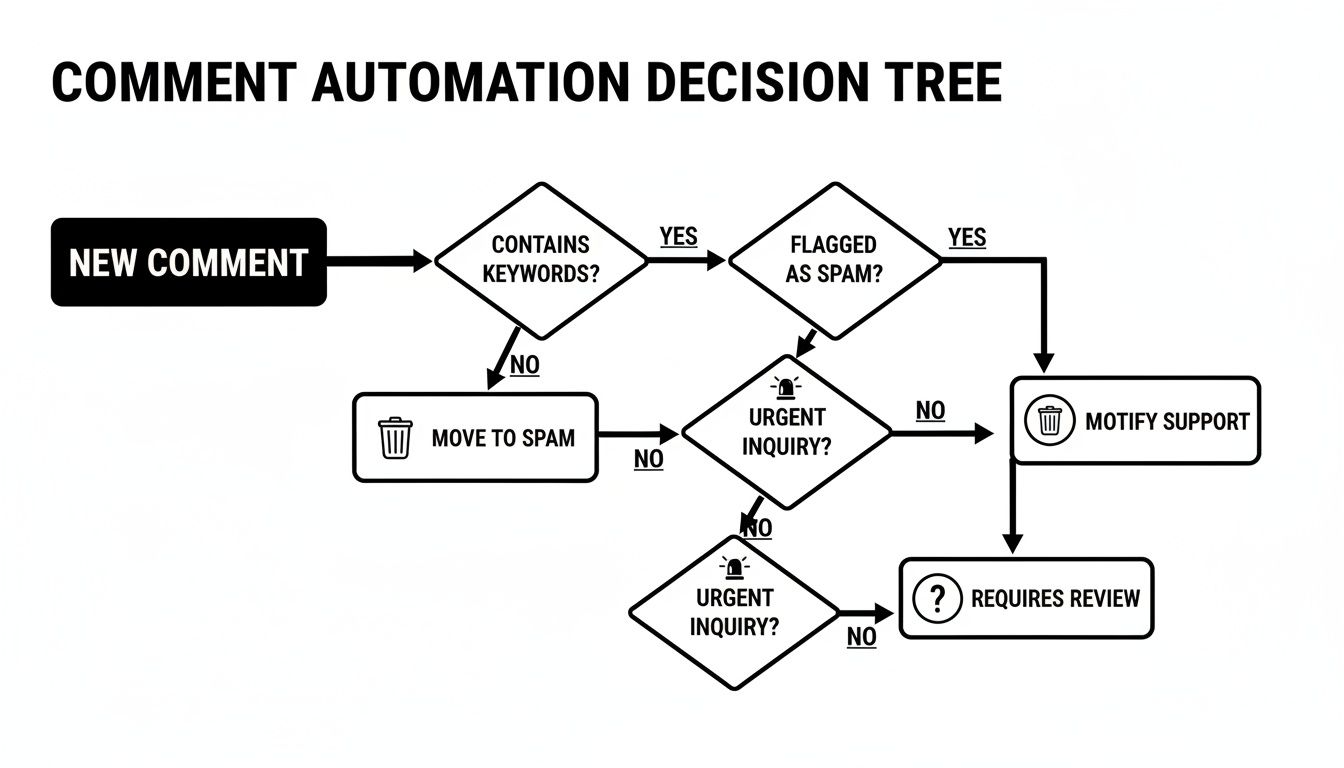
As you can see, this kind of flow automatically filters comments, flagging the simple questions for quick replies and pushing the urgent stuff straight to the front of the line.
Defining Your Escalation Flowchart
Your social media manager can't—and shouldn't—handle every single issue that comes through. A clear escalation path prevents your front-line team from being put in impossible situations and makes sure sensitive issues get the right expertise, fast.
The moment a customer complaint mentions legal action, safety concerns, or a potential data breach, it stops being a social media issue. It becomes a company-wide priority, and your escalation plan needs to reflect that urgency.
An escalation matrix is the simplest way to make this crystal clear for everyone on your team. It maps out exactly who handles what, removing the guesswork when time is of the essence.
Here’s a basic template to show you what I mean.
Response and Escalation Matrix
This matrix helps your team quickly determine the right course of action for different types of comments or messages, ensuring a timely and appropriate response.
Scenario Type | Recommended Initial Action | Escalation Trigger | Final Owner |
|---|---|---|---|
Product Complaint | Empathize, offer DM support. | Multiple similar complaints emerge. | Product Manager |
Shipping Issue | Apologize, ask for order # in DM. | User claims fraud or theft. | Customer Support Lead |
Technical Glitch | Acknowledge, ask for details. | Widespread outage reported. | Engineering Lead |
Legal Threat | Do not engage. Flag internally. | Any mention of "lawyer" or "sue." | Legal Department |
A simple chart like this removes ambiguity and minimizes response delays when the stakes are high, ensuring the right people are involved from the get-go.
Turning Negatives into Trust-Building Moments
Don't underestimate the power of a well-executed response. Social media has become a primary 'Trust Engine' for modern brands. Research shows that 71% of consumers are more likely to recommend a brand that provides a positive experience on social media.
What's more, brands that transparently address problems can gain 65% more trust from their audience. Handling criticism well isn't just about damage control; it's a powerful way to build loyalty.
I saw a great real-world example of this recently. A direct-to-consumer clothing brand got a wave of comments about inconsistent sizing on a new item. Instead of deleting the comments, they posted a public acknowledgment. They thanked everyone for the feedback and announced they were updating the product page with more precise measurements based on what customers were saying.
They turned a product flaw into a public demonstration of their commitment to listening.
That's the core of effective reputation management on social media. It’s not about being perfect. It's about being present, accountable, and human when things go wrong. Your playbook is the tool that makes it possible for your team to do that consistently, turning your social channels from a potential liability into your greatest asset for building lasting customer relationships.
Navigating a Full-Blown Social Media Crisis
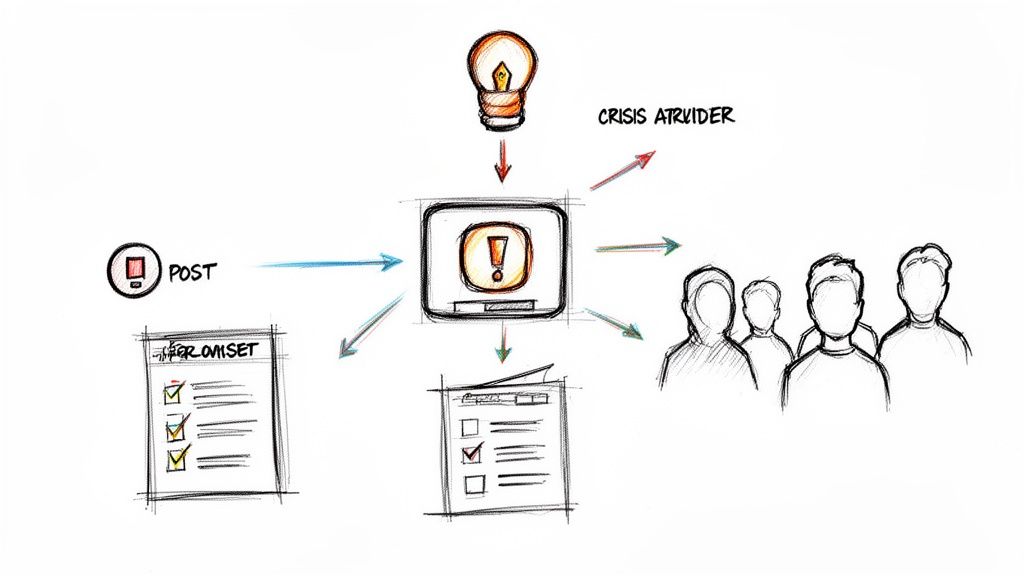
Even with the best planning in the world, sometimes a small issue can catch fire and turn into a full-blown crisis. A single viral video, a product safety scare, or a comment that lands badly can completely hijack your brand's narrative in minutes. When that happens, panic is your worst enemy. A clear, pre-defined plan is your only way out.
This isn’t just theory. Social media moves at the speed of light, far faster than traditional news cycles. A structured crisis management plan is the only way you’ll regain control and protect your brand when the pressure is on.
The Immediate First Steps
The second you confirm a crisis is brewing, your first moves are everything. You need speed, and you need control. Before you even begin to think about what you're going to say publicly, you have to lock down your own outgoing communications to stop pouring fuel on the fire.
Here's your immediate checklist:
Pause All Scheduled Content: Hit the brakes on every single pre-scheduled post, ad, and automated campaign across all your channels. The absolute last thing you need is a cheerful, tone-deaf promotion popping up while your brand is under siege.
Assemble Your Crisis Team: Get your pre-designated crisis team on a call—now. This group should include key players from social media, PR, legal, and leadership. Everyone needs to know their exact role and report to a single point person to avoid chaos.
Establish a "Single Source of Truth": Create a central communication hub, like a dedicated Slack channel or a live document. This is where all verified information and approved messaging will live. It’s a simple step that prevents conflicting statements and ensures your entire team is working from the same script.
Crafting Your Initial Holding Statement
Look, you're not going to have all the answers right away, and that's fine. Your first public message isn’t about solving the problem. It’s about showing you’re aware, you’re taking it seriously, and you're in control. This is where a holding statement comes in.
This first message needs to be quick, empathetic, and factual. It typically has just three core parts:
Acknowledge the situation: "We are aware of the issue regarding [brief, neutral description of the event]."
State you are investigating: "We are looking into this with the utmost urgency to understand what happened."
Provide a timeline for the next update: "We will share more information here by [Time/Date]."
This simple statement buys you precious time to gather the facts without looking like you’re dodging the issue. Silence during a crisis often looks a lot like guilt or incompetence, so getting a holding statement out the door fast is a non-negotiable part of your reputation management on social media crisis plan.
A crisis doesn't become a disaster because of the initial problem. It becomes a disaster because of a poor response. Your first actions set the tone for the entire recovery process.
Communicating with Empathy and Transparency
As you get more information, your communication needs to evolve from just acknowledging the problem to actively addressing it. The tone you strike here is critical. Ditch the corporate jargon and defensive language. It’s time to speak like a human.
Lead with empathy. Acknowledge the frustration, anger, or concern your audience is feeling. Even if the problem wasn't entirely your fault, you need to own the response. Simple phrases like, "We understand why you're upset" or "We are deeply sorry for the concern this has caused" can make a huge difference.
Then, be as transparent as you possibly can. Share what you know, what you’re doing to fix it, and the steps you’re taking to make sure it never happens again. If you messed up, just say it. People are far more forgiving of brands that own their mistakes than those that try to hide or deflect blame.
The Post-Crisis Analysis
Making it through the storm isn't the end of the road. In fact, once things have calmed down, the most important work begins: the post-crisis analysis. This is your chance to turn a negative event into a powerful learning opportunity that makes your brand stronger.
Get the crisis team back together for a thorough debrief. This is the time for hard questions. What parts of our response went well? Where were our blind spots? Could our monitoring have caught this sooner? What broke down in our escalation process?
Document every single finding. Use these insights to refine your crisis plan, update your response templates, and improve your internal workflows. A crisis is a painful, high-stakes test of your brand’s resilience. The real goal of effective reputation management isn’t just to survive—it’s to emerge stronger, with lessons learned and a better plan in hand.
Measuring Success and Proving the ROI of Your Efforts
All the work you put into managing your brand’s reputation on social media means very little if you can’t show its value. Proving your efforts are a key business driver, not just another cost center, is absolutely essential.
To do this, you have to move beyond vanity metrics like likes and followers. Instead, you need to focus on the data that truly reflects your brand's health and, ultimately, its impact on the bottom line.
Think of it this way: your social media activity generates a mountain of data. The real challenge is connecting that data to tangible business outcomes. By tracking the right key performance indicators (KPIs), you can build a clear narrative that shows stakeholders exactly how protecting your brand's reputation pays off.
Key Metrics for Your Reputation Dashboard
A simple, focused dashboard is your best friend for communicating success. Instead of drowning stakeholders in dozens of charts, concentrate on a handful of core metrics that tell a powerful story. Your dashboard should give anyone a clear, at-a-glance view of your brand’s reputational health.
Here are the essential KPIs I always recommend including:
Overall Sentiment Score: This is your big-picture metric. Track the percentage of positive, negative, and neutral mentions over time. A rising positive sentiment score is a direct signal that your engagement strategies are hitting the mark.
Average Response Time: How quickly is your team actually getting back to comments and DMs? This metric is a direct measure of your commitment to customer care. A faster response time almost always correlates with higher customer satisfaction and can stop minor issues from blowing up.
Share of Voice (SOV): This KPI measures your brand’s visibility compared to your direct competitors. A growing SOV shows that your brand is becoming a more prominent part of the industry conversation, which is a key goal of proactive reputation building.
Volume of Negative Mentions: Keep an eye on the raw number of negative comments and messages. A consistent decrease here is solid proof that your proactive content and crisis prevention efforts are working.
Connecting Social Metrics to Business Outcomes
Tracking these social KPIs is the first step, but the real magic happens when you link them to actual business results. This is how you prove the direct return on investment (ROI) of your tools and your team.
It transforms the conversation from "we answered 500 comments" to "our faster response time contributed to a 5% lift in customer retention."
The ultimate goal isn't just to report on social media activity; it's to demonstrate how that activity drives revenue, reduces costs, and builds long-term brand equity. Your data should tell a business story, not just a social one.
For example, you can correlate an improvement in sentiment around your ad comments with a higher Return on Ad Spend (ROAS). It makes sense, right? When potential customers see positive, helpful interactions on your ads, their trust in your brand increases, making them much more likely to convert.
By using a tool like Meet Alto AI to filter and respond to comments efficiently, you directly support your paid media goals. This is how you show that excellent reputation management isn't just a defensive play—it's a powerful engine for growth.
A Few Final Questions
How Can a Small Team Manage Reputation 24/7 Without Burning Out?
For a lean team, trying to be everywhere at once is a direct path to burnout. The secret isn't more hours; it's smarter automation.
Start by funneling all your comments and DMs into a single, centralized inbox. From there, you can set up automation rules to instantly hide spam and comments with profanity. You can even use AI to handle the simple, repetitive questions that eat up so much time.
This clears out the low-level noise automatically. Next, create keyword alerts for high-stakes terms like "angry," "refund," or "legal." That way, your phone only buzzes after hours for the stuff that actually matters. This mix of smart automation and targeted alerts gives you round-the-clock protection without needing someone glued to a screen.
A quick note on terms: Social monitoring is reactive. It’s all about tracking and responding to direct mentions of your brand—the conversations happening to you. Social listening, on the other hand, is proactive. It’s about tuning into the broader conversations around your industry, competitors, and key topics to spot trends before they hit.
Should We Delete Negative Comments on Our Ads?
This is a tricky one, and the answer is almost always: it depends.
If it's legitimate criticism, deleting it can seriously backfire. Nothing screams "we have something to hide" faster. Your best move is to reply publicly, show some empathy, and then offer to take the conversation to a private channel like DMs to sort it out.
However, if a comment is pure spam, contains hate speech, or clearly violates community standards, you should absolutely hide or delete it. The key is to have a clear, written moderation policy and stick to it every single time. Consistency is your best friend here.
Turning your comments and DMs into an asset isn't just a defensive move—it's a proactive strategy. When you centralize conversations, automate the repetitive work, and filter out the noise, you do more than just protect your brand. You create opportunities to convert more customers, and you do it with less manual effort. See how a smart inbox from Meet Alto AI can streamline your entire reputation management workflow.