What Is Conversational Marketing? A Beginner's Guide to Turning Chats into Sales
Learn what is conversational marketing and how to harness it on Instagram and Facebook to boost engagement, sales, and loyalty.

Alto AI
on
Feb 23, 2026
What Is Conversational Marketing? A Beginner's Guide to Turning Chats into Sales
Are you tired of shouting into the void with one-way marketing blasts that get ignored? Over 90% of business leaders now see conversational marketing as essential because it directly boosts sales. It’s a complete shift from broadcasting to engaging in real-time, one-on-one dialogues that build relationships and guide customers through their buying journey.
This guide will break down exactly what conversational marketing is, why it's no longer optional, and how you can use it to turn your social media interactions into a reliable revenue stream. Forget megaphones; it’s time to start a conversation.
From Megaphones to Meaningful Dialogue: The Core Concept
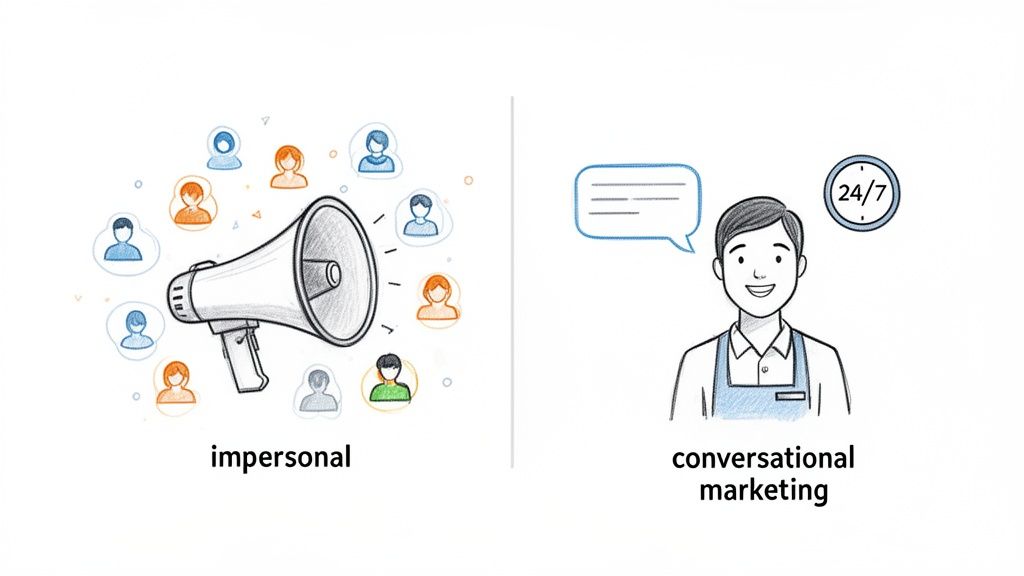
For decades, marketing was a one-way street. Brands blasted mass messages through TV ads, billboards, and generic emails, hoping a tiny fraction would listen. This traditional approach is impersonal, slow, and works on the brand's schedule, not the customer's.
Conversational marketing flips this model on its head. Instead of broadcasting, you engage in personal, one-on-one dialogues. The strategy is built on a simple yet powerful idea: treat customers like people, not leads. It's about building relationships through real-time interactions on the channels your customers already use, like Instagram DMs and Facebook Messenger.
This approach is feedback-driven and puts the customer’s immediate needs first. It’s defined by a few core principles:
Real-Time Engagement: Conversations happen the moment a customer is ready, not hours or days later.
Personalization at Scale: Interactions are tailored to the individual's context, questions, and history with your brand.
Building Relationships: The main goal is to create trust and loyalty, not just push for a quick transaction.
To truly master this, you need to understand the principles of human-centered conversational design, which focuses on creating natural and intuitive user experiences.
Conversational Marketing vs. Traditional Marketing
The difference between the two is stark. One is about interruption; the other is about invitation. Let's break down what that looks like in practice.
Aspect | Traditional Marketing | Conversational Marketing |
|---|---|---|
Communication | One-way broadcast (brand to customer) | Two-way dialogue (brand <> customer) |
Timing | Brand-scheduled (campaigns, ad slots) | Customer-led (real-time, on-demand) |
Approach | Impersonal and generic | Personal and contextual |
Goal | Generate leads, make a sale | Build relationships, create loyalty |
Channels | TV, radio, print, email blasts | DMs, comments, live chat, SMS |
This shift is critical for modern e-commerce brands. Using AI for social media marketing is the key to scaling these personal interactions without overwhelming your team.
Key Takeaway: The fundamental change is moving from talking at your audience to talking with them. This simple shift unlocks higher engagement, better leads, and more sales from your social channels.
This new model isn't just about being friendly; it's about being effective. It meets customers exactly where they are—whether in an Instagram DM, a Facebook comment, or a website chat—at the precise moment they show interest.
Why You Can't Afford to Wait on Conversational Marketing
Ignoring the shift to conversational marketing is like a retail store in 2005 deciding not to build a website. You're not just missing a trend; you're choosing to become invisible to a massive part of your market. Modern buyers demand immediate, one-on-one chats on platforms like Instagram and Facebook, and they won't tolerate slow, impersonal brands.
When a customer messages you, they expect a reply in under 10 minutes. If they don't get one, they don't wait around. They move on, usually straight to a competitor who's ready to talk.
The biggest mistake is seeing this as a "nice-to-have." In reality, it's a fundamental shift in consumer behavior. Every unanswered DM, every ignored comment, and every slow email is a tangible loss—a lost sale, a frustrated customer, and a blown opportunity to build loyalty.
The Data Tells a Clear Story
This isn't just anecdotal; the numbers paint a stark picture. Conversational marketing is so critical that 92% of business decision-makers now consider it essential. This is a direct response to a powerful realization: conversations sell.
In fact, a whopping 80% of companies report an increase in sales after implementing conversational techniques, with 68% seeing better customer retention. The financial upside is undeniable.
These stats highlight a simple truth. Engaging in real-time dialogue isn’t just good customer service; it's a direct driver of revenue and loyalty. The brands that get this see immediate returns.
Increased Sales: By instantly answering product questions and guiding customers, you remove friction from the buying process. The result is higher conversion rates.
Better Retention: When customers feel heard and valued through personal interaction, they’re far more likely to return.
Improved Ad ROI: Turning comments on your social ads into direct conversations captures high-intent leads that would otherwise scroll away, making your ad spend work much harder.
This new reality requires a new playbook. Check out our guide on how to master social media lead generation to turn these interactions into measurable results.
The Growing Cost of Inaction
What happens to brands that stick to the old one-way communication model? The consequences get worse over time. You don’t just stagnate; you actively lose ground.
First, your customer experience plummets. Potential buyers are left with unanswered questions, leading to frustration and abandoned carts. Your brand starts to look unresponsive and out of touch.
Second, your marketing becomes less effective. While competitors are building relationships in the DMs, you're still shouting into the void with generic blasts. Your cost per acquisition creeps up as your messages fail to connect with an audience craving personal interaction.
Finally, your team burns out. Trying to manually keep up with the flood of comments and messages is an impossible task. Valuable leads slip through the cracks, and your team wastes time on repetitive tasks instead of focusing on conversations that drive sales.
Your Key Channels and Metrics for Success
To win at conversational marketing, you must nail two things: knowing where to talk to customers and knowing how to measure what's working. It’s not about being everywhere at once. It’s about being smart and focusing on the channels where a single chat can lead directly to a sale.
For any modern e-commerce or DTC brand, the real action is on Instagram and Facebook. These platforms are no longer just for posting pretty pictures; they're conversational goldmines. It's where your customers hang out, and it's where they expect to connect with you.
The proof is in the numbers: a staggering 75% of consumers now prefer to message a brand privately over using traditional channels. Research also shows that 9 out of 10 consumers want the option to message businesses. As the latest insights on the rise of conversational marketing show, this is a massive shift in how people shop.
Identifying Your Most Valuable Channels
Let’s get specific. Instead of just thinking "social media," pinpoint the exact places on Instagram and Facebook where high-intent conversations happen.
Instagram & Facebook DMs: This is your direct line. When someone slides into your DMs with a product question or a Story reply, they need an answer now.
Ad Comments: A comment on your paid ad like, "How much?" or "Do you ship to Canada?" is a lead waving their hand. The classic play is to reply publicly and then immediately move to the DMs to close the deal.
Organic Post Comments: Just like ad comments, these show someone is actively paying attention. A quick, helpful reply can turn a casual follower into a first-time customer.
Instagram Story Replies: When someone replies to your Story, they're reacting to something timely. This is as warm as a lead gets. A quick, conversational reply can guide them right to checkout.
Juggling these touchpoints can get messy fast. To learn how to bring these conversations into one place without your team losing their minds, check out our guide on strategic social media inbox management.
Moving Beyond Vanity Metrics
So, you know where to play. Now, how do you keep score? Likes and follower counts don't pay the bills. Success in conversational marketing is about metrics that tie directly to business growth.
The goal is to move from tracking "busyness" to tracking business. It's not about how many messages you send, but how many of those messages lead to revenue.
Here are the KPIs that actually matter.
Essential Conversational Marketing KPIs
Metric | What It Measures | Why It Matters |
|---|---|---|
First Response Time | The average time it takes to send the first reply to a new message. | Speed is everything. A fast response shows you respect the customer's time and dramatically boosts your chances of making a sale. |
Conversation-to-Lead Rate | The percentage of conversations that turn into a qualified lead (e.g., getting an email). | This shows your chats are actually capturing valuable customer information for future marketing and follow-ups. |
Conversation-to-Sale Rate | The percentage of conversations that end in a direct purchase. | This is the money metric. It's the ultimate proof that your conversational efforts are generating cold, hard cash. |
Conversational ROI | The total revenue from conversations divided by the cost of your efforts (tools, team time). | This KPI gives you a clear financial picture and proves the value of your investment to leadership. |
Tracking these numbers gives you a clear view of what’s driving growth. By focusing on these specific channels and KPIs, you're not just chatting with customers—you're building a system that reliably grows your business.
How to Build Your Conversational Marketing Engine
Moving from chaotic, manual processes to a well-oiled machine is the entire point of a conversational marketing engine. This is where you put your strategy to work on Instagram and Facebook, creating repeatable workflows that capture leads and drive sales, even while you sleep.
The goal isn't just to reply faster; it's to build a system that turns every interaction into a measurable business outcome. You’ll go from "managing" your inbox to actively monetizing it by setting up specific playbooks for common scenarios.
Building this engine comes down to three core phases: choosing your channels, measuring what happens, and optimizing your approach over and over.
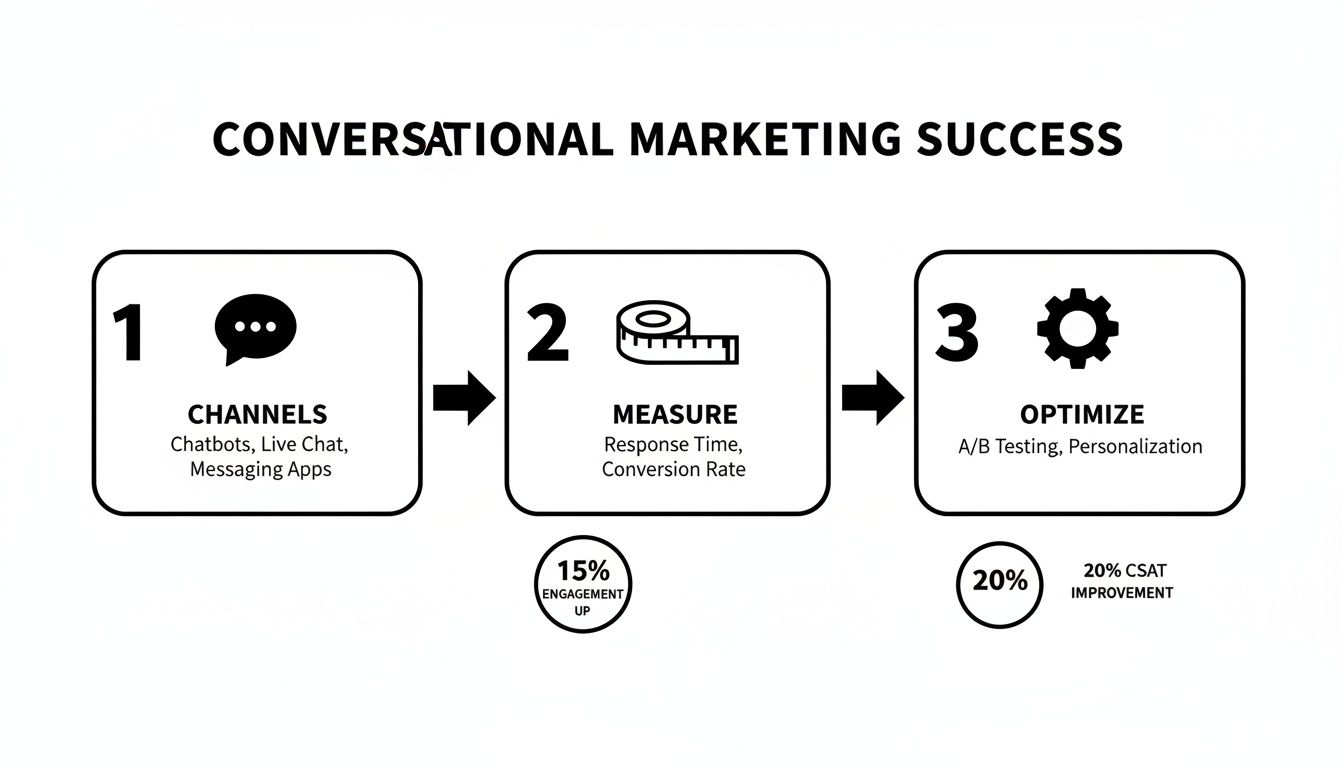
This is a loop, not a one-and-done setup. You constantly measure what’s working and fine-tune your engine to get better results.
Start With High-Impact Automation Playbooks
Instead of trying to automate everything at once, focus on workflows that give you the biggest bang for your buck. For e-commerce brands on Instagram and Facebook, a few clear winners stand out.
Here are two essential playbooks to build first:
The Comment-to-DM Automation: This is the most powerful play for brands running paid ads. When a user comments with a buying signal ("How much?" or "Got this in blue?"), an automated workflow instantly replies in the comments and sends a private DM to start a one-on-one chat. This captures the lead while their interest is red-hot.
The Story Reply Flow: When someone replies to your Instagram Story, they are highly engaged. Set up an automation that instantly responds, answers their question, and provides a direct link to the featured product. This simple flow turns a casual interaction into a direct path to purchase.
Just implementing these two automations can dramatically boost your lead capture. You can learn more in our guide to social media marketing automation.
Key Takeaway: The goal of these playbooks is to immediately move public interactions into private, one-on-one conversations. This is where you can qualify leads, handle objections, and guide customers toward a purchase without the noise of a public comments section.
Handling Common Customer Scenarios With Speed
Once your core automations are running, you can build flows for various customer interactions. The key is to provide instant, helpful responses that solve the customer's problem fast.
Here’s how you can tackle a few common scenarios:
Purchase Inquiries: A customer DMs, "I'm interested in the new sneakers." Your engine should ask qualifying questions like, "Great choice! What size are you looking for?" and then provide a direct link to the product page.
Product Questions: A user asks, "Is this product vegan?" Your system should tap into a knowledge base to instantly reply, "Yes, it is! All our products are 100% vegan," and then ask, "Would you like me to add it to your cart?"
Customer Issues: A customer messages, "My order hasn't arrived." An automated flow should ask for their order number, check the status, and give an immediate update.
The business impact of these flows is huge. Conversational marketing can increase conversion rates by up to 45%. Messaging gets three times higher engagement than classic email marketing, and Facebook Messenger delivers a 30% higher ROI compared to retargeting ads.
How to Scale Your Strategy With AI
Manually replying to every comment, DM, and story reaction is a fantastic strategy—until it works too well. The moment your brand gets real traction, that manual approach becomes your biggest bottleneck. Suddenly, you're facing missed leads, slow responses, and a comments section buried in spam.
This is precisely where AI becomes your most valuable player. Trying to scale conversational marketing without the right tools is like trying to manage a warehouse by hand—chaotic, inefficient, and bound to break down.
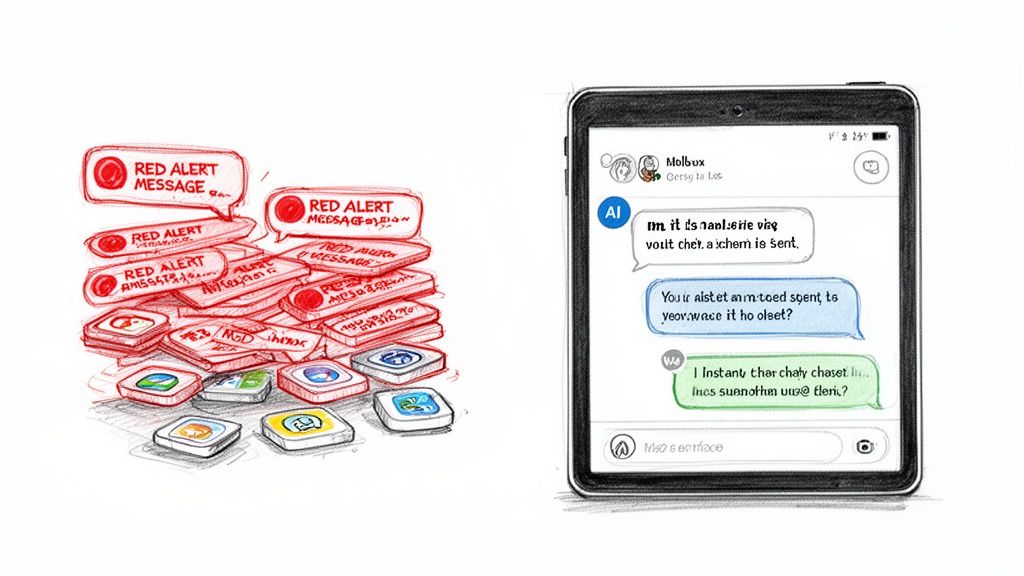
From Manual Chaos to Automated Conversion
Imagine a DTC brand running a killer ad campaign. Comments pour in: "How much?" "Do you ship to Australia?" Buried under hundreds of notifications, the social media manager only gets to a fraction of them. That's the "before" picture—a team drowning in manual work and losing sales.
Now, imagine that same brand using Meet Alto AI. The second a comment is posted, a custom AI personality—trained on the brand’s unique voice—instantly replies. It answers questions, hides spam, and even sends a DM to start a sales chat. High-intent leads are automatically tagged and pushed to the top of the queue. That's the "after" picture—a lean team turning social buzz into revenue.
Alto isn’t just another tool; it’s a complete system for turning social conversations into a predictable revenue stream. It ends the chaos and ensures no lead is ever missed.
Platforms like Meet Alto AI completely change the game. Instead of your team being a bottleneck, they become strategists overseeing an AI-powered engine. To see how this applies beyond comments, our guide on AI for social media management digs into automating your entire workflow.
The Power of a Unified and Intelligent Inbox
The first step to scaling is to stop juggling multiple apps. A unified inbox, like the one in Meet Alto AI, brings every message from Instagram and Facebook into one clean feed. But a truly intelligent inbox does more; it uses AI to make messages actionable.
This table breaks down how AI features solve common scaling challenges for DTC brands.
Alto AI Feature Impact on Conversational Marketing
Challenge | Manual Approach (The Problem) | Alto AI Solution (The Impact) |
|---|---|---|
Keeping Brand Voice | Agents use canned, generic replies that sound robotic and off-brand, hurting customer connection. | AI Personalities are trained on your unique brand voice, product info, and past conversations for authentic, on-brand automated replies. |
Prioritizing Leads | All messages look the same. Hot leads asking to buy are lost in a sea of support questions and spam. | Sentiment Tagging automatically analyzes messages for purchase intent, frustration, or spam, letting your team focus on high-value conversations first. |
Managing Spam | Your team wastes hours manually deleting spam and troll comments, which hurts brand image and buries real customer questions. | Spam & Profanity Filtering instantly and automatically hides damaging comments, keeping your feed clean and professional without any manual effort. |
Slow Response Times | A small team can't possibly keep up with hundreds of DMs and comments, leading to frustrated customers and lost sales. | 24/7 Automation provides instant answers to common questions, ensuring every customer feels heard, even when your team is offline. |
Each feature works to turn your inbox from a reactive chore into a proactive sales engine. To take this further, you can add an AI chatbot to WhatsApp Business groups to open another powerful channel.
Turning Conversations into Currency at Scale
The real goal is to drive more revenue without hiring a bigger team. An AI-powered platform provides that direct link between conversations and your bottom line.
Take Jomashop, a major online luxury retailer. They get hundreds of high-value DMs daily. Handling that volume manually meant leaving money on the table. By bringing in an AI agent, they got their median response time down to 8 seconds and now handle 73% of all chats automatically. This allowed them to manage 5x more messages and turn an operational nightmare into a powerful sales engine. That’s what true scale looks like.
Common Conversational Marketing Pitfalls to Avoid
Diving into conversational marketing can be a massive upgrade, but common roadblocks can hurt your ROI and damage customer trust. Avoiding these pitfalls is key to creating a strategy that actually helps people, not annoys them.
The most common mistake? Launching without a clear plan. Brands switch on a chatbot and hope for the best. But without clear goals and proven playbooks, you usually end up with a clunky, confusing experience that frustrates users and delivers zero value.
Overly Robotic or Off-Brand Tone
One of the fastest ways to lose a customer is to sound like a machine. If your automated replies are generic, stiff, or miss your brand's personality, the whole conversation feels empty. A fun, edgy clothing brand shouldn't send DMs that read like a stuffy corporate email. That disconnect shatters trust.
Solution: Build custom AI personalities. Tools like Meet Alto AI let you train an AI on your specific brand voice, successful past conversations, and product catalog. This ensures every automated interaction sounds genuinely like you.
No Smooth Handoff to a Human
AI is incredible for handling common questions, but it can't—and shouldn't—do everything. A huge pitfall is failing to create a seamless transition from bot to human when a conversation gets complicated, a customer gets upset, or a high-value sales opportunity arises.
When a customer gets stuck in an endless bot loop, desperately typing "speak to a human," you’ve already lost them. That friction point is where many conversational strategies fall apart.
Here’s how to build a smooth handoff process:
Set Clear Triggers: Define moments a conversation needs a human, based on keywords (like "speak to an agent"), negative sentiment, or a sales query.
Provide Full Context: The human agent who takes over must see the entire conversation history instantly. Making a customer repeat themselves is a cardinal sin of customer service.
Use Smart Routing: Automatically assign the conversation to the right team—sales, support, or a VIP manager—based on the customer’s needs.
Tracking the Wrong Metrics
Finally, too many brands fall into the trap of measuring "busyness" instead of business impact. Tracking metrics like the total number of messages sent is pure vanity. It tells you nothing about whether your strategy is working.
Focus on outcomes, not activity. Are your conversations turning into qualified leads? Are they resulting in sales? Is your ad spend becoming more efficient? These are the questions that tie your efforts directly to revenue and prove the real value of conversational marketing.
Frequently Asked Questions
Still have questions about conversational marketing? Let's clear up the most common ones.
How quickly can I see results from conversational marketing?
You'll see some wins almost immediately. Metrics like response time and lead capture rates can improve within the first week, especially with an automation platform. Brands running social ads often report a noticeable uptick in qualified leads within 30 days. The bigger business impacts—like a real lift in sales and return on ad spend (ROAS)—usually become clear within the first quarter.
Is conversational marketing only for large companies?
Not at all. In fact, it's a game-changer for small teams and solo founders. Tools like Meet Alto AI level the playing field, letting smaller brands provide the instant, 24/7 engagement that used to be possible only for huge corporations. By automating repetitive tasks, it frees you to focus on high-value conversations that close sales.
Key Insight: Conversational marketing isn't about company size; it's about efficiency. For small teams, it's a force multiplier that lets you punch well above your weight.
Will using AI make my brand sound robotic?
That's a fair concern. But modern AI is a world away from the clunky chatbots of the past. With a platform like Meet Alto AI, you build custom AI personalities trained on your brand's unique voice—using your marketing materials and past conversations. This ensures every automated reply sounds authentic and helpful. The goal isn't to replace your team but to handle initial questions instantly and pass complex chats to a real person.
What is the difference between a chatbot and a conversational marketing platform?
A simple chatbot follows a rigid, pre-programmed script, often on a single channel like your website. It can handle basic FAQs but doesn't learn or adapt. A true conversational marketing platform is a complete system.
Simple Chatbot: Sticks to a fixed script, lives on one channel, and has limited capabilities.
Conversational Marketing Platform (like Meet Alto AI): Pulls messages from all social channels into one inbox, uses advanced AI to spot leads and personalize replies, and gives you deep analytics on what's working.
Think of it this way: a chatbot is a single tool. A conversational marketing platform is an entire engine for managing, monetizing, and scaling every conversation on social media.
Ready to turn your social media comments and DMs into a reliable revenue stream? Meet Alto AI gives you the power to automate responses, filter spam, and surface high-intent leads 24/7. Stop missing out on sales and see how our AI-powered inbox can transform your social selling strategy. Start your free trial today.